

4.2 Groundwater Pollution Risk Assessment of Typical
Groundwater Contamination Sites
Groundwater pollution risk refers to the likelihood that the groundwater in the
aquifer is contaminated to an unacceptable level due to human activities. It is an
objective, uncertain, and developing result of the interaction between the aquifer
vulnerability to pollution and the pollution load caused by human activities (Aller
et al. 1987; Zhang 2014). Given this, groundwater pollution risk is characterized by
the following attributes: (1) Natural attributes: The groundwater system itself has
certain resistance and resilience to external pollution stress. When the concentration
of pollutants stays in the acceptable range, the groundwater system can be restored
to equilibrium by self-regulation. The recovery and regulating ability depends on
the natural conditions of the aquifer. (2) Social attributes: Groundwater pollution
risk is widely affected by human activities. The unreasonable ways of production
and life of humans have not only produced massive pollutants, but also undermined
the groundwater environment by changing the groundwater circulation process such
as infiltration, recharge and runoff. (3) Uncertainties: Groundwater pollution risk
involves multiple factors and variables. The uncertainties therein manifest the
objective stochastic characteristics of the groundwater system, including the
heterogeneity of system variables and the uncertainty of risk in time and space.
(4) Dynamics: The groundwater system is a huge dynamic open system that exists
in a changing environment. External stress factors and system developments make
groundwater pollution risk dynamic (Li et al. 2013; Liu et al. 2013; Shen and Li
2010; Teng et al. 2012).
Groundwater pollution risk assessment should encompass the incidence of
pollution accidents and the consequences of pollution damages. In other words, the
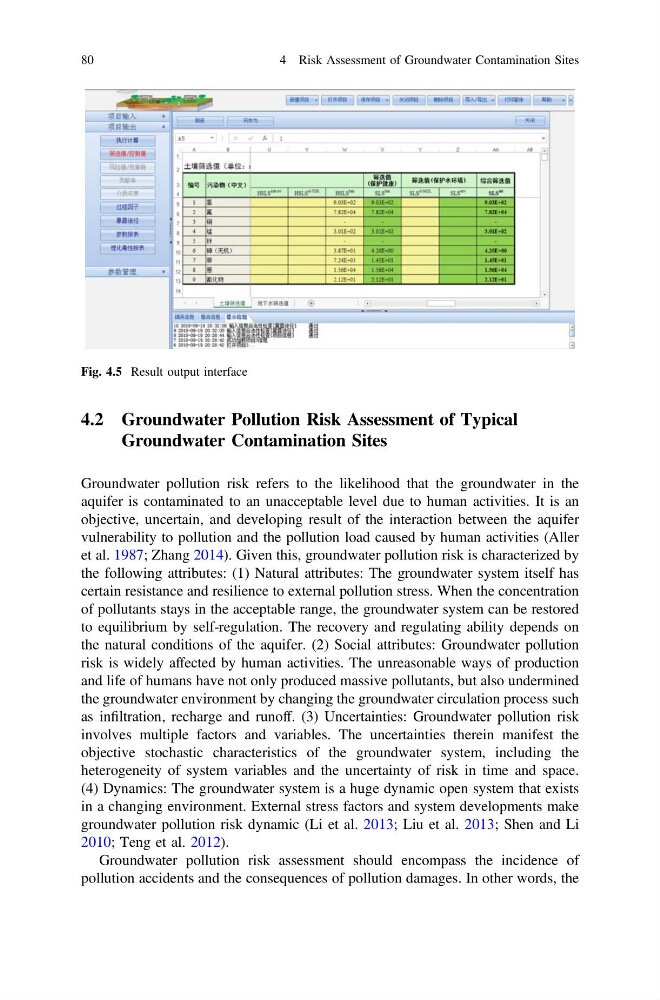
Fig. 4.5 Result output interface
80
4 Risk Assessment of Groundwater Contamination Sites
Groundwater Contamination Sites
Groundwater pollution risk refers to the likelihood that the groundwater in the
aquifer is contaminated to an unacceptable level due to human activities. It is an
objective, uncertain, and developing result of the interaction between the aquifer
vulnerability to pollution and the pollution load caused by human activities (Aller
et al. 1987; Zhang 2014). Given this, groundwater pollution risk is characterized by
the following attributes: (1) Natural attributes: The groundwater system itself has
certain resistance and resilience to external pollution stress. When the concentration
of pollutants stays in the acceptable range, the groundwater system can be restored
to equilibrium by self-regulation. The recovery and regulating ability depends on
the natural conditions of the aquifer. (2) Social attributes: Groundwater pollution
risk is widely affected by human activities. The unreasonable ways of production
and life of humans have not only produced massive pollutants, but also undermined
the groundwater environment by changing the groundwater circulation process such
as infiltration, recharge and runoff. (3) Uncertainties: Groundwater pollution risk
involves multiple factors and variables. The uncertainties therein manifest the
objective stochastic characteristics of the groundwater system, including the
heterogeneity of system variables and the uncertainty of risk in time and space.
(4) Dynamics: The groundwater system is a huge dynamic open system that exists
in a changing environment. External stress factors and system developments make
groundwater pollution risk dynamic (Li et al. 2013; Liu et al. 2013; Shen and Li
2010; Teng et al. 2012).
Groundwater pollution risk assessment should encompass the incidence of
pollution accidents and the consequences of pollution damages. In other words, the
Fig. 4.5 Result output interface
80
4 Risk Assessment of Groundwater Contamination Sites