

economic and technological factors. A group of countries, regions and agencies in
the world have specified the maximum acceptable risk in health risk assessment, but
provided different acceptable exposure limits. As China has not yet developed such
limits, foreign standards are common applied, including the acceptable health risk
of 1*10
−6 /yr recommended by the Swedish Environmental Protection Agency, the
Netherlands Ministry of Infrastructure and Water Management and the Royal
Society, the human health risk of 1*10
−4 /yr recommended by the US EPA, and the
maximum acceptable risk of 5*10
−5 /yr recommended by the International
Commission on Radiological Protection (ICRP).
In environmental risk assessment, the results are often uncertain due to incomplete understanding of the current and future state of studied systems, hazard
severity and characterization. In exposure assessment, uncertainties arise from
measurement, sampling and systematic errors in the investigation process of
exposure parameters. They can be divided into parameter uncertainty, model
uncertainty and scenario uncertainty.
(1) Parameter uncertainty may be related to all parameters in the assessment,
involving sampling, analysis and systematic errors. For example, soil pollutant
concentrations or wind speed in the sites may produce uncertainties.
(2) Model uncertainty is related to the extent to which the models used can simulate the real world. In essence, models help us understand and predict the real
system by simplifying the real situation.
(3) Scenario uncertainty is related to the constraints of the conceptual model in the
exposure assessment. For example, simple assumptions are made to assess
relatively complex real-life scenarios, while numerous social and economic
conditions are considered.
The variability in the structure of actual exposed populations can also lead to
uncertainties in risk assessment. Unlike the uncertainties described above, such
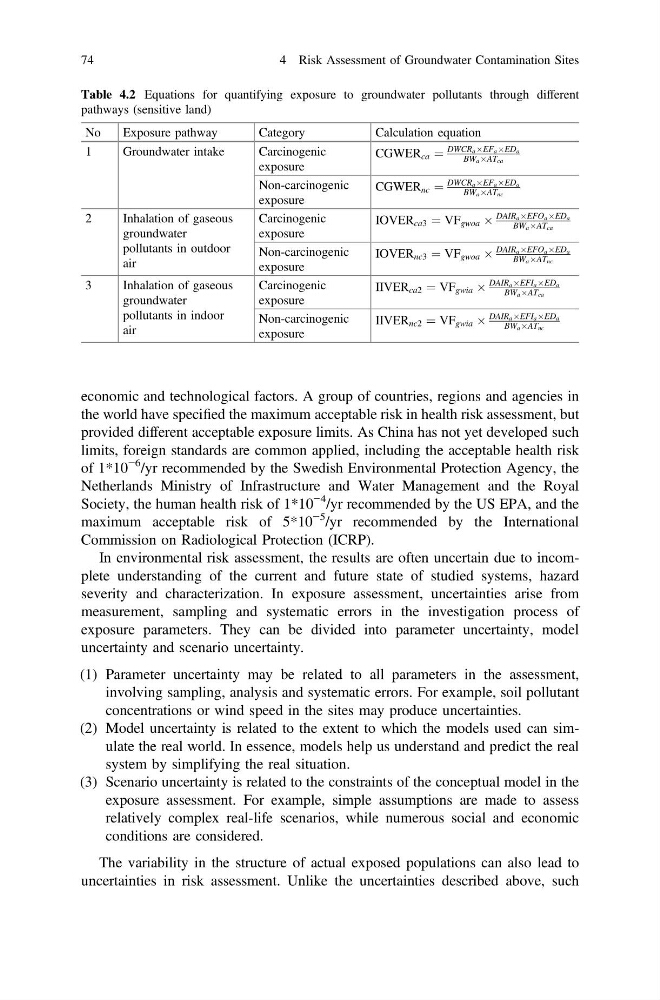
Table 4.2 Equations for quantifying exposure to groundwater pollutants through different
pathways (sensitive land)
No
Exposure pathway
Category
Calculation equation
1
Groundwater intake
Carcinogenic
exposure
CGWER ca ¼
DWCRaÂEFaÂEDa
BWaÂATca
Non-carcinogenic
exposure
CGWER nc ¼
DWCRaÂEFaÂEDa
BWaÂATnc
2
Inhalation of gaseous
groundwater
pollutants in outdoor
air
Carcinogenic
exposure
IOVER ca3 ¼ VF gwoa Â
DAIRaÂEFOaÂEDa
BWaÂATca
Non-carcinogenic
exposure
IOVER nc3 ¼ VF gwoa Â
DAIRaÂEFOaÂEDa
BWaÂATnc
3
Inhalation of gaseous
groundwater
pollutants in indoor
air
Carcinogenic
exposure
IIVER ca2 ¼ VF gwia Â
DAIRaÂEFIaÂEDa
BWaÂATca
Non-carcinogenic
exposure
IIVER nc2 ¼ VF gwia Â
DAIRaÂEFIaÂEDa
BWaÂATnc
74
4 Risk Assessment of Groundwater Contamination Sites
the world have specified the maximum acceptable risk in health risk assessment, but
provided different acceptable exposure limits. As China has not yet developed such
limits, foreign standards are common applied, including the acceptable health risk
of 1*10
−6 /yr recommended by the Swedish Environmental Protection Agency, the
Netherlands Ministry of Infrastructure and Water Management and the Royal
Society, the human health risk of 1*10
−4 /yr recommended by the US EPA, and the
maximum acceptable risk of 5*10
−5 /yr recommended by the International
Commission on Radiological Protection (ICRP).
In environmental risk assessment, the results are often uncertain due to incomplete understanding of the current and future state of studied systems, hazard
severity and characterization. In exposure assessment, uncertainties arise from
measurement, sampling and systematic errors in the investigation process of
exposure parameters. They can be divided into parameter uncertainty, model
uncertainty and scenario uncertainty.
(1) Parameter uncertainty may be related to all parameters in the assessment,
involving sampling, analysis and systematic errors. For example, soil pollutant
concentrations or wind speed in the sites may produce uncertainties.
(2) Model uncertainty is related to the extent to which the models used can simulate the real world. In essence, models help us understand and predict the real
system by simplifying the real situation.
(3) Scenario uncertainty is related to the constraints of the conceptual model in the
exposure assessment. For example, simple assumptions are made to assess
relatively complex real-life scenarios, while numerous social and economic
conditions are considered.
The variability in the structure of actual exposed populations can also lead to
uncertainties in risk assessment. Unlike the uncertainties described above, such
Table 4.2 Equations for quantifying exposure to groundwater pollutants through different
pathways (sensitive land)
No
Exposure pathway
Category
Calculation equation
1
Groundwater intake
Carcinogenic
exposure
CGWER ca ¼
DWCRaÂEFaÂEDa
BWaÂATca
Non-carcinogenic
exposure
CGWER nc ¼
DWCRaÂEFaÂEDa
BWaÂATnc
2
Inhalation of gaseous
groundwater
pollutants in outdoor
air
Carcinogenic
exposure
IOVER ca3 ¼ VF gwoa Â
DAIRaÂEFOaÂEDa
BWaÂATca
Non-carcinogenic
exposure
IOVER nc3 ¼ VF gwoa Â
DAIRaÂEFOaÂEDa
BWaÂATnc
3
Inhalation of gaseous
groundwater
pollutants in indoor
air
Carcinogenic
exposure
IIVER ca2 ¼ VF gwia Â
DAIRaÂEFIaÂEDa
BWaÂATca
Non-carcinogenic
exposure
IIVER nc2 ¼ VF gwia Â
DAIRaÂEFIaÂEDa
BWaÂATnc
74
4 Risk Assessment of Groundwater Contamination Sites