

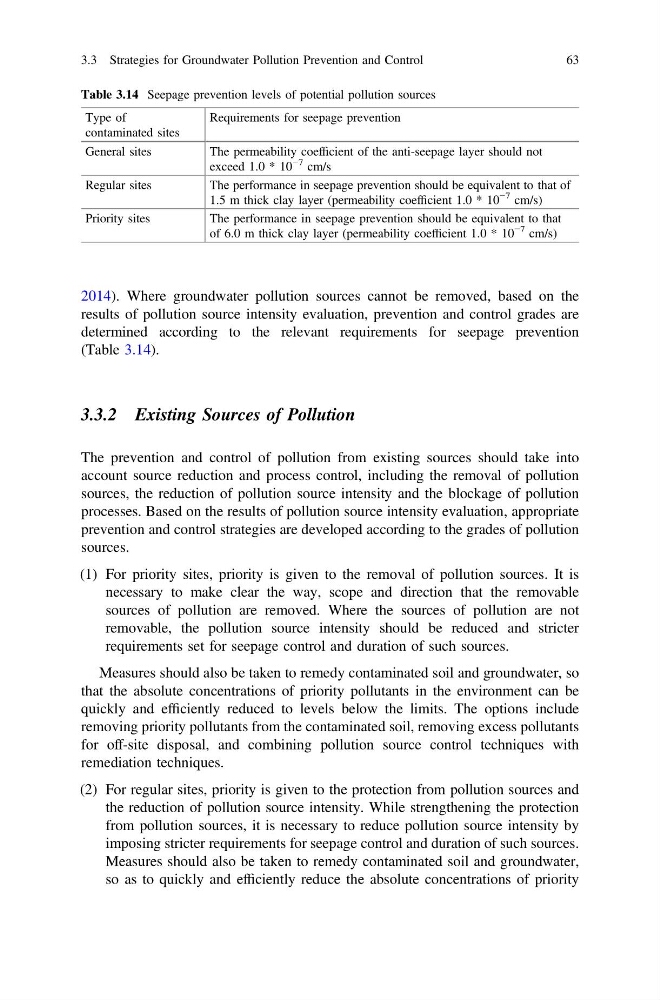
2014). Where groundwater pollution sources cannot be removed, based on the
results of pollution source intensity evaluation, prevention and control grades are
determined according to the relevant requirements for seepage prevention
(Table 3.14).
3.3.2 Existing Sources of Pollution
The prevention and control of pollution from existing sources should take into
account source reduction and process control, including the removal of pollution
sources, the reduction of pollution source intensity and the blockage of pollution
processes. Based on the results of pollution source intensity evaluation, appropriate
prevention and control strategies are developed according to the grades of pollution
sources.
(1) For priority sites, priority is given to the removal of pollution sources. It is
necessary to make clear the way, scope and direction that the removable
sources of pollution are removed. Where the sources of pollution are not
removable, the pollution source intensity should be reduced and stricter
requirements set for seepage control and duration of such sources.
Measures should also be taken to remedy contaminated soil and groundwater, so
that the absolute concentrations of priority pollutants in the environment can be
quickly and efficiently reduced to levels below the limits. The options include
removing priority pollutants from the contaminated soil, removing excess pollutants
for off-site disposal, and combining pollution source control techniques with
remediation techniques.
(2) For regular sites, priority is given to the protection from pollution sources and
the reduction of pollution source intensity. While strengthening the protection
from pollution sources, it is necessary to reduce pollution source intensity by
imposing stricter requirements for seepage control and duration of such sources.
Measures should also be taken to remedy contaminated soil and groundwater,
so as to quickly and efficiently reduce the absolute concentrations of priority
Table 3.14 Seepage prevention levels of potential pollution sources
Type of
contaminated sites
Requirements for seepage prevention
General sites
The permeability coefficient of the anti-seepage layer should not
exceed 1.0 * 10
−7 cm/s
Regular sites
The performance in seepage prevention should be equivalent to that of
1.5 m thick clay layer (permeability coefficient 1.0 * 10
−7 cm/s)
Priority sites
The performance in seepage prevention should be equivalent to that
of 6.0 m thick clay layer (permeability coefficient 1.0 * 10
−7 cm/s)
3.3 Strategies for Groundwater Pollution Prevention and Control
63
results of pollution source intensity evaluation, prevention and control grades are
determined according to the relevant requirements for seepage prevention
(Table 3.14).
3.3.2 Existing Sources of Pollution
The prevention and control of pollution from existing sources should take into
account source reduction and process control, including the removal of pollution
sources, the reduction of pollution source intensity and the blockage of pollution
processes. Based on the results of pollution source intensity evaluation, appropriate
prevention and control strategies are developed according to the grades of pollution
sources.
(1) For priority sites, priority is given to the removal of pollution sources. It is
necessary to make clear the way, scope and direction that the removable
sources of pollution are removed. Where the sources of pollution are not
removable, the pollution source intensity should be reduced and stricter
requirements set for seepage control and duration of such sources.
Measures should also be taken to remedy contaminated soil and groundwater, so
that the absolute concentrations of priority pollutants in the environment can be
quickly and efficiently reduced to levels below the limits. The options include
removing priority pollutants from the contaminated soil, removing excess pollutants
for off-site disposal, and combining pollution source control techniques with
remediation techniques.
(2) For regular sites, priority is given to the protection from pollution sources and
the reduction of pollution source intensity. While strengthening the protection
from pollution sources, it is necessary to reduce pollution source intensity by
imposing stricter requirements for seepage control and duration of such sources.
Measures should also be taken to remedy contaminated soil and groundwater,
so as to quickly and efficiently reduce the absolute concentrations of priority
Table 3.14 Seepage prevention levels of potential pollution sources
Type of
contaminated sites
Requirements for seepage prevention
General sites
The permeability coefficient of the anti-seepage layer should not
exceed 1.0 * 10
−7 cm/s
Regular sites
The performance in seepage prevention should be equivalent to that of
1.5 m thick clay layer (permeability coefficient 1.0 * 10
−7 cm/s)
Priority sites
The performance in seepage prevention should be equivalent to that
of 6.0 m thick clay layer (permeability coefficient 1.0 * 10
−7 cm/s)
3.3 Strategies for Groundwater Pollution Prevention and Control
63