

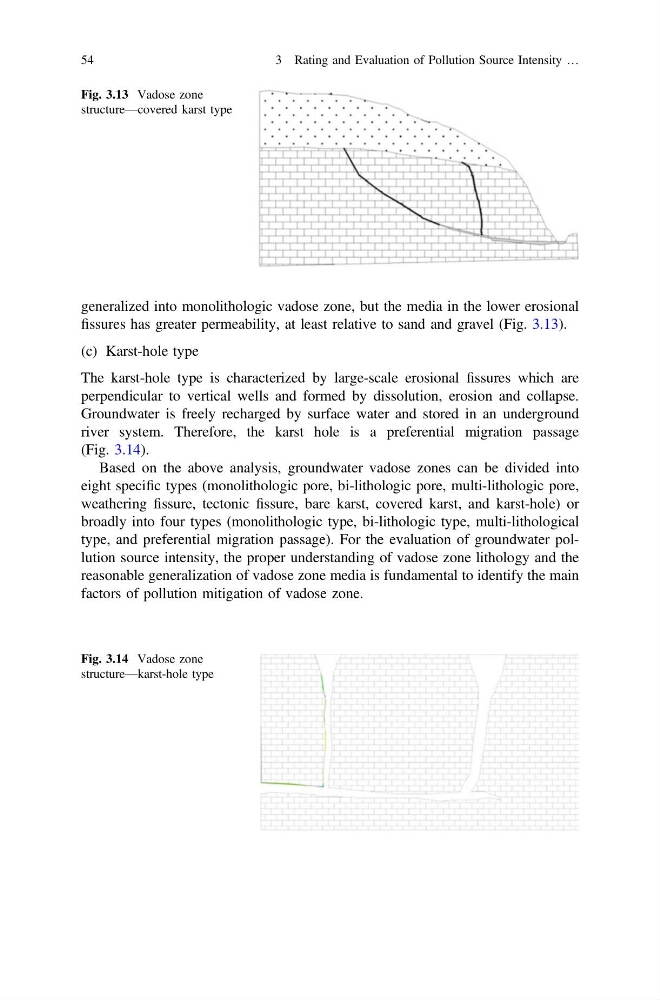
generalized into monolithologic vadose zone, but the media in the lower erosional
fissures has greater permeability, at least relative to sand and gravel (Fig. 3.13).
(c) Karst-hole type
The karst-hole type is characterized by large-scale erosional fissures which are
perpendicular to vertical wells and formed by dissolution, erosion and collapse.
Groundwater is freely recharged by surface water and stored in an underground
river system. Therefore, the karst hole is a preferential migration passage
(Fig. 3.14).
Based on the above analysis, groundwater vadose zones can be divided into
eight specific types (monolithologic pore, bi-lithologic pore, multi-lithologic pore,
weathering fissure, tectonic fissure, bare karst, covered karst, and karst-hole) or
broadly into four types (monolithologic type, bi-lithologic type, multi-lithological
type, and preferential migration passage). For the evaluation of groundwater pollution source intensity, the proper understanding of vadose zone lithology and the
reasonable generalization of vadose zone media is fundamental to identify the main
factors of pollution mitigation of vadose zone.
Fig. 3.13 Vadose zone
structure—covered karst type
Fig. 3.14 Vadose zone
structure—karst-hole type
54
3 Rating and Evaluation of Pollution Source Intensity …
fissures has greater permeability, at least relative to sand and gravel (Fig. 3.13).
(c) Karst-hole type
The karst-hole type is characterized by large-scale erosional fissures which are
perpendicular to vertical wells and formed by dissolution, erosion and collapse.
Groundwater is freely recharged by surface water and stored in an underground
river system. Therefore, the karst hole is a preferential migration passage
(Fig. 3.14).
Based on the above analysis, groundwater vadose zones can be divided into
eight specific types (monolithologic pore, bi-lithologic pore, multi-lithologic pore,
weathering fissure, tectonic fissure, bare karst, covered karst, and karst-hole) or
broadly into four types (monolithologic type, bi-lithologic type, multi-lithological
type, and preferential migration passage). For the evaluation of groundwater pollution source intensity, the proper understanding of vadose zone lithology and the
reasonable generalization of vadose zone media is fundamental to identify the main
factors of pollution mitigation of vadose zone.
Fig. 3.13 Vadose zone
structure—covered karst type
Fig. 3.14 Vadose zone
structure—karst-hole type
54
3 Rating and Evaluation of Pollution Source Intensity …