

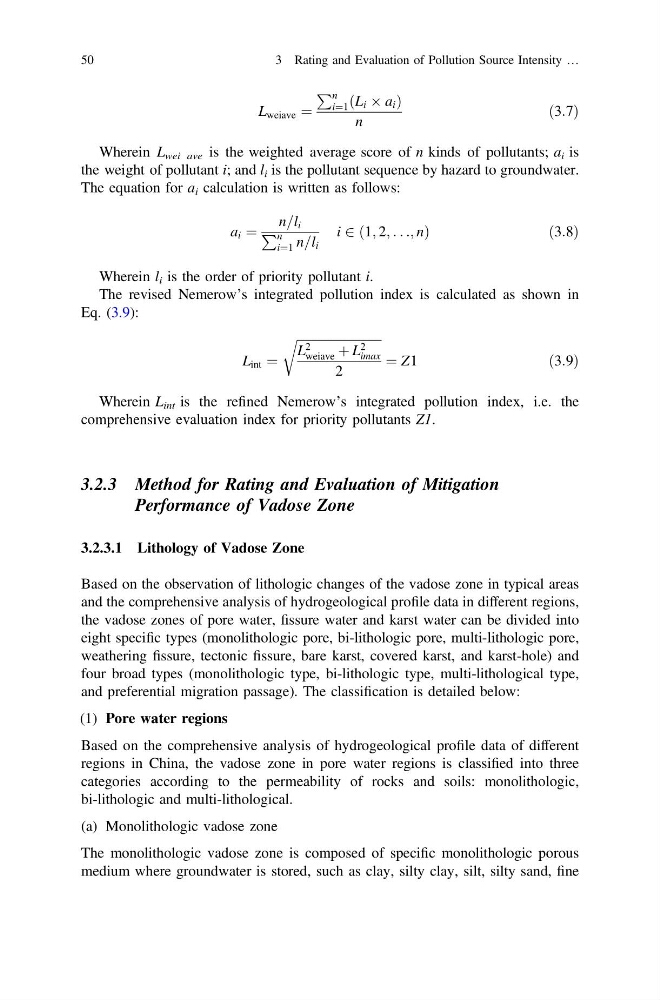
L weiave ¼
P n
i¼1 L i  a i
ð
Þ
n
ð3:7Þ
Wherein L wei ave is the weighted average score of n kinds of pollutants; a i is
the weight of pollutant i; and l i is the pollutant sequence by hazard to groundwater.
The equation for a i calculation is written as follows:
a i ¼
n=l i
P n
i¼1 n=l i
i 2 1; 2; . . .; n
ð
Þ
ð 3:8Þ
Wherein l i is the order of priority pollutant i.
The revised Nemerow’s integrated pollution index is calculated as shown in
Eq. (3.9):
L int ¼
ffiffiffiffiffiffiffiffiffiffiffiffiffiffiffiffiffiffiffiffiffiffiffiffiffiffiffi
L 2
weiave þ L 2
imax
2
r
¼ Z1
ð3:9Þ
Wherein L int is the refined Nemerow’s integrated pollution index, i.e. the
comprehensive evaluation index for priority pollutants Z1.
3.2.3 Method for Rating and Evaluation of Mitigation
Performance of Vadose Zone
3.2.3.1 Lithology of Vadose Zone
Based on the observation of lithologic changes of the vadose zone in typical areas
and the comprehensive analysis of hydrogeological profile data in different regions,
the vadose zones of pore water, fissure water and karst water can be divided into
eight specific types (monolithologic pore, bi-lithologic pore, multi-lithologic pore,
weathering fissure, tectonic fissure, bare karst, covered karst, and karst-hole) and
four broad types (monolithologic type, bi-lithologic type, multi-lithological type,
and preferential migration passage). The classification is detailed below:
(1) Pore water regions
Based on the comprehensive analysis of hydrogeological profile data of different
regions in China, the vadose zone in pore water regions is classified into three
categories according to the permeability of rocks and soils: monolithologic,
bi-lithologic and multi-lithological.
(a) Monolithologic vadose zone
The monolithologic vadose zone is composed of specific monolithologic porous
medium where groundwater is stored, such as clay, silty clay, silt, silty sand, fine
50
3 Rating and Evaluation of Pollution Source Intensity …
P n
i¼1 L i  a i
ð
Þ
n
ð3:7Þ
Wherein L wei ave is the weighted average score of n kinds of pollutants; a i is
the weight of pollutant i; and l i is the pollutant sequence by hazard to groundwater.
The equation for a i calculation is written as follows:
a i ¼
n=l i
P n
i¼1 n=l i
i 2 1; 2; . . .; n
ð
Þ
ð 3:8Þ
Wherein l i is the order of priority pollutant i.
The revised Nemerow’s integrated pollution index is calculated as shown in
Eq. (3.9):
L int ¼
ffiffiffiffiffiffiffiffiffiffiffiffiffiffiffiffiffiffiffiffiffiffiffiffiffiffiffi
L 2
weiave þ L 2
imax
2
r
¼ Z1
ð3:9Þ
Wherein L int is the refined Nemerow’s integrated pollution index, i.e. the
comprehensive evaluation index for priority pollutants Z1.
3.2.3 Method for Rating and Evaluation of Mitigation
Performance of Vadose Zone
3.2.3.1 Lithology of Vadose Zone
Based on the observation of lithologic changes of the vadose zone in typical areas
and the comprehensive analysis of hydrogeological profile data in different regions,
the vadose zones of pore water, fissure water and karst water can be divided into
eight specific types (monolithologic pore, bi-lithologic pore, multi-lithologic pore,
weathering fissure, tectonic fissure, bare karst, covered karst, and karst-hole) and
four broad types (monolithologic type, bi-lithologic type, multi-lithological type,
and preferential migration passage). The classification is detailed below:
(1) Pore water regions
Based on the comprehensive analysis of hydrogeological profile data of different
regions in China, the vadose zone in pore water regions is classified into three
categories according to the permeability of rocks and soils: monolithologic,
bi-lithologic and multi-lithological.
(a) Monolithologic vadose zone
The monolithologic vadose zone is composed of specific monolithologic porous
medium where groundwater is stored, such as clay, silty clay, silt, silty sand, fine
50
3 Rating and Evaluation of Pollution Source Intensity …