

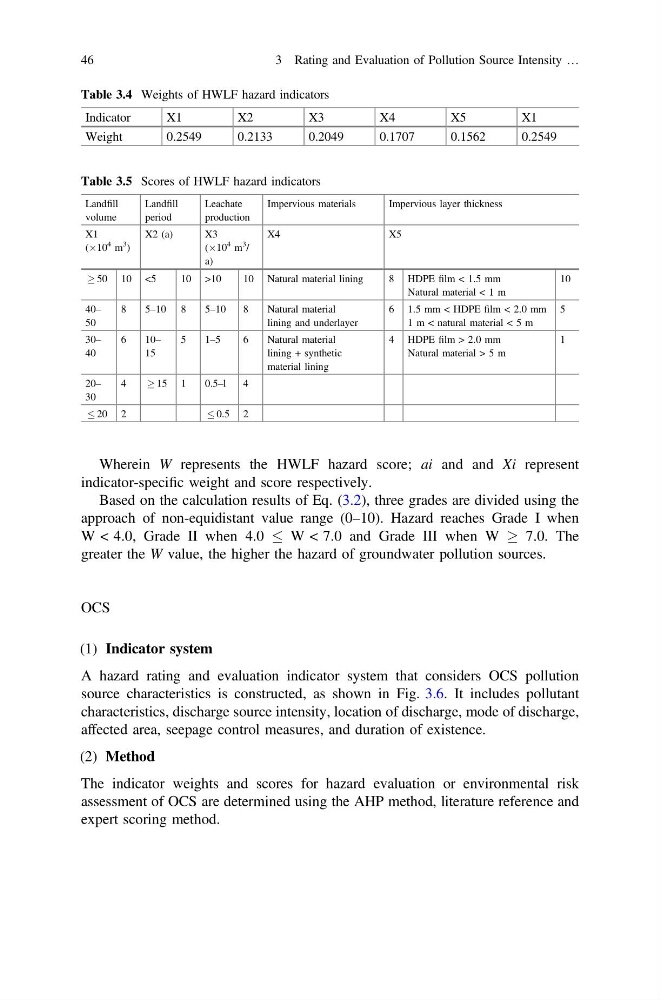
Wherein W represents the HWLF hazard score; ai and and Xi represent
indicator-specific weight and score respectively.
Based on the calculation results of Eq. (3.2), three grades are divided using the
approach of non-equidistant value range (0–10). Hazard reaches Grade I when
W < 4.0, Grade II when 4.0
W < 7.0 and Grade III when W ! 7.0. The
greater the W value, the higher the hazard of groundwater pollution sources.
OCS
(1) Indicator system
A hazard rating and evaluation indicator system that considers OCS pollution
source characteristics is constructed, as shown in Fig. 3.6. It includes pollutant
characteristics, discharge source intensity, location of discharge, mode of discharge,
affected area, seepage control measures, and duration of existence.
(2) Method
The indicator weights and scores for hazard evaluation or environmental risk
assessment of OCS are determined using the AHP method, literature reference and
expert scoring method.
Table 3.4 Weights of HWLF hazard indicators
Indicator
X1
X2
X3
X4
X5
X1
Weight
0.2549
0.2133
0.2049
0.1707
0.1562
0.2549
Table 3.5 Scores of HWLF hazard indicators
Landfill
volume
Landfill
period
Leachate
production
Impervious materials
Impervious layer thickness
X1
(Â10
4 m
3
)
X2 (a)
X3
(Â10
4 m
3
/
a)
X4
X5
! 50 10 <5
10 >10
10 Natural material lining
8 HDPE film < 1.5 mm
Natural material < 1 m
10
40–
50
8
5–10 8
5–10
8
Natural material
lining and underlayer
6 1.5 mm < HDPE film < 2.0 mm
1 m < natural material < 5 m
5
30–
40
6
10–
15
5
1–5
6
Natural material
lining + synthetic
material lining
4 HDPE film > 2.0 mm
Natural material > 5 m
1
20–
30
4
! 15 1
0.5–l
4
20 2
0.5 2
46
3 Rating and Evaluation of Pollution Source Intensity …
indicator-specific weight and score respectively.
Based on the calculation results of Eq. (3.2), three grades are divided using the
approach of non-equidistant value range (0–10). Hazard reaches Grade I when
W < 4.0, Grade II when 4.0
W < 7.0 and Grade III when W ! 7.0. The
greater the W value, the higher the hazard of groundwater pollution sources.
OCS
(1) Indicator system
A hazard rating and evaluation indicator system that considers OCS pollution
source characteristics is constructed, as shown in Fig. 3.6. It includes pollutant
characteristics, discharge source intensity, location of discharge, mode of discharge,
affected area, seepage control measures, and duration of existence.
(2) Method
The indicator weights and scores for hazard evaluation or environmental risk
assessment of OCS are determined using the AHP method, literature reference and
expert scoring method.
Table 3.4 Weights of HWLF hazard indicators
Indicator
X1
X2
X3
X4
X5
X1
Weight
0.2549
0.2133
0.2049
0.1707
0.1562
0.2549
Table 3.5 Scores of HWLF hazard indicators
Landfill
volume
Landfill
period
Leachate
production
Impervious materials
Impervious layer thickness
X1
(Â10
4 m
3
)
X2 (a)
X3
(Â10
4 m
3
/
a)
X4
X5
! 50 10 <5
10 >10
10 Natural material lining
8 HDPE film < 1.5 mm
Natural material < 1 m
10
40–
50
8
5–10 8
5–10
8
Natural material
lining and underlayer
6 1.5 mm < HDPE film < 2.0 mm
1 m < natural material < 5 m
5
30–
40
6
10–
15
5
1–5
6
Natural material
lining + synthetic
material lining
4 HDPE film > 2.0 mm
Natural material > 5 m
1
20–
30
4
! 15 1
0.5–l
4
20 2
0.5 2
46
3 Rating and Evaluation of Pollution Source Intensity …