

• Karst water and fissure water in mountainous and hilly areas
The method for such deployment in a standard MSWLF site can be referred to.
(c) HWLFs
• General landfill sites
– Pore water in plains and gentle plateaus
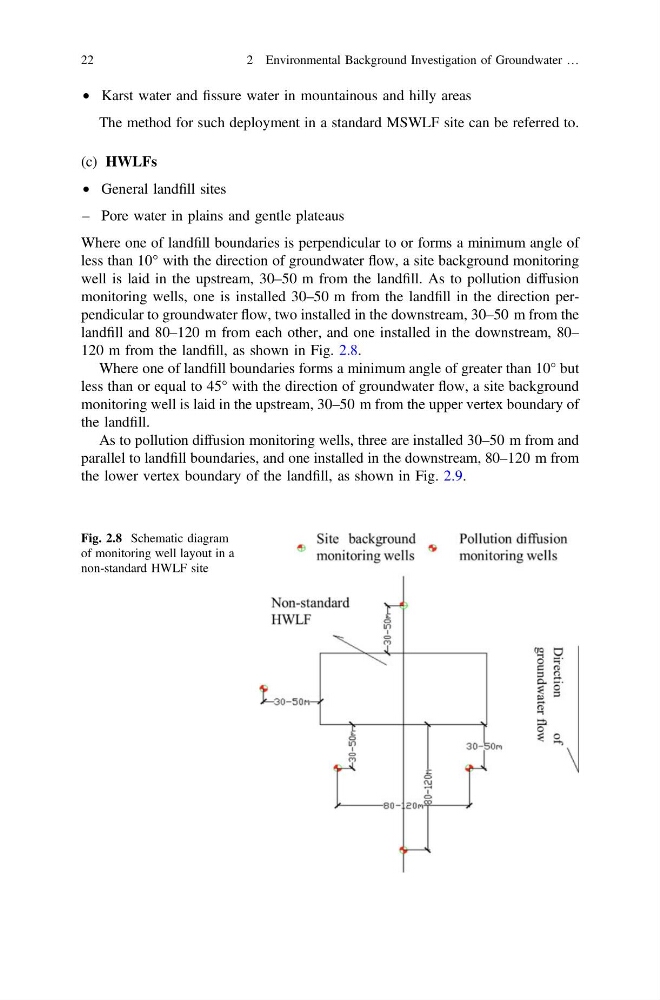
Where one of landfill boundaries is perpendicular to or forms a minimum angle of
less than 10° with the direction of groundwater flow, a site background monitoring
well is laid in the upstream, 30–50 m from the landfill. As to pollution diffusion
monitoring wells, one is installed 30–50 m from the landfill in the direction perpendicular to groundwater flow, two installed in the downstream, 30–50 m from the
landfill and 80–120 m from each other, and one installed in the downstream, 80–
120 m from the landfill, as shown in Fig. 2.8.
Where one of landfill boundaries forms a minimum angle of greater than 10° but
less than or equal to 45° with the direction of groundwater flow, a site background
monitoring well is laid in the upstream, 30–50 m from the upper vertex boundary of
the landfill.
As to pollution diffusion monitoring wells, three are installed 30–50 m from and
parallel to landfill boundaries, and one installed in the downstream, 80–120 m from
the lower vertex boundary of the landfill, as shown in Fig. 2.9.
Fig. 2.8 Schematic diagram
of monitoring well layout in a
non-standard HWLF site
22
2 Environmental Background Investigation of Groundwater …
The method for such deployment in a standard MSWLF site can be referred to.
(c) HWLFs
• General landfill sites
– Pore water in plains and gentle plateaus
Where one of landfill boundaries is perpendicular to or forms a minimum angle of
less than 10° with the direction of groundwater flow, a site background monitoring
well is laid in the upstream, 30–50 m from the landfill. As to pollution diffusion
monitoring wells, one is installed 30–50 m from the landfill in the direction perpendicular to groundwater flow, two installed in the downstream, 30–50 m from the
landfill and 80–120 m from each other, and one installed in the downstream, 80–
120 m from the landfill, as shown in Fig. 2.8.
Where one of landfill boundaries forms a minimum angle of greater than 10° but
less than or equal to 45° with the direction of groundwater flow, a site background
monitoring well is laid in the upstream, 30–50 m from the upper vertex boundary of
the landfill.
As to pollution diffusion monitoring wells, three are installed 30–50 m from and
parallel to landfill boundaries, and one installed in the downstream, 80–120 m from
the lower vertex boundary of the landfill, as shown in Fig. 2.9.
Fig. 2.8 Schematic diagram
of monitoring well layout in a
non-standard HWLF site
22
2 Environmental Background Investigation of Groundwater …