

5. Assessment of groundwater environmental health risks in the informal
landfill
As can be seen in Table 5.94, some of the indicators of groundwater quality in the
1st aquifer at the landfill site exceeded the Class III limits set in national standard
“Quality standard for ground water”. Meanwhile, the excavation horizon at the
water source location in Daxing District is generally Quaternary confined water and
bedrock water with a buried depth greater than 50 m. The 1st aquifer exposed by
the landfill was not used for drinking. Therefore, it is necessary to separately launch
health risk assessment of groundwater pollutants at the landfill.
(1) Health risk assessment
① Pollutant screening
Screening has been carried out according to industrial standard “Technical guidelines for risk assessment of contaminated site” (HJ25.3-2014) and the “Guidelines
for health risk assessment of groundwater pollution (trial)” and the pollutants
selected for the risk evaluation in the next step are: nitrate, nitrite,
ammonia-nitrogen, fluoride, chloride, cyanide, volatile phenols, mercury, arsenic,
manganese, cadmium, zinc, hexavalent chromium and lead.
② Toxicity assessment
I. Carcinogenic toxicity
Carcinogenic toxicity of the pollutants of concern is determined according to the
research achievements of the International Agency for Research on Cancer (IARC)
and the US Environmental Protection Agency (EPA) Integrated Risk Information
System (IRIS). Preference is given to the carcinogenic classification of IARC while
reference is given to that of the US Environmental Protection Agency. The results
of carcinogenicity determination are shown in Table 5.99. Among them, 10 pollutants of concern (nitrite, nitrate, ammonia-nitrogen, fluoride, chloride, cyanide,
volatile phenols, mercury, manganese, cadmium, zinc and lead) are
non-carcinogenic, and 2 pollutants of concern (arsenic and hexavalent chromium)
are carcinogenic.
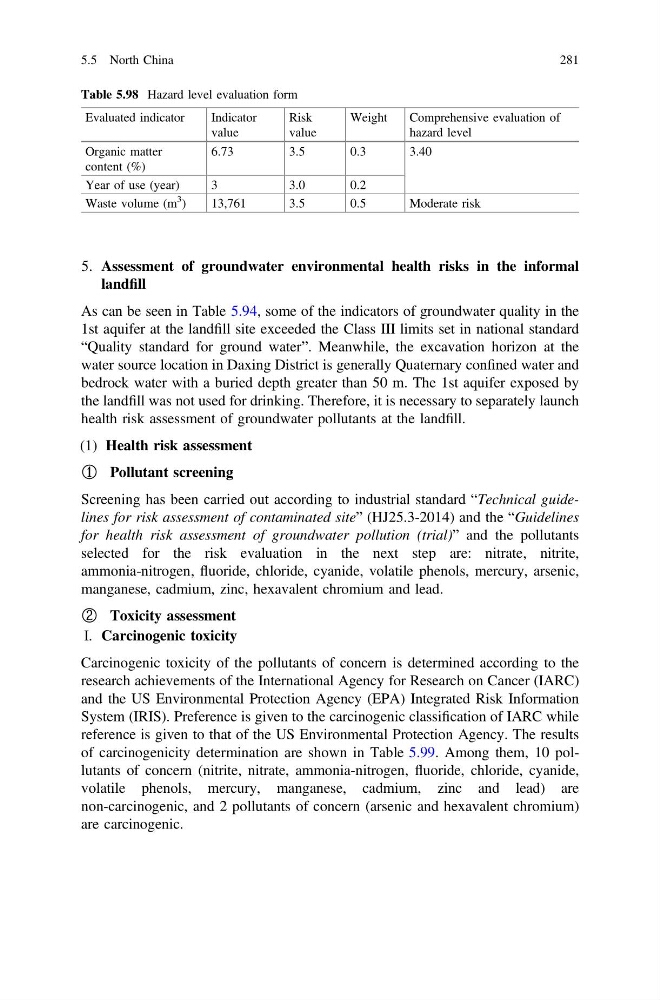
Table 5.98 Hazard level evaluation form
Evaluated indicator
Indicator
value
Risk
value
Weight
Comprehensive evaluation of
hazard level
Organic matter
content (%)
6.73
3.5
0.3
3.40
Year of use (year)
3
3.0
0.2
Waste volume (m
3
)
13,761
3.5
0.5
Moderate risk
5.5 North China
281
landfill
As can be seen in Table 5.94, some of the indicators of groundwater quality in the
1st aquifer at the landfill site exceeded the Class III limits set in national standard
“Quality standard for ground water”. Meanwhile, the excavation horizon at the
water source location in Daxing District is generally Quaternary confined water and
bedrock water with a buried depth greater than 50 m. The 1st aquifer exposed by
the landfill was not used for drinking. Therefore, it is necessary to separately launch
health risk assessment of groundwater pollutants at the landfill.
(1) Health risk assessment
① Pollutant screening
Screening has been carried out according to industrial standard “Technical guidelines for risk assessment of contaminated site” (HJ25.3-2014) and the “Guidelines
for health risk assessment of groundwater pollution (trial)” and the pollutants
selected for the risk evaluation in the next step are: nitrate, nitrite,
ammonia-nitrogen, fluoride, chloride, cyanide, volatile phenols, mercury, arsenic,
manganese, cadmium, zinc, hexavalent chromium and lead.
② Toxicity assessment
I. Carcinogenic toxicity
Carcinogenic toxicity of the pollutants of concern is determined according to the
research achievements of the International Agency for Research on Cancer (IARC)
and the US Environmental Protection Agency (EPA) Integrated Risk Information
System (IRIS). Preference is given to the carcinogenic classification of IARC while
reference is given to that of the US Environmental Protection Agency. The results
of carcinogenicity determination are shown in Table 5.99. Among them, 10 pollutants of concern (nitrite, nitrate, ammonia-nitrogen, fluoride, chloride, cyanide,
volatile phenols, mercury, manganese, cadmium, zinc and lead) are
non-carcinogenic, and 2 pollutants of concern (arsenic and hexavalent chromium)
are carcinogenic.
Table 5.98 Hazard level evaluation form
Evaluated indicator
Indicator
value
Risk
value
Weight
Comprehensive evaluation of
hazard level
Organic matter
content (%)
6.73
3.5
0.3
3.40
Year of use (year)
3
3.0
0.2
Waste volume (m
3
)
13,761
3.5
0.5
Moderate risk
5.5 North China
281