

No dispersion test was done this time. According to the field geological and
hydrogeological conditions, even if it is done, it can only represent local areas or
plots. Therefore, according to the lithologic characteristics of the investigation area
and relevant stratigraphic research experience, the empirical formula
aL = 0.83 Â (1gL)2.414 is adopted for the dispersion coefficient, where L is the
scale of pollutant transport or the approximate maximum inner diameter of the
study area (L = 57.55 m). We get the longitudinal dispersion aL = 3.249 m in the
upper part of the strongly and moderately weathered bedrock in the predicted area.
According to DL = aL Â u, we get DL = 3.249 Â 1.05 = 3.411 m
2 /d.
According to the principle of maximum damage, the initial concentrations of
NH 3 –H and COD cr are 800 mg/L and 10,000 mg/L respectively when the leachate
in the landfill leaks completely and the seepage control measures are destroyed.
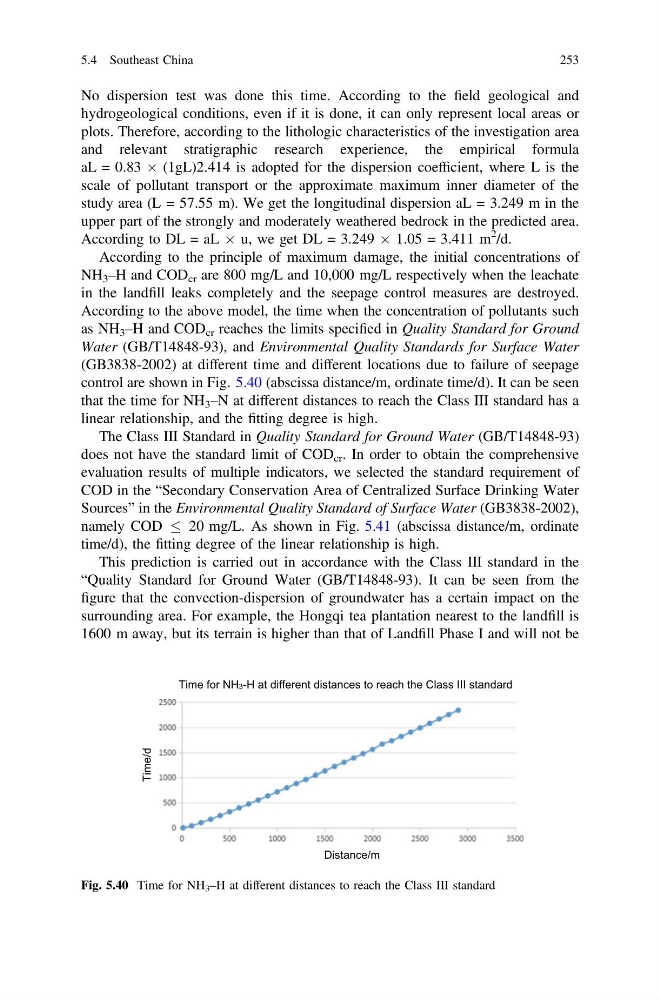
According to the above model, the time when the concentration of pollutants such
as NH 3 –H and COD cr reaches the limits specified in Quality Standard for Ground
Water (GB/T14848-93), and Environmental Quality Standards for Surface Water
(GB3838-2002) at different time and different locations due to failure of seepage
control are shown in Fig. 5.40 (abscissa distance/m, ordinate time/d). It can be seen
that the time for NH 3 –N at different distances to reach the Class III standard has a
linear relationship, and the fitting degree is high.
The Class III Standard in Quality Standard for Ground Water (GB/T14848-93)
does not have the standard limit of COD cr . In order to obtain the comprehensive
evaluation results of multiple indicators, we selected the standard requirement of
COD in the “Secondary Conservation Area of Centralized Surface Drinking Water
Sources” in the Environmental Quality Standard of Surface Water (GB3838-2002),
namely COD
20 mg/L. As shown in Fig. 5.41 (abscissa distance/m, ordinate
time/d), the fitting degree of the linear relationship is high.
This prediction is carried out in accordance with the Class III standard in the
“Quality Standard for Ground Water (GB/T14848-93). It can be seen from the
figure that the convection-dispersion of groundwater has a certain impact on the
surrounding area. For example, the Hongqi tea plantation nearest to the landfill is
1600 m away, but its terrain is higher than that of Landfill Phase I and will not be
7LPHIRU1++DWGLIIHUHQWGLVWDQFHVWRUHDFKWKH&ODVV,,,VWDQGDUG
7LPHG
'LVWDQFHP
Fig. 5.40 Time for NH 3 –H at different distances to reach the Class III standard
5.4 Southeast China
253
hydrogeological conditions, even if it is done, it can only represent local areas or
plots. Therefore, according to the lithologic characteristics of the investigation area
and relevant stratigraphic research experience, the empirical formula
aL = 0.83 Â (1gL)2.414 is adopted for the dispersion coefficient, where L is the
scale of pollutant transport or the approximate maximum inner diameter of the
study area (L = 57.55 m). We get the longitudinal dispersion aL = 3.249 m in the
upper part of the strongly and moderately weathered bedrock in the predicted area.
According to DL = aL Â u, we get DL = 3.249 Â 1.05 = 3.411 m
2 /d.
According to the principle of maximum damage, the initial concentrations of
NH 3 –H and COD cr are 800 mg/L and 10,000 mg/L respectively when the leachate
in the landfill leaks completely and the seepage control measures are destroyed.
According to the above model, the time when the concentration of pollutants such
as NH 3 –H and COD cr reaches the limits specified in Quality Standard for Ground
Water (GB/T14848-93), and Environmental Quality Standards for Surface Water
(GB3838-2002) at different time and different locations due to failure of seepage
control are shown in Fig. 5.40 (abscissa distance/m, ordinate time/d). It can be seen
that the time for NH 3 –N at different distances to reach the Class III standard has a
linear relationship, and the fitting degree is high.
The Class III Standard in Quality Standard for Ground Water (GB/T14848-93)
does not have the standard limit of COD cr . In order to obtain the comprehensive
evaluation results of multiple indicators, we selected the standard requirement of
COD in the “Secondary Conservation Area of Centralized Surface Drinking Water
Sources” in the Environmental Quality Standard of Surface Water (GB3838-2002),
namely COD
20 mg/L. As shown in Fig. 5.41 (abscissa distance/m, ordinate
time/d), the fitting degree of the linear relationship is high.
This prediction is carried out in accordance with the Class III standard in the
“Quality Standard for Ground Water (GB/T14848-93). It can be seen from the
figure that the convection-dispersion of groundwater has a certain impact on the
surrounding area. For example, the Hongqi tea plantation nearest to the landfill is
1600 m away, but its terrain is higher than that of Landfill Phase I and will not be
7LPHIRU1++DWGLIIHUHQWGLVWDQFHVWRUHDFKWKH&ODVV,,,VWDQGDUG
7LPHG
'LVWDQFHP
Fig. 5.40 Time for NH 3 –H at different distances to reach the Class III standard
5.4 Southeast China
253