

• Exposure assessment
– Types of land use
In this health risk assessment, the site is categorized into non-sensitive land, considering the way of groundwater utilization by people in the site and the surrounding area.
– Source-pathway-receptor analysis
Pollution sources
Since this study aims to assess the human health risks of groundwater in contaminated sites, the pollution sources are deemed to be the municipal solid waste
landfill.
Pollutant migration pathways
Leachate is the primary source of pollution for groundwater in the landfill.
Pollutants penetrate into the groundwater through the soil, leading to groundwater
contamination in the site. Further, pollutants migrate, transform, and spread through
groundwater flows.
Receptors
Groundwater pollutants will pose hazards to the exposed workers of the site. Given
this, workers inside the site are identified as sensitive receptors, according to the
landfill use and the surrounding population.
– Exposure pathway analysis
Receptors in a polluted environment may be exposed by groundwater intake and
indoor and outdoor inhalation of vapor from groundwater. According to the results
of field investigation, groundwater in the site does not support drinking, so the
identified pathways of exposure are indoor and outdoor inhalation of vapor from
groundwater. However, the screening levels calculated using the HERA model
indicate no exposure for receptors, which considers the characteristics of focus
pollutants.
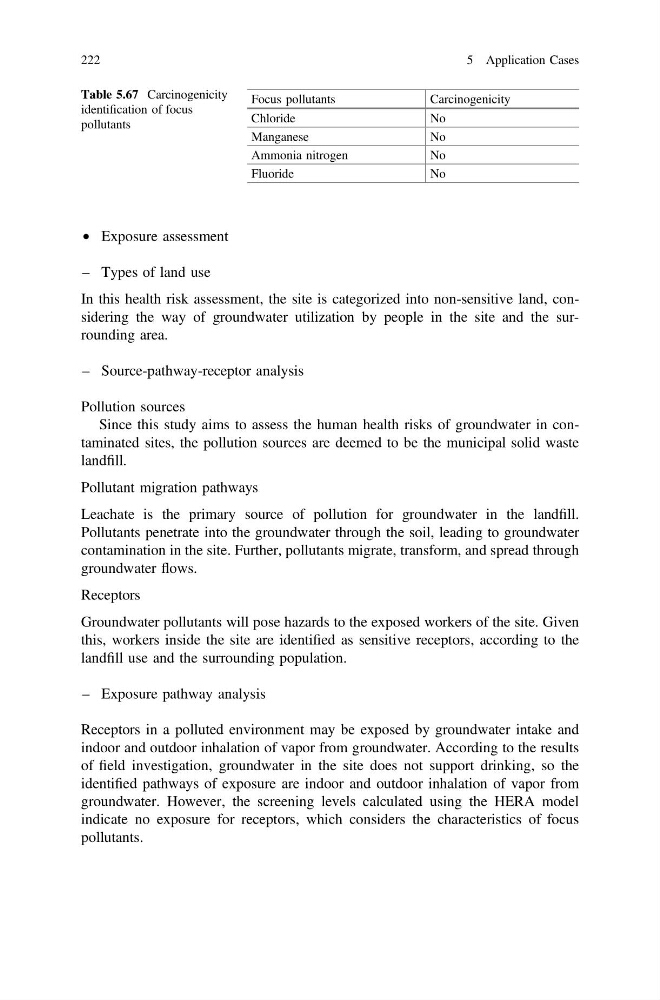
Table 5.67 Carcinogenicity
identification of focus
pollutants
Focus pollutants
Carcinogenicity
Chloride
No
Manganese
No
Ammonia nitrogen
No
Fluoride
No
222
5 Application Cases
– Types of land use
In this health risk assessment, the site is categorized into non-sensitive land, considering the way of groundwater utilization by people in the site and the surrounding area.
– Source-pathway-receptor analysis
Pollution sources
Since this study aims to assess the human health risks of groundwater in contaminated sites, the pollution sources are deemed to be the municipal solid waste
landfill.
Pollutant migration pathways
Leachate is the primary source of pollution for groundwater in the landfill.
Pollutants penetrate into the groundwater through the soil, leading to groundwater
contamination in the site. Further, pollutants migrate, transform, and spread through
groundwater flows.
Receptors
Groundwater pollutants will pose hazards to the exposed workers of the site. Given
this, workers inside the site are identified as sensitive receptors, according to the
landfill use and the surrounding population.
– Exposure pathway analysis
Receptors in a polluted environment may be exposed by groundwater intake and
indoor and outdoor inhalation of vapor from groundwater. According to the results
of field investigation, groundwater in the site does not support drinking, so the
identified pathways of exposure are indoor and outdoor inhalation of vapor from
groundwater. However, the screening levels calculated using the HERA model
indicate no exposure for receptors, which considers the characteristics of focus
pollutants.
Table 5.67 Carcinogenicity
identification of focus
pollutants
Focus pollutants
Carcinogenicity
Chloride
No
Manganese
No
Ammonia nitrogen
No
Fluoride
No
222
5 Application Cases