

and nickel Grade IV standards. In general, the groundwater quality is poor in the
OCS site, but there is no excess of organic pollutants such as benzene and toluene.
Since groundwater in the site does not serve as a drinking water source, the
health risk assessment is performed using the HERA model according to the
Technical Guidelines for Risk Assessment of Contaminated Sites (HJ25.3–2014)
and the Guidelines for Health Risk Assessment for Contaminated Groundwater
(Trial).
(a) Health risk assessment
• Pollutant screening
According to the Technical Guidelines for Risk Assessment of Contaminated Sites
(HJ25.3–2014) and the Guidelines for Health Risk Assessment for Contaminated
Groundwater (Trial), the following hazardous and toxic pollutants are included in
the health risk assessment: ammonia nitrogen, hexavalent chromium, total nickel,
total lead, total vanadium, total mercury, total arsenic, benzene, toluene, ethylbenzene, m-/p-xylene, and o-xylene.
• Toxicity assessment
– Carcinogenicity identification
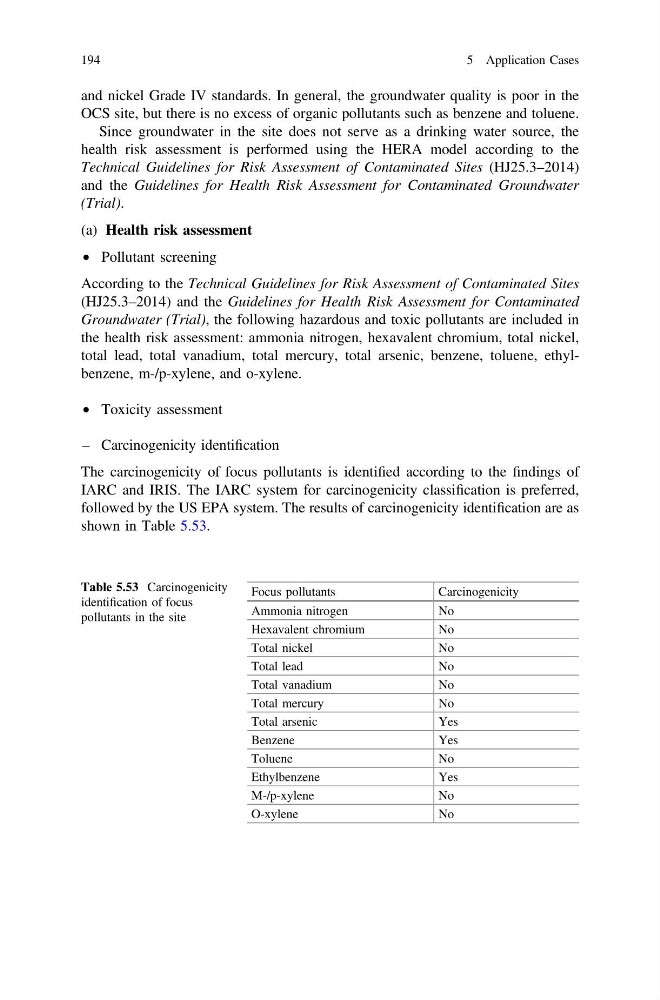
The carcinogenicity of focus pollutants is identified according to the findings of
IARC and IRIS. The IARC system for carcinogenicity classification is preferred,
followed by the US EPA system. The results of carcinogenicity identification are as
shown in Table 5.53.
Table 5.53 Carcinogenicity
identification of focus
pollutants in the site
Focus pollutants
Carcinogenicity
Ammonia nitrogen
No
Hexavalent chromium
No
Total nickel
No
Total lead
No
Total vanadium
No
Total mercury
No
Total arsenic
Yes
Benzene
Yes
Toluene
No
Ethylbenzene
Yes
M-/p-xylene
No
O-xylene
No
194
5 Application Cases
OCS site, but there is no excess of organic pollutants such as benzene and toluene.
Since groundwater in the site does not serve as a drinking water source, the
health risk assessment is performed using the HERA model according to the
Technical Guidelines for Risk Assessment of Contaminated Sites (HJ25.3–2014)
and the Guidelines for Health Risk Assessment for Contaminated Groundwater
(Trial).
(a) Health risk assessment
• Pollutant screening
According to the Technical Guidelines for Risk Assessment of Contaminated Sites
(HJ25.3–2014) and the Guidelines for Health Risk Assessment for Contaminated
Groundwater (Trial), the following hazardous and toxic pollutants are included in
the health risk assessment: ammonia nitrogen, hexavalent chromium, total nickel,
total lead, total vanadium, total mercury, total arsenic, benzene, toluene, ethylbenzene, m-/p-xylene, and o-xylene.
• Toxicity assessment
– Carcinogenicity identification
The carcinogenicity of focus pollutants is identified according to the findings of
IARC and IRIS. The IARC system for carcinogenicity classification is preferred,
followed by the US EPA system. The results of carcinogenicity identification are as
shown in Table 5.53.
Table 5.53 Carcinogenicity
identification of focus
pollutants in the site
Focus pollutants
Carcinogenicity
Ammonia nitrogen
No
Hexavalent chromium
No
Total nickel
No
Total lead
No
Total vanadium
No
Total mercury
No
Total arsenic
Yes
Benzene
Yes
Toluene
No
Ethylbenzene
Yes
M-/p-xylene
No
O-xylene
No
194
5 Application Cases