

phyllites with gray-white marble, schist, slate, phyllite, crystalline limestone,
metamorphic sandstone, and sandstone. Along with endless geological transformation of these strata, tectonic fissures and weathering fissures have been formed,
which makes groundwater endowment and migration possible. However, groundwater exists to different degrees due to many factors such as meteorology, topography and aqueous media. In the middle and high mountainous areas with an
altitude of over 3800 m, the groundwater exists in solid phase during the cold
season because of permafrost. In other seasons, the groundwater can migrate, and
affected by terrain, generally emerges as springs that replenish the river basin. The
middle and low mountainous areas less than 3800 m above sea level, the
groundwater is comprised of bedrock fissure water, but as compared with
high-altitude areas, the groundwater quantity is restricted by less precipitation and
groundwater quality undermined by aqueous media and evaporation.
• Seepage control measures
Harmful gases generated from the corruption of landfilled waste, such as methane,
hydrogen sulfide and nitrogen, are discharged through the gas drainage system to
100 cm above land surface for dissipation, in order to prevent self-ignition,
explosion and other accident hazards. Landfill leachate associated with natural
precipitation and inherent water is also discharged through the drainage system.
A part of the leachate is evaporated and the other, sprinkled on the landfill. The
leachate is not discharged beyond the landfill because given great evaporation and
small precipitation, only a small amount of leachate is produced owning to the high
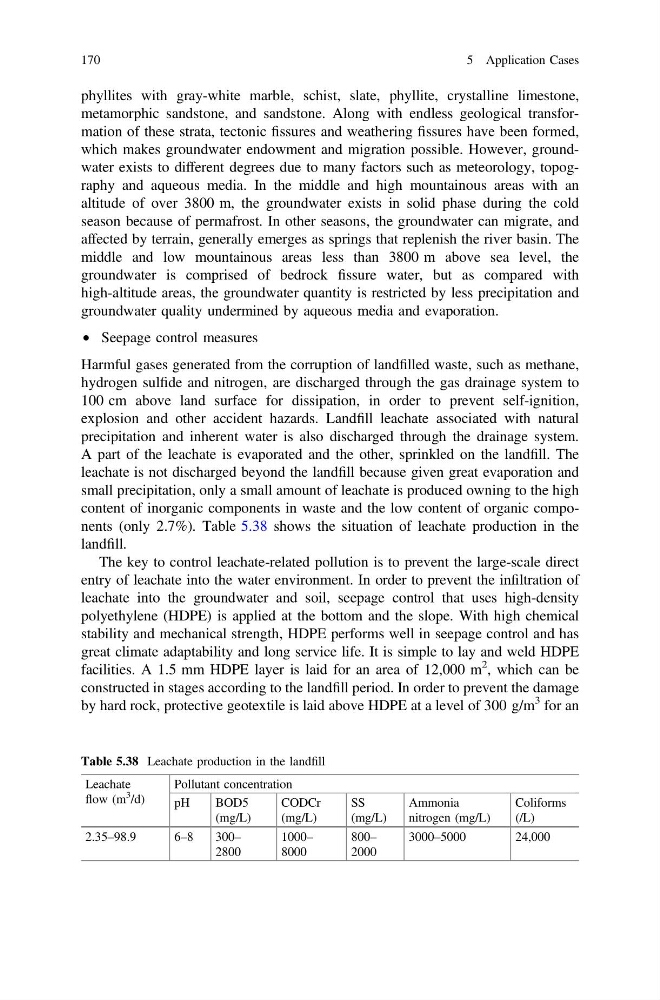
content of inorganic components in waste and the low content of organic components (only 2.7%). Table 5.38 shows the situation of leachate production in the
landfill.
The key to control leachate-related pollution is to prevent the large-scale direct
entry of leachate into the water environment. In order to prevent the infiltration of
leachate into the groundwater and soil, seepage control that uses high-density
polyethylene (HDPE) is applied at the bottom and the slope. With high chemical
stability and mechanical strength, HDPE performs well in seepage control and has
great climate adaptability and long service life. It is simple to lay and weld HDPE
facilities. A 1.5 mm HDPE layer is laid for an area of 12,000 m
2 , which can be
constructed in stages according to the landfill period. In order to prevent the damage
by hard rock, protective geotextile is laid above HDPE at a level of 300 g/m
3 for an
Table 5.38 Leachate production in the landfill
Leachate
flow (m
3
/d)
Pollutant concentration
pH
BOD5
(mg/L)
CODCr
(mg/L)
SS
(mg/L)
Ammonia
nitrogen (mg/L)
Coliforms
(/L)
2.35–98.9
6–8
300–
2800
1000–
8000
800–
2000
3000–5000
24,000
170
5 Application Cases
metamorphic sandstone, and sandstone. Along with endless geological transformation of these strata, tectonic fissures and weathering fissures have been formed,
which makes groundwater endowment and migration possible. However, groundwater exists to different degrees due to many factors such as meteorology, topography and aqueous media. In the middle and high mountainous areas with an
altitude of over 3800 m, the groundwater exists in solid phase during the cold
season because of permafrost. In other seasons, the groundwater can migrate, and
affected by terrain, generally emerges as springs that replenish the river basin. The
middle and low mountainous areas less than 3800 m above sea level, the
groundwater is comprised of bedrock fissure water, but as compared with
high-altitude areas, the groundwater quantity is restricted by less precipitation and
groundwater quality undermined by aqueous media and evaporation.
• Seepage control measures
Harmful gases generated from the corruption of landfilled waste, such as methane,
hydrogen sulfide and nitrogen, are discharged through the gas drainage system to
100 cm above land surface for dissipation, in order to prevent self-ignition,
explosion and other accident hazards. Landfill leachate associated with natural
precipitation and inherent water is also discharged through the drainage system.
A part of the leachate is evaporated and the other, sprinkled on the landfill. The
leachate is not discharged beyond the landfill because given great evaporation and
small precipitation, only a small amount of leachate is produced owning to the high
content of inorganic components in waste and the low content of organic components (only 2.7%). Table 5.38 shows the situation of leachate production in the
landfill.
The key to control leachate-related pollution is to prevent the large-scale direct
entry of leachate into the water environment. In order to prevent the infiltration of
leachate into the groundwater and soil, seepage control that uses high-density
polyethylene (HDPE) is applied at the bottom and the slope. With high chemical
stability and mechanical strength, HDPE performs well in seepage control and has
great climate adaptability and long service life. It is simple to lay and weld HDPE
facilities. A 1.5 mm HDPE layer is laid for an area of 12,000 m
2 , which can be
constructed in stages according to the landfill period. In order to prevent the damage
by hard rock, protective geotextile is laid above HDPE at a level of 300 g/m
3 for an
Table 5.38 Leachate production in the landfill
Leachate
flow (m
3
/d)
Pollutant concentration
pH
BOD5
(mg/L)
CODCr
(mg/L)
SS
(mg/L)
Ammonia
nitrogen (mg/L)
Coliforms
(/L)
2.35–98.9
6–8
300–
2800
1000–
8000
800–
2000
3000–5000
24,000
170
5 Application Cases