

– Receptors
During the use of the site, groundwater pollutants will pose hazards to the exposed
workers of the site and residents of the surrounding areas. According to the given
landfill use and the surrounding population, workers inside the site and residents
around the site are identified as sensitive receptors.
• Exposure pathway analysis
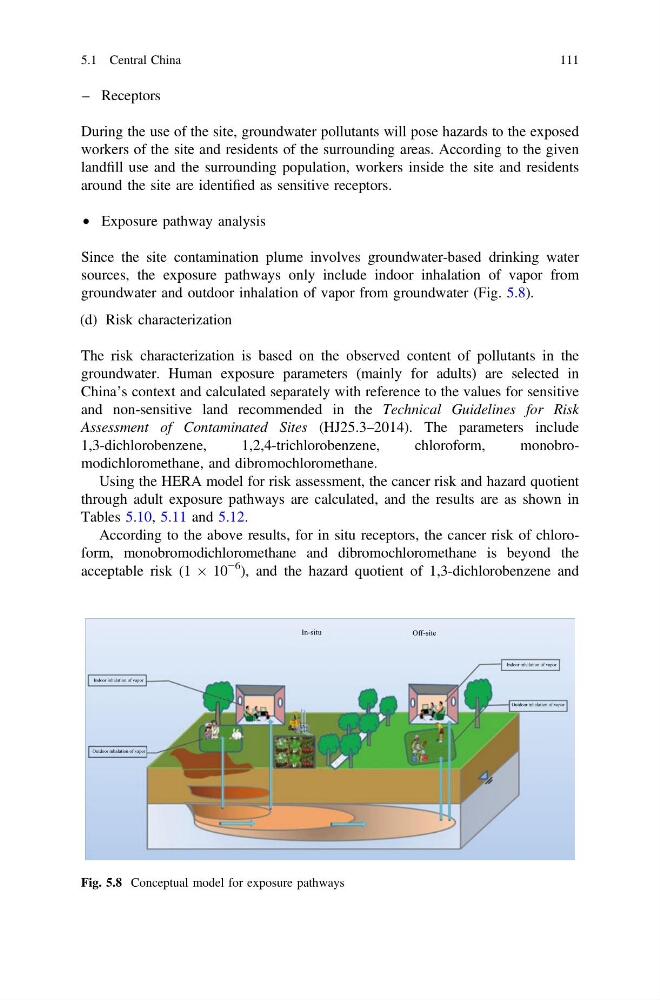
Since the site contamination plume involves groundwater-based drinking water
sources, the exposure pathways only include indoor inhalation of vapor from
groundwater and outdoor inhalation of vapor from groundwater (Fig. 5.8).
(d) Risk characterization
The risk characterization is based on the observed content of pollutants in the
groundwater. Human exposure parameters (mainly for adults) are selected in
China’s context and calculated separately with reference to the values for sensitive
and non-sensitive land recommended in the Technical Guidelines for Risk
Assessment of Contaminated Sites (HJ25.3–2014). The parameters include
1,3-dichlorobenzene,
1,2,4-trichlorobenzene,
chloroform,
monobromodichloromethane, and dibromochloromethane.
Using the HERA model for risk assessment, the cancer risk and hazard quotient
through adult exposure pathways are calculated, and the results are as shown in
Tables 5.10, 5.11 and 5.12.
According to the above results, for in situ receptors, the cancer risk of chloroform, monobromodichloromethane and dibromochloromethane is beyond the
acceptable risk (1 Â 10
−6 ), and the hazard quotient of 1,3-dichlorobenzene and
In-situ
Off-site
Indoor inhalation of vapor
Outdoor inhalation of vapor
Indoor inhalation of vapor
Outdoor inhalation of vapor
Fig. 5.8 Conceptual model for exposure pathways
5.1 Central China
111
During the use of the site, groundwater pollutants will pose hazards to the exposed
workers of the site and residents of the surrounding areas. According to the given
landfill use and the surrounding population, workers inside the site and residents
around the site are identified as sensitive receptors.
• Exposure pathway analysis
Since the site contamination plume involves groundwater-based drinking water
sources, the exposure pathways only include indoor inhalation of vapor from
groundwater and outdoor inhalation of vapor from groundwater (Fig. 5.8).
(d) Risk characterization
The risk characterization is based on the observed content of pollutants in the
groundwater. Human exposure parameters (mainly for adults) are selected in
China’s context and calculated separately with reference to the values for sensitive
and non-sensitive land recommended in the Technical Guidelines for Risk
Assessment of Contaminated Sites (HJ25.3–2014). The parameters include
1,3-dichlorobenzene,
1,2,4-trichlorobenzene,
chloroform,
monobromodichloromethane, and dibromochloromethane.
Using the HERA model for risk assessment, the cancer risk and hazard quotient
through adult exposure pathways are calculated, and the results are as shown in
Tables 5.10, 5.11 and 5.12.
According to the above results, for in situ receptors, the cancer risk of chloroform, monobromodichloromethane and dibromochloromethane is beyond the
acceptable risk (1 Â 10
−6 ), and the hazard quotient of 1,3-dichlorobenzene and
In-situ
Off-site
Indoor inhalation of vapor
Outdoor inhalation of vapor
Indoor inhalation of vapor
Outdoor inhalation of vapor
Fig. 5.8 Conceptual model for exposure pathways
5.1 Central China
111