

– Toxicity values
The relevant US assessment systems are adopted, wherein the toxicity values are all
obtained from the aforementioned databases. The toxicity values of focus pollutants
are as shown in Table 5.9.
(c) Exposure assessment
Exposure assessment is a process of measuring, estimating or predicting the
magnitude, frequency, duration of human exposure to pollutants in the media,
which serves as a quantitative basis for risk assessment. It includes the assessment
of the scenarios, media, pathways, concentrations, and quantities of exposure.
• Types of land use
In this health risk assessment, the site is categorized into non-sensitive land, considering the hydrogeological conditions of the site and groundwater utilization of
the surrounding area. The site contamination plume covers groundwater that is used
as a drinking water source.
• Source-pathway-receptor analysis
– Pollution sources
Since this study aims to assess the human health risks of groundwater in contaminated sites, the pollution sources are deemed to be contaminated groundwater in
the given landfill in Hubei Province.
– Pollutant migration pathways
Though the landfill was closed in 2009, there are still wastes that are not yet
disposed of. Pollutants in the groundwater environment of the landfill mainly come
from leachate and other substances that are produced by simple waste disposal and
infiltrate through soil into the groundwater. Its infiltration efficiency is related to the
local soil and hydrological environment. Once the groundwater is contaminated,
such pollutants migrate, transform, and spread through groundwater flows.
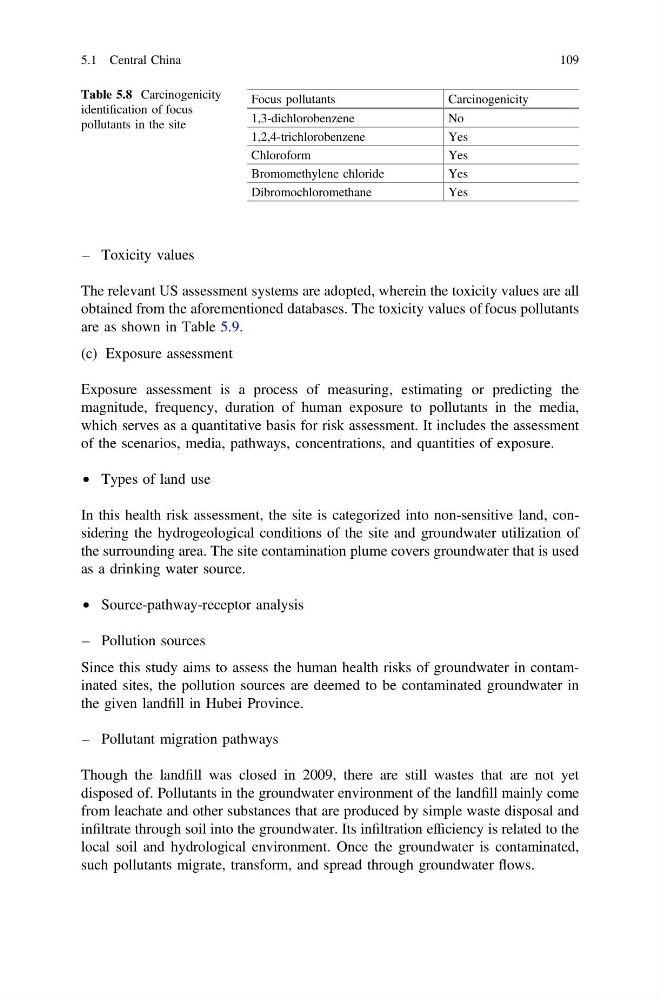
Table 5.8 Carcinogenicity
identification of focus
pollutants in the site
Focus pollutants
Carcinogenicity
1,3-dichlorobenzene
No
1,2,4-trichlorobenzene
Yes
Chloroform
Yes
Bromomethylene chloride
Yes
Dibromochloromethane
Yes
5.1 Central China
109
The relevant US assessment systems are adopted, wherein the toxicity values are all
obtained from the aforementioned databases. The toxicity values of focus pollutants
are as shown in Table 5.9.
(c) Exposure assessment
Exposure assessment is a process of measuring, estimating or predicting the
magnitude, frequency, duration of human exposure to pollutants in the media,
which serves as a quantitative basis for risk assessment. It includes the assessment
of the scenarios, media, pathways, concentrations, and quantities of exposure.
• Types of land use
In this health risk assessment, the site is categorized into non-sensitive land, considering the hydrogeological conditions of the site and groundwater utilization of
the surrounding area. The site contamination plume covers groundwater that is used
as a drinking water source.
• Source-pathway-receptor analysis
– Pollution sources
Since this study aims to assess the human health risks of groundwater in contaminated sites, the pollution sources are deemed to be contaminated groundwater in
the given landfill in Hubei Province.
– Pollutant migration pathways
Though the landfill was closed in 2009, there are still wastes that are not yet
disposed of. Pollutants in the groundwater environment of the landfill mainly come
from leachate and other substances that are produced by simple waste disposal and
infiltrate through soil into the groundwater. Its infiltration efficiency is related to the
local soil and hydrological environment. Once the groundwater is contaminated,
such pollutants migrate, transform, and spread through groundwater flows.
Table 5.8 Carcinogenicity
identification of focus
pollutants in the site
Focus pollutants
Carcinogenicity
1,3-dichlorobenzene
No
1,2,4-trichlorobenzene
Yes
Chloroform
Yes
Bromomethylene chloride
Yes
Dibromochloromethane
Yes
5.1 Central China
109