

7 Material-service Systems for Sustainable Resource Management
93
Table 7.1 Main differences between a MSS and a PSS
Material service system
Product service system
Material suppliers offer producers the use of
materials through services
Producers offer consumers the use of products
through services
Marketable set of materials and services
capable of jointly fulfilling the needs of
producers
Marketable set of products and services
capable of jointly fulfilling the needs of
consumers
Selling the function of materials
Selling the function of products
Producers enter a business relationship with
suppliers based on a ‘pay per use’ model
Consumers enter a business relationship with
producers based on a ‘pay per use’ model
Material suppliers retain ownership of the
resource
Producers retain ownership of the resource
Ownership of the IP for materials,
manufacturing processes and products remains
with the inventors
Ownership of the IP for materials,
manufacturing processes and products remains
with the inventors
downstream transformations made to resources by producers or other stakeholders.
Two scenarios are envisaged to deploy a MSS, namely a MSS used in conjunction
with a PSS and a MSS used on its own. The scenarios are explored in the next two
sections.
7.4.1 Use of a MSS with a PSS
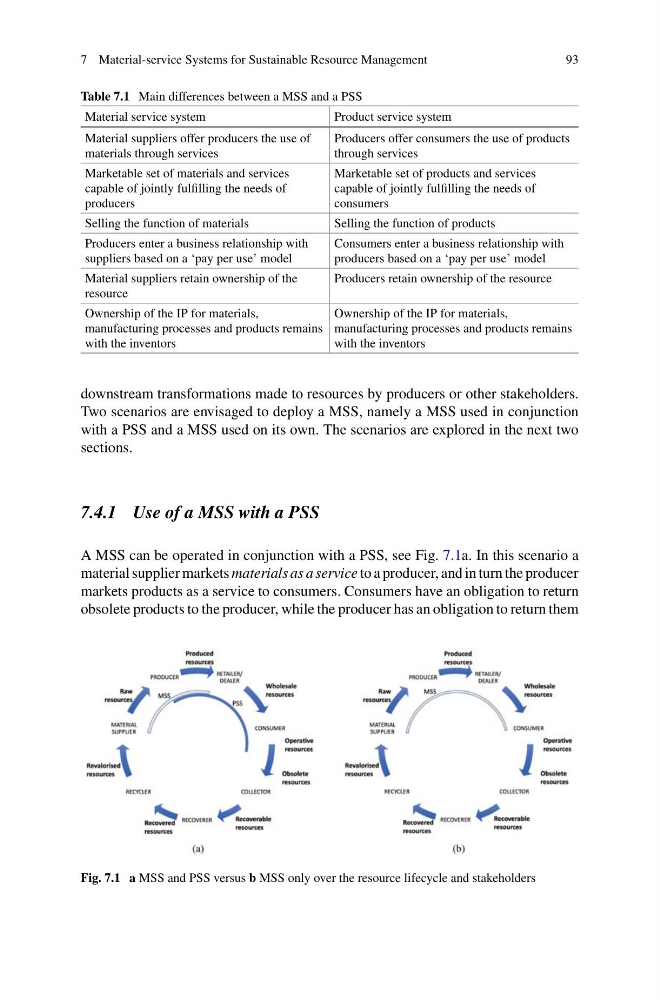
A MSS can be operated in conjunction with a PSS, see Fig. 7.1a. In this scenario a
material supplier markets materials as a service to a producer, and in turn the producer
markets products as a service to consumers. Consumers have an obligation to return
obsolete products to the producer, while the producer has an obligation to return them
Fig. 7.1 a MSS and PSS versus b MSS only over the resource lifecycle and stakeholders
93
Table 7.1 Main differences between a MSS and a PSS
Material service system
Product service system
Material suppliers offer producers the use of
materials through services
Producers offer consumers the use of products
through services
Marketable set of materials and services
capable of jointly fulfilling the needs of
producers
Marketable set of products and services
capable of jointly fulfilling the needs of
consumers
Selling the function of materials
Selling the function of products
Producers enter a business relationship with
suppliers based on a ‘pay per use’ model
Consumers enter a business relationship with
producers based on a ‘pay per use’ model
Material suppliers retain ownership of the
resource
Producers retain ownership of the resource
Ownership of the IP for materials,
manufacturing processes and products remains
with the inventors
Ownership of the IP for materials,
manufacturing processes and products remains
with the inventors
downstream transformations made to resources by producers or other stakeholders.
Two scenarios are envisaged to deploy a MSS, namely a MSS used in conjunction
with a PSS and a MSS used on its own. The scenarios are explored in the next two
sections.
7.4.1 Use of a MSS with a PSS
A MSS can be operated in conjunction with a PSS, see Fig. 7.1a. In this scenario a
material supplier markets materials as a service to a producer, and in turn the producer
markets products as a service to consumers. Consumers have an obligation to return
obsolete products to the producer, while the producer has an obligation to return them
Fig. 7.1 a MSS and PSS versus b MSS only over the resource lifecycle and stakeholders