

68
J. Tao and S. Yu
valuable lifetime of the device. In addition, reuse strategies may bring forward environmental benefits, such as material and energy saving for manufacturing new parts.
To address the legal concerns of circulating exoskeletons, related laws and regulations
are then investigated. It is found that companies with “Medical Device Manufacturing
Enterprise License” are allowed to recycle spare parts from retired medical device,
and sell qualified renovated devices. Also, the newly issued “Regulations on the
Supervision and Administration of Medical Devices” liberalizes the transfer of the
safety and effectiveness of the transferred medical devices. Thus, it opens channel
of exoskeleton cascade reuse in the rehabilitation service system.
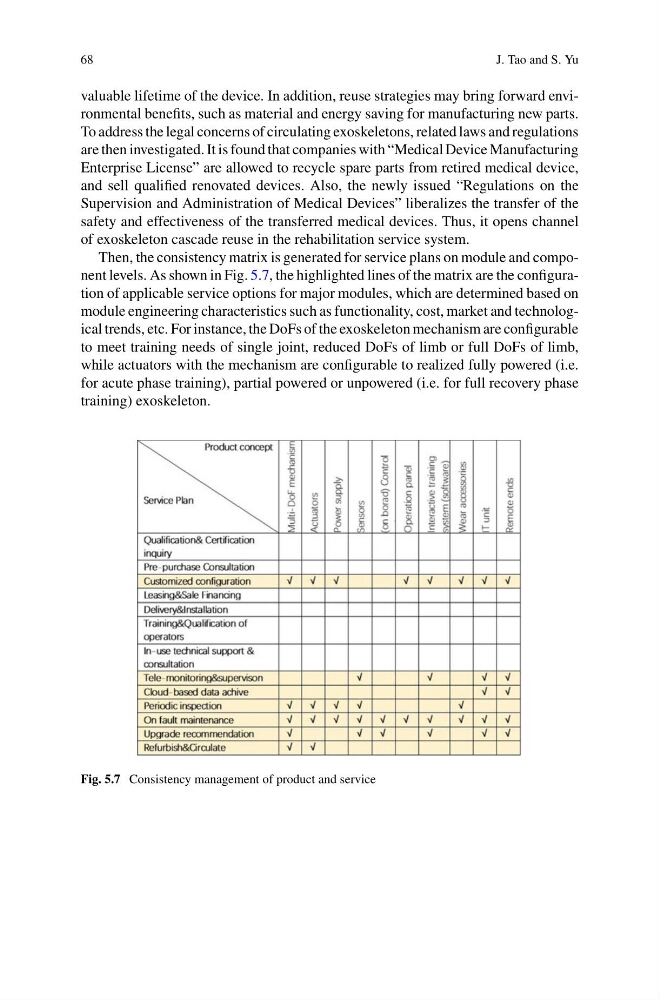
Then, the consistency matrix is generated for service plans on module and component levels. As shown in Fig. 5.7, the highlighted lines of the matrix are the configuration of applicable service options for major modules, which are determined based on
module engineering characteristics such as functionality, cost, market and technological trends, etc. For instance, the DoFs of the exoskeleton mechanism are configurable
to meet training needs of single joint, reduced DoFs of limb or full DoFs of limb,
while actuators with the mechanism are configurable to realized fully powered (i.e.
for acute phase training), partial powered or unpowered (i.e. for full recovery phase
training) exoskeleton.
Fig. 5.7 Consistency management of product and service
J. Tao and S. Yu
valuable lifetime of the device. In addition, reuse strategies may bring forward environmental benefits, such as material and energy saving for manufacturing new parts.
To address the legal concerns of circulating exoskeletons, related laws and regulations
are then investigated. It is found that companies with “Medical Device Manufacturing
Enterprise License” are allowed to recycle spare parts from retired medical device,
and sell qualified renovated devices. Also, the newly issued “Regulations on the
Supervision and Administration of Medical Devices” liberalizes the transfer of the
safety and effectiveness of the transferred medical devices. Thus, it opens channel
of exoskeleton cascade reuse in the rehabilitation service system.
Then, the consistency matrix is generated for service plans on module and component levels. As shown in Fig. 5.7, the highlighted lines of the matrix are the configuration of applicable service options for major modules, which are determined based on
module engineering characteristics such as functionality, cost, market and technological trends, etc. For instance, the DoFs of the exoskeleton mechanism are configurable
to meet training needs of single joint, reduced DoFs of limb or full DoFs of limb,
while actuators with the mechanism are configurable to realized fully powered (i.e.
for acute phase training), partial powered or unpowered (i.e. for full recovery phase
training) exoskeleton.
Fig. 5.7 Consistency management of product and service