

5 Service Design of Rehabilitative Exoskeleton for Sustainable …
65
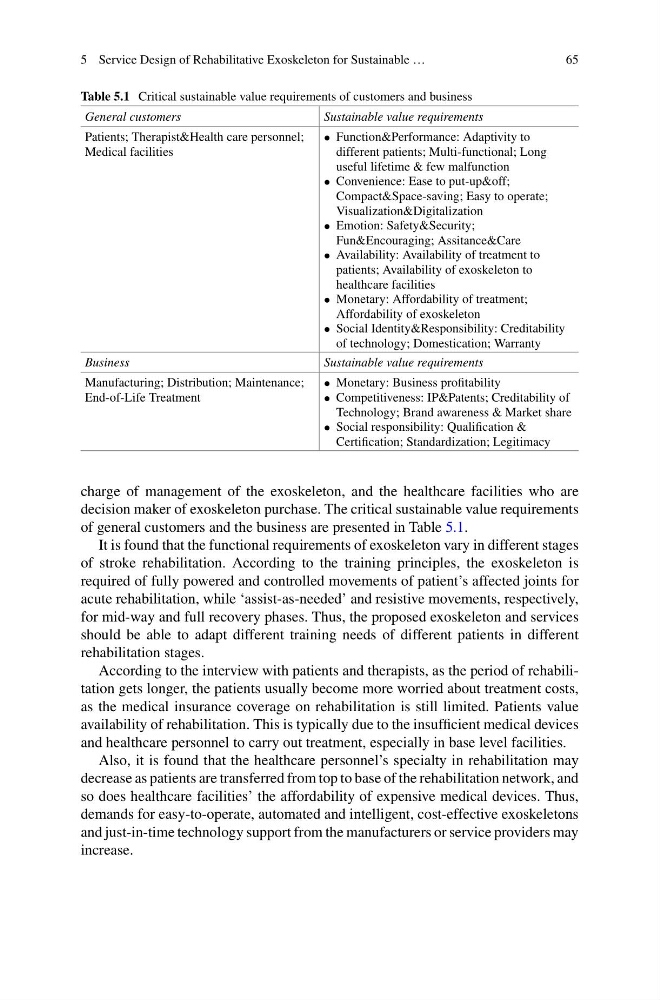
Table 5.1 Critical sustainable value requirements of customers and business
General customers
Sustainable value requirements
Patients; Therapist&Health care personnel;
Medical facilities
• Function&Performance: Adaptivity to
different patients; Multi-functional; Long
useful lifetime & few malfunction
• Convenience: Ease to put-up&off;
Compact&Space-saving; Easy to operate;
Visualization&Digitalization
• Emotion: Safety&Security;
Fun&Encouraging; Assitance&Care
• Availability: Availability of treatment to
patients; Availability of exoskeleton to
healthcare facilities
• Monetary: Affordability of treatment;
Affordability of exoskeleton
• Social Identity&Responsibility: Creditability
of technology; Domestication; Warranty
Business
Sustainable value requirements
Manufacturing; Distribution; Maintenance;
End-of-Life Treatment
• Monetary: Business profitability
• Competitiveness: IP&Patents; Creditability of
Technology; Brand awareness & Market share
• Social responsibility: Qualification &
Certification; Standardization; Legitimacy
charge of management of the exoskeleton, and the healthcare facilities who are
decision maker of exoskeleton purchase. The critical sustainable value requirements
of general customers and the business are presented in Table 5.1.
It is found that the functional requirements of exoskeleton vary in different stages
of stroke rehabilitation. According to the training principles, the exoskeleton is
required of fully powered and controlled movements of patient’s affected joints for
acute rehabilitation, while ‘assist-as-needed’ and resistive movements, respectively,
for mid-way and full recovery phases. Thus, the proposed exoskeleton and services
should be able to adapt different training needs of different patients in different
rehabilitation stages.
According to the interview with patients and therapists, as the period of rehabilitation gets longer, the patients usually become more worried about treatment costs,
as the medical insurance coverage on rehabilitation is still limited. Patients value
availability of rehabilitation. This is typically due to the insufficient medical devices
and healthcare personnel to carry out treatment, especially in base level facilities.
Also, it is found that the healthcare personnel’s specialty in rehabilitation may
decrease as patients are transferred from top to base of the rehabilitation network, and
so does healthcare facilities’ the affordability of expensive medical devices. Thus,
demands for easy-to-operate, automated and intelligent, cost-effective exoskeletons
and just-in-time technology support from the manufacturers or service providers may
increase.
65
Table 5.1 Critical sustainable value requirements of customers and business
General customers
Sustainable value requirements
Patients; Therapist&Health care personnel;
Medical facilities
• Function&Performance: Adaptivity to
different patients; Multi-functional; Long
useful lifetime & few malfunction
• Convenience: Ease to put-up&off;
Compact&Space-saving; Easy to operate;
Visualization&Digitalization
• Emotion: Safety&Security;
Fun&Encouraging; Assitance&Care
• Availability: Availability of treatment to
patients; Availability of exoskeleton to
healthcare facilities
• Monetary: Affordability of treatment;
Affordability of exoskeleton
• Social Identity&Responsibility: Creditability
of technology; Domestication; Warranty
Business
Sustainable value requirements
Manufacturing; Distribution; Maintenance;
End-of-Life Treatment
• Monetary: Business profitability
• Competitiveness: IP&Patents; Creditability of
Technology; Brand awareness & Market share
• Social responsibility: Qualification &
Certification; Standardization; Legitimacy
charge of management of the exoskeleton, and the healthcare facilities who are
decision maker of exoskeleton purchase. The critical sustainable value requirements
of general customers and the business are presented in Table 5.1.
It is found that the functional requirements of exoskeleton vary in different stages
of stroke rehabilitation. According to the training principles, the exoskeleton is
required of fully powered and controlled movements of patient’s affected joints for
acute rehabilitation, while ‘assist-as-needed’ and resistive movements, respectively,
for mid-way and full recovery phases. Thus, the proposed exoskeleton and services
should be able to adapt different training needs of different patients in different
rehabilitation stages.
According to the interview with patients and therapists, as the period of rehabilitation gets longer, the patients usually become more worried about treatment costs,
as the medical insurance coverage on rehabilitation is still limited. Patients value
availability of rehabilitation. This is typically due to the insufficient medical devices
and healthcare personnel to carry out treatment, especially in base level facilities.
Also, it is found that the healthcare personnel’s specialty in rehabilitation may
decrease as patients are transferred from top to base of the rehabilitation network, and
so does healthcare facilities’ the affordability of expensive medical devices. Thus,
demands for easy-to-operate, automated and intelligent, cost-effective exoskeletons
and just-in-time technology support from the manufacturers or service providers may
increase.