

54
L.-H. Shih and Y.-T. Chien
Table 4.2 Recommended
strategies in five stages
Behavioral stages
Strategy (rank)
I. Being aware of battery status
Threat (2)
Reminder (4)
II. Finding information of
charging stations
Tunnel (5)
Simulation (6)
Data Visualization (8)
Self monitor (9)
III. Selecting stations
Color (1)
Diversified function (3)
Discount (7)
IV. Checking detail information of
the selected station
Media richness and
interactivity (12)
V. Swapping battery
Color (1)
number of partially charged batteries so that users could be aware of the likelihood
of getting a partially charged battery in the crowded station. The ‘threat and coping
appraisal’ strategy has the second highest persuasion score. The users consider the
type of message like ‘you should swap the battery earlier to avoid the risk of not
finding available charged battery’ is persuasive.
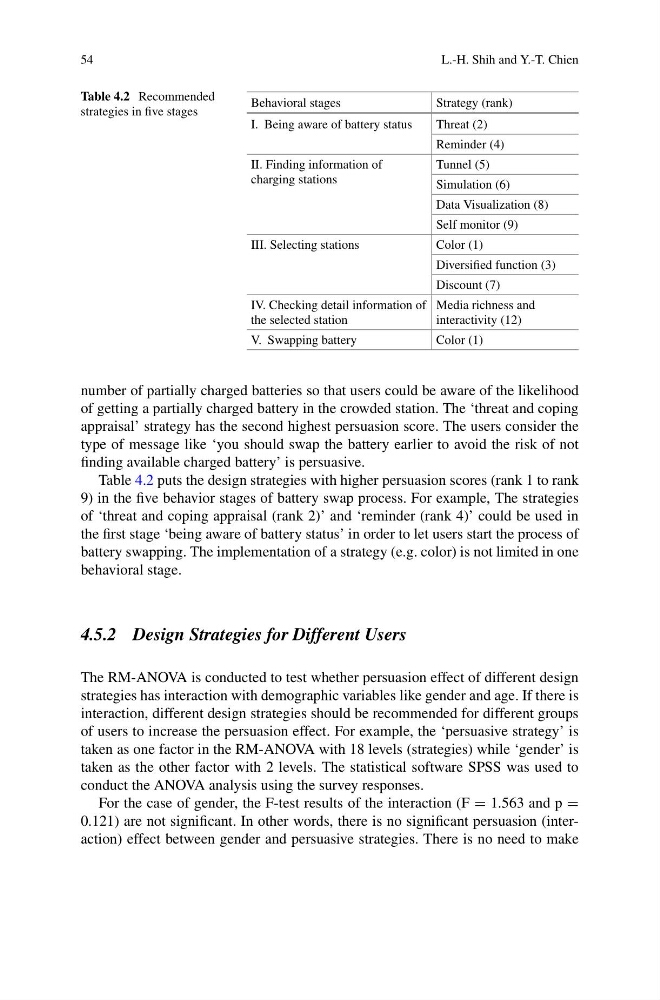
Table 4.2 puts the design strategies with higher persuasion scores (rank 1 to rank
9) in the five behavior stages of battery swap process. For example, The strategies
of ‘threat and coping appraisal (rank 2)’ and ‘reminder (rank 4)’ could be used in
the first stage ‘being aware of battery status’ in order to let users start the process of
battery swapping. The implementation of a strategy (e.g. color) is not limited in one
behavioral stage.
4.5.2 Design Strategies for Different Users
The RM-ANOVA is conducted to test whether persuasion effect of different design
strategies has interaction with demographic variables like gender and age. If there is
interaction, different design strategies should be recommended for different groups
of users to increase the persuasion effect. For example, the ‘persuasive strategy’ is
taken as one factor in the RM-ANOVA with 18 levels (strategies) while ‘gender’ is
taken as the other factor with 2 levels. The statistical software SPSS was used to
conduct the ANOVA analysis using the survey responses.
For the case of gender, the F-test results of the interaction (F = 1.563 and p =
0.121) are not significant. In other words, there is no significant persuasion (interaction) effect between gender and persuasive strategies. There is no need to make
L.-H. Shih and Y.-T. Chien
Table 4.2 Recommended
strategies in five stages
Behavioral stages
Strategy (rank)
I. Being aware of battery status
Threat (2)
Reminder (4)
II. Finding information of
charging stations
Tunnel (5)
Simulation (6)
Data Visualization (8)
Self monitor (9)
III. Selecting stations
Color (1)
Diversified function (3)
Discount (7)
IV. Checking detail information of
the selected station
Media richness and
interactivity (12)
V. Swapping battery
Color (1)
number of partially charged batteries so that users could be aware of the likelihood
of getting a partially charged battery in the crowded station. The ‘threat and coping
appraisal’ strategy has the second highest persuasion score. The users consider the
type of message like ‘you should swap the battery earlier to avoid the risk of not
finding available charged battery’ is persuasive.
Table 4.2 puts the design strategies with higher persuasion scores (rank 1 to rank
9) in the five behavior stages of battery swap process. For example, The strategies
of ‘threat and coping appraisal (rank 2)’ and ‘reminder (rank 4)’ could be used in
the first stage ‘being aware of battery status’ in order to let users start the process of
battery swapping. The implementation of a strategy (e.g. color) is not limited in one
behavioral stage.
4.5.2 Design Strategies for Different Users
The RM-ANOVA is conducted to test whether persuasion effect of different design
strategies has interaction with demographic variables like gender and age. If there is
interaction, different design strategies should be recommended for different groups
of users to increase the persuasion effect. For example, the ‘persuasive strategy’ is
taken as one factor in the RM-ANOVA with 18 levels (strategies) while ‘gender’ is
taken as the other factor with 2 levels. The statistical software SPSS was used to
conduct the ANOVA analysis using the survey responses.
For the case of gender, the F-test results of the interaction (F = 1.563 and p =
0.121) are not significant. In other words, there is no significant persuasion (interaction) effect between gender and persuasive strategies. There is no need to make