

36 Additive Manufacturing for Circular Manufacturing: Trends …
519
techniques used in today’s remanufacturing, and outlines the challenges in the application of these techniques. Section 36.4 presents a review of the applications of
metal 3D printing in remanufacturing, along with a summary of the challenges on
the techniques. The final section summarizes the main points of the article.
36.2 Material Restoration in Remanufacturing
RRRDR prolong the usage duration of products and components, and thus contribute
to saving materials and energy in manufacturing. In RRRDR, remanufacturing can
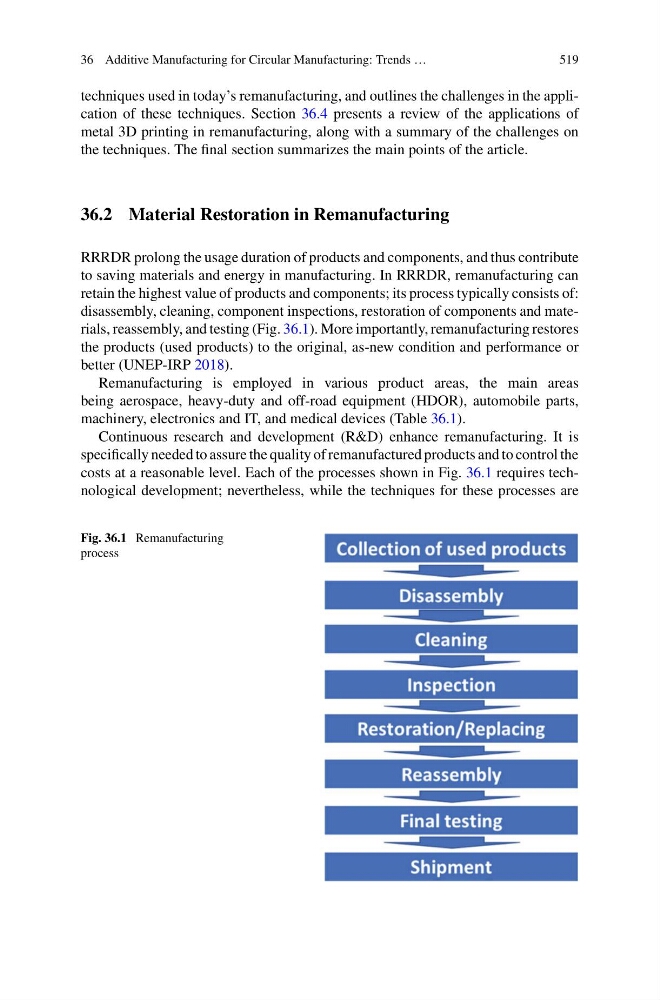
retain the highest value of products and components; its process typically consists of:
disassembly, cleaning, component inspections, restoration of components and materials, reassembly, and testing (Fig. 36.1). More importantly, remanufacturing restores
the products (used products) to the original, as-new condition and performance or
better (UNEP-IRP 2018).
Remanufacturing is employed in various product areas, the main areas
being aerospace, heavy-duty and off-road equipment (HDOR), automobile parts,
machinery, electronics and IT, and medical devices (Table 36.1).
Continuous research and development (R&D) enhance remanufacturing. It is
specifically needed to assure the quality of remanufactured products and to control the
costs at a reasonable level. Each of the processes shown in Fig. 36.1 requires technological development; nevertheless, while the techniques for these processes are
Fig. 36.1 Remanufacturing
process
519
techniques used in today’s remanufacturing, and outlines the challenges in the application of these techniques. Section 36.4 presents a review of the applications of
metal 3D printing in remanufacturing, along with a summary of the challenges on
the techniques. The final section summarizes the main points of the article.
36.2 Material Restoration in Remanufacturing
RRRDR prolong the usage duration of products and components, and thus contribute
to saving materials and energy in manufacturing. In RRRDR, remanufacturing can
retain the highest value of products and components; its process typically consists of:
disassembly, cleaning, component inspections, restoration of components and materials, reassembly, and testing (Fig. 36.1). More importantly, remanufacturing restores
the products (used products) to the original, as-new condition and performance or
better (UNEP-IRP 2018).
Remanufacturing is employed in various product areas, the main areas
being aerospace, heavy-duty and off-road equipment (HDOR), automobile parts,
machinery, electronics and IT, and medical devices (Table 36.1).
Continuous research and development (R&D) enhance remanufacturing. It is
specifically needed to assure the quality of remanufactured products and to control the
costs at a reasonable level. Each of the processes shown in Fig. 36.1 requires technological development; nevertheless, while the techniques for these processes are
Fig. 36.1 Remanufacturing
process