

366
N. F. Nissen et al.
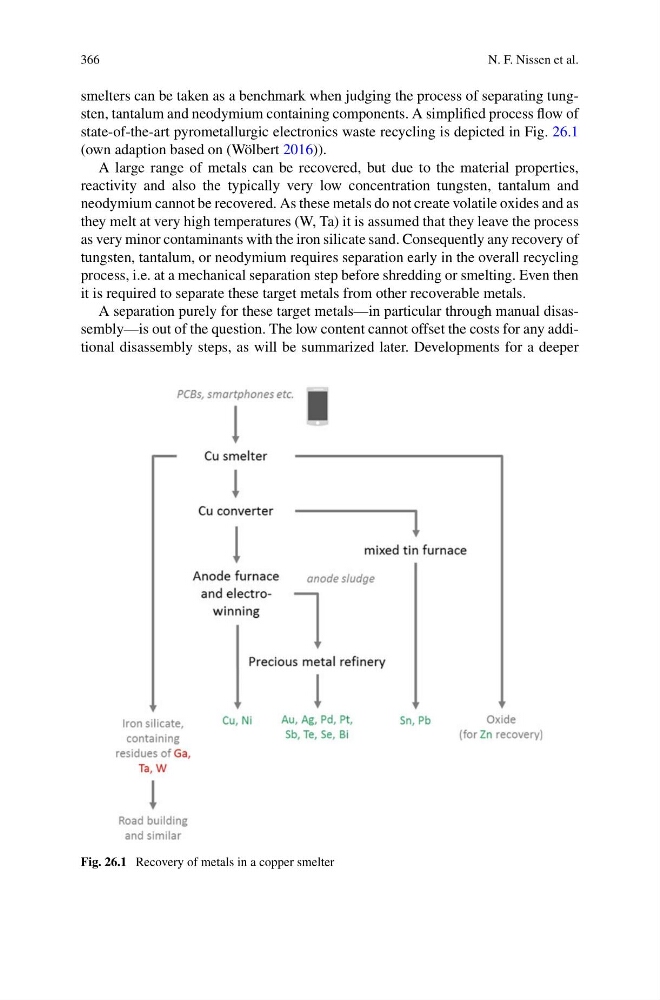
smelters can be taken as a benchmark when judging the process of separating tungsten, tantalum and neodymium containing components. A simplified process flow of
state-of-the-art pyrometallurgic electronics waste recycling is depicted in Fig. 26.1
(own adaption based on (Wölbert 2016)).
A large range of metals can be recovered, but due to the material properties,
reactivity and also the typically very low concentration tungsten, tantalum and
neodymium cannot be recovered. As these metals do not create volatile oxides and as
they melt at very high temperatures (W, Ta) it is assumed that they leave the process
as very minor contaminants with the iron silicate sand. Consequently any recovery of
tungsten, tantalum, or neodymium requires separation early in the overall recycling
process, i.e. at a mechanical separation step before shredding or smelting. Even then
it is required to separate these target metals from other recoverable metals.
A separation purely for these target metals—in particular through manual disassembly—is out of the question. The low content cannot offset the costs for any additional disassembly steps, as will be summarized later. Developments for a deeper
Fig. 26.1 Recovery of metals in a copper smelter
N. F. Nissen et al.
smelters can be taken as a benchmark when judging the process of separating tungsten, tantalum and neodymium containing components. A simplified process flow of
state-of-the-art pyrometallurgic electronics waste recycling is depicted in Fig. 26.1
(own adaption based on (Wölbert 2016)).
A large range of metals can be recovered, but due to the material properties,
reactivity and also the typically very low concentration tungsten, tantalum and
neodymium cannot be recovered. As these metals do not create volatile oxides and as
they melt at very high temperatures (W, Ta) it is assumed that they leave the process
as very minor contaminants with the iron silicate sand. Consequently any recovery of
tungsten, tantalum, or neodymium requires separation early in the overall recycling
process, i.e. at a mechanical separation step before shredding or smelting. Even then
it is required to separate these target metals from other recoverable metals.
A separation purely for these target metals—in particular through manual disassembly—is out of the question. The low content cannot offset the costs for any additional disassembly steps, as will be summarized later. Developments for a deeper
Fig. 26.1 Recovery of metals in a copper smelter