

346
T. Sugahara et al.
When a part agent proposes replacement, the user replaces the part with one of
the parts on the market. Using this method, replacements occur by selling the parts
owned by the user and buying the parts on the market.
The buying price and selling price are determined by the market according to the
part condition, and the transaction is carried out. The parts purchased by the market
are stored in the market and are candidates for buying during the next transaction.
If the performance of a part drops below a certain level, and the subsequent use
is hindered, repair is performed, and the selling price increases based on the amount
of the repair.
24.4.2 Reuse Between Users
When the user cannot find the desired part in the market, or when there is no used
market near the user, reuse between neighboring inhabitants may be carried out.
Yamamori et al. (Yamamori et al. 2015) developed a simulation system that
supports reuse of consumers using a part agent system to promote reuse of the used
parts.
When a part agent proposes reuse between users, the part agent selects an
appropriate partner to promote reuse.
The procedure from the suggestion of reuse by the part agent system to the
transaction is as follows:
(1) Propose reuse
The part agent that manages the information regarding the part proposes reuse
to the user.
(2) Calculate the degree of satisfaction (DoS)
Part agents are divided into sellers and buyers. Once they are separated, DoS
is defined as an indicator for each user to decide who to address. Each agent
performs calculation of the DoS for the part agents in the opposite position.
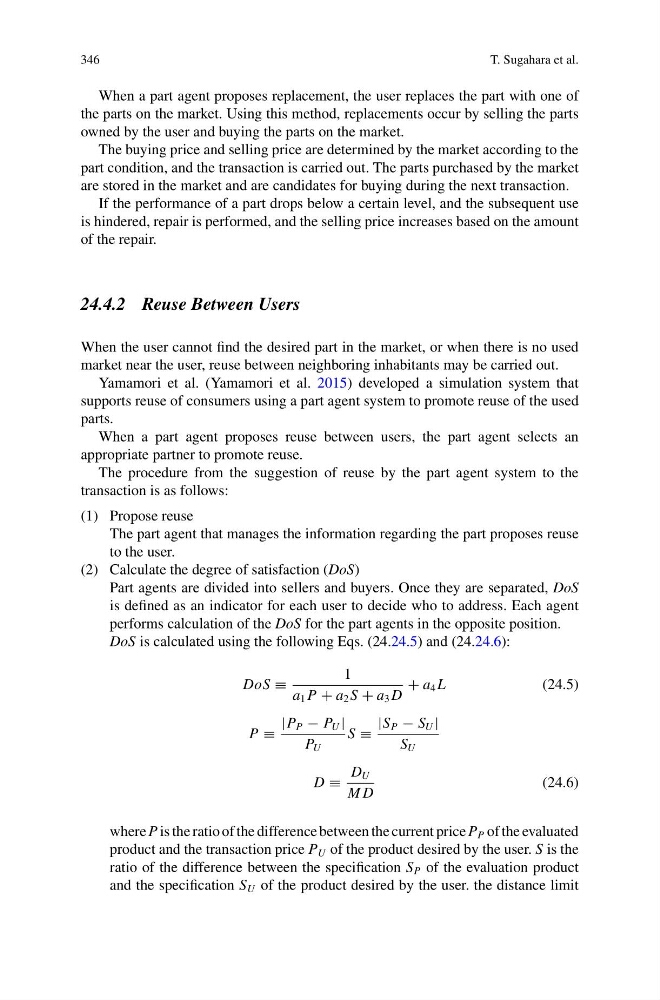
DoS is calculated using the following Eqs. (24.24.5) and (24.24.6):
DoS ≡
1
a 1 P + a 2 S + a 3 D
+ a 4 L
(24.5)
P ≡
|P P − P U |
P U
S ≡
|S P − S U |
S U
D ≡
D U
M D
(24.6)
where P is the ratio of the difference between the current price P P of the evaluated
product and the transaction price P U of the product desired by the user. S is the
ratio of the difference between the specification S P of the evaluation product
and the specification S U of the product desired by the user. the distance limit
T. Sugahara et al.
When a part agent proposes replacement, the user replaces the part with one of
the parts on the market. Using this method, replacements occur by selling the parts
owned by the user and buying the parts on the market.
The buying price and selling price are determined by the market according to the
part condition, and the transaction is carried out. The parts purchased by the market
are stored in the market and are candidates for buying during the next transaction.
If the performance of a part drops below a certain level, and the subsequent use
is hindered, repair is performed, and the selling price increases based on the amount
of the repair.
24.4.2 Reuse Between Users
When the user cannot find the desired part in the market, or when there is no used
market near the user, reuse between neighboring inhabitants may be carried out.
Yamamori et al. (Yamamori et al. 2015) developed a simulation system that
supports reuse of consumers using a part agent system to promote reuse of the used
parts.
When a part agent proposes reuse between users, the part agent selects an
appropriate partner to promote reuse.
The procedure from the suggestion of reuse by the part agent system to the
transaction is as follows:
(1) Propose reuse
The part agent that manages the information regarding the part proposes reuse
to the user.
(2) Calculate the degree of satisfaction (DoS)
Part agents are divided into sellers and buyers. Once they are separated, DoS
is defined as an indicator for each user to decide who to address. Each agent
performs calculation of the DoS for the part agents in the opposite position.
DoS is calculated using the following Eqs. (24.24.5) and (24.24.6):
DoS ≡
1
a 1 P + a 2 S + a 3 D
+ a 4 L
(24.5)
P ≡
|P P − P U |
P U
S ≡
|S P − S U |
S U
D ≡
D U
M D
(24.6)
where P is the ratio of the difference between the current price P P of the evaluated
product and the transaction price P U of the product desired by the user. S is the
ratio of the difference between the specification S P of the evaluation product
and the specification S U of the product desired by the user. the distance limit