

23 Application of Causality Model to Propose Maintenance …
335
of the parts. A route connected by a path is defined as a “route,” and the next stage
is evaluated by calculating the expected values of all routes existing ahead of the
next stage. From right to left, the table presents the values of each stage from the
end of the expanded life cycle and the procedure for aggregating the probabilities of
the paths connected to that stage for each route. The expected value for each route
is obtained by multiplying the sum of the values of the stages in the route by the
probability of the path.
It is necessary to give the probability of the path based on the situation for each of
the assumed next stages, and the failure probability affects the value. Therefore, in
this study, the stage to be advanced is decided by incorporating the failure probability
estimated in Sect. 23.6 as an equation for obtaining the probability of the path.
23.8 Example: A Simple Manipulator
As an example, a method for determining the maintenance action by estimating
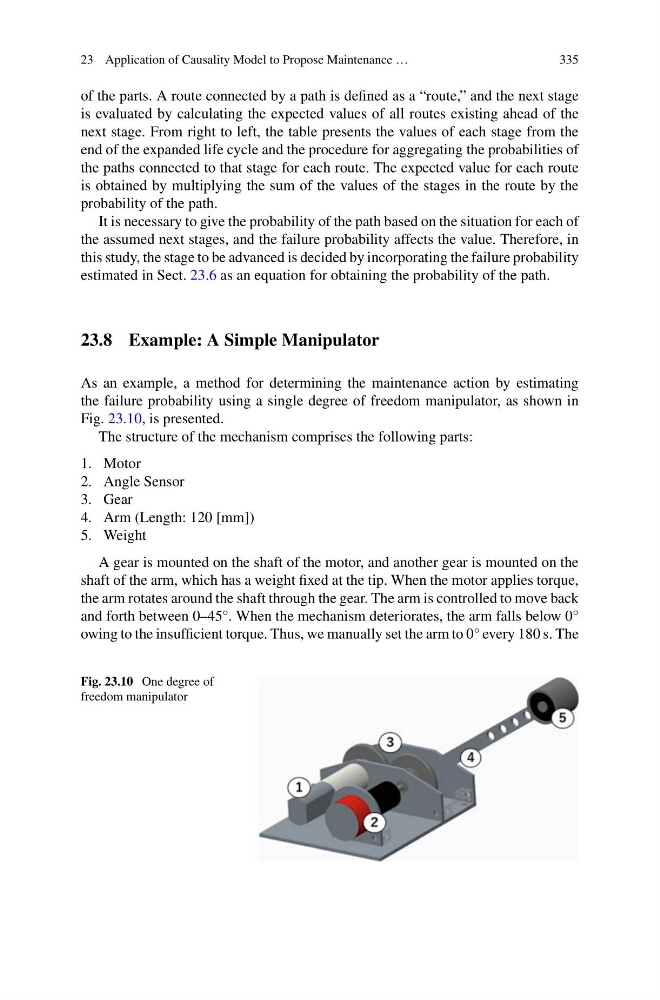
the failure probability using a single degree of freedom manipulator, as shown in
Fig. 23.10, is presented.
The structure of the mechanism comprises the following parts:
1. Motor
2. Angle Sensor
3. Gear
4. Arm (Length: 120 [mm])
5. Weight
A gear is mounted on the shaft of the motor, and another gear is mounted on the
shaft of the arm, which has a weight fixed at the tip. When the motor applies torque,
the arm rotates around the shaft through the gear. The arm is controlled to move back
and forth between 0–45°. When the mechanism deteriorates, the arm falls below 0°
owing to the insufficient torque. Thus, we manually set the arm to 0° every 180 s. The
Fig. 23.10 One degree of
freedom manipulator
335
of the parts. A route connected by a path is defined as a “route,” and the next stage
is evaluated by calculating the expected values of all routes existing ahead of the
next stage. From right to left, the table presents the values of each stage from the
end of the expanded life cycle and the procedure for aggregating the probabilities of
the paths connected to that stage for each route. The expected value for each route
is obtained by multiplying the sum of the values of the stages in the route by the
probability of the path.
It is necessary to give the probability of the path based on the situation for each of
the assumed next stages, and the failure probability affects the value. Therefore, in
this study, the stage to be advanced is decided by incorporating the failure probability
estimated in Sect. 23.6 as an equation for obtaining the probability of the path.
23.8 Example: A Simple Manipulator
As an example, a method for determining the maintenance action by estimating
the failure probability using a single degree of freedom manipulator, as shown in
Fig. 23.10, is presented.
The structure of the mechanism comprises the following parts:
1. Motor
2. Angle Sensor
3. Gear
4. Arm (Length: 120 [mm])
5. Weight
A gear is mounted on the shaft of the motor, and another gear is mounted on the
shaft of the arm, which has a weight fixed at the tip. When the motor applies torque,
the arm rotates around the shaft through the gear. The arm is controlled to move back
and forth between 0–45°. When the mechanism deteriorates, the arm falls below 0°
owing to the insufficient torque. Thus, we manually set the arm to 0° every 180 s. The
Fig. 23.10 One degree of
freedom manipulator