

282
Y. Fukazawa et al.
in order to reuse parts efficiently, it is necessary to save and utilize part operation
histories and deterioration information, and to propose appropriate actions according
to the state of the parts.
For this purpose, we develop a part agent (Tanaka and Hiraoka 2009) that manages
the information of each part over the entire life cycle using network agent technology.
Parts are managed by associating them with part agents using RFID (radio-frequency
identification) tags (Borriello 2005). A part agents have a function to predict deterioration based on the operation history and the deterioration information of parts, and
to replace them appropriately to reuse machine parts efficiently. In order to clarify
the problems and the effects of the function, we developed manipulators using part
agents and carried out an experiment to replace their modules for the reuse.
In this paper, we propose a method to exchange modules of manipulators using
part agents, and discuss issues involved in the module-exchange experiment.
20.2 Basic Concept of Module Exchange
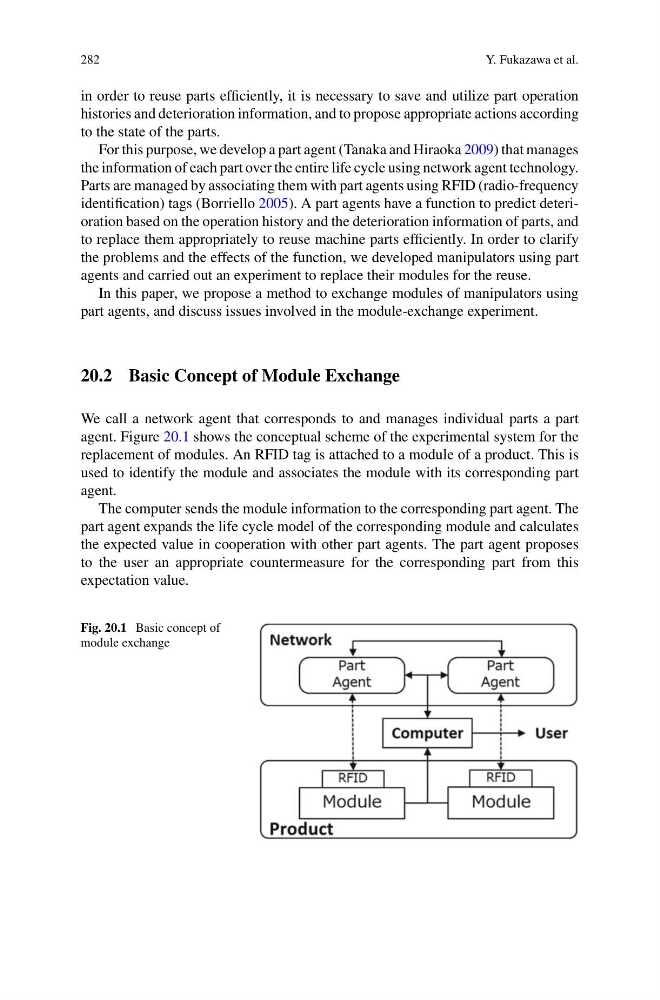
We call a network agent that corresponds to and manages individual parts a part
agent. Figure 20.1 shows the conceptual scheme of the experimental system for the
replacement of modules. An RFID tag is attached to a module of a product. This is
used to identify the module and associates the module with its corresponding part
agent.
The computer sends the module information to the corresponding part agent. The
part agent expands the life cycle model of the corresponding module and calculates
the expected value in cooperation with other part agents. The part agent proposes
to the user an appropriate countermeasure for the corresponding part from this
expectation value.
Fig. 20.1 Basic concept of
module exchange
Y. Fukazawa et al.
in order to reuse parts efficiently, it is necessary to save and utilize part operation
histories and deterioration information, and to propose appropriate actions according
to the state of the parts.
For this purpose, we develop a part agent (Tanaka and Hiraoka 2009) that manages
the information of each part over the entire life cycle using network agent technology.
Parts are managed by associating them with part agents using RFID (radio-frequency
identification) tags (Borriello 2005). A part agents have a function to predict deterioration based on the operation history and the deterioration information of parts, and
to replace them appropriately to reuse machine parts efficiently. In order to clarify
the problems and the effects of the function, we developed manipulators using part
agents and carried out an experiment to replace their modules for the reuse.
In this paper, we propose a method to exchange modules of manipulators using
part agents, and discuss issues involved in the module-exchange experiment.
20.2 Basic Concept of Module Exchange
We call a network agent that corresponds to and manages individual parts a part
agent. Figure 20.1 shows the conceptual scheme of the experimental system for the
replacement of modules. An RFID tag is attached to a module of a product. This is
used to identify the module and associates the module with its corresponding part
agent.
The computer sends the module information to the corresponding part agent. The
part agent expands the life cycle model of the corresponding module and calculates
the expected value in cooperation with other part agents. The part agent proposes
to the user an appropriate countermeasure for the corresponding part from this
expectation value.
Fig. 20.1 Basic concept of
module exchange