

272
K. Asai et al.
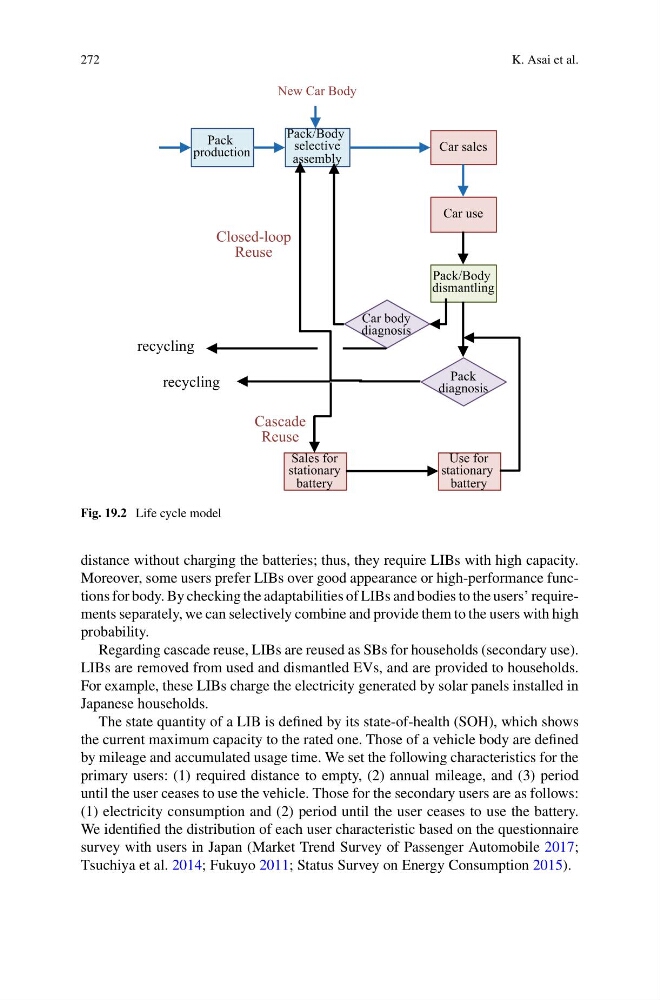
Fig. 19.2 Life cycle model
distance without charging the batteries; thus, they require LIBs with high capacity.
Moreover, some users prefer LIBs over good appearance or high-performance functions for body. By checking the adaptabilities of LIBs and bodies to the users’ requirements separately, we can selectively combine and provide them to the users with high
probability.
Regarding cascade reuse, LIBs are reused as SBs for households (secondary use).
LIBs are removed from used and dismantled EVs, and are provided to households.
For example, these LIBs charge the electricity generated by solar panels installed in
Japanese households.
The state quantity of a LIB is defined by its state-of-health (SOH), which shows
the current maximum capacity to the rated one. Those of a vehicle body are defined
by mileage and accumulated usage time. We set the following characteristics for the
primary users: (1) required distance to empty, (2) annual mileage, and (3) period
until the user ceases to use the vehicle. Those for the secondary users are as follows:
(1) electricity consumption and (2) period until the user ceases to use the battery.
We identified the distribution of each user characteristic based on the questionnaire
survey with users in Japan (Market Trend Survey of Passenger Automobile 2017;
Tsuchiya et al. 2014; Fukuyo 2011; Status Survey on Energy Consumption 2015).
K. Asai et al.
Fig. 19.2 Life cycle model
distance without charging the batteries; thus, they require LIBs with high capacity.
Moreover, some users prefer LIBs over good appearance or high-performance functions for body. By checking the adaptabilities of LIBs and bodies to the users’ requirements separately, we can selectively combine and provide them to the users with high
probability.
Regarding cascade reuse, LIBs are reused as SBs for households (secondary use).
LIBs are removed from used and dismantled EVs, and are provided to households.
For example, these LIBs charge the electricity generated by solar panels installed in
Japanese households.
The state quantity of a LIB is defined by its state-of-health (SOH), which shows
the current maximum capacity to the rated one. Those of a vehicle body are defined
by mileage and accumulated usage time. We set the following characteristics for the
primary users: (1) required distance to empty, (2) annual mileage, and (3) period
until the user ceases to use the vehicle. Those for the secondary users are as follows:
(1) electricity consumption and (2) period until the user ceases to use the battery.
We identified the distribution of each user characteristic based on the questionnaire
survey with users in Japan (Market Trend Survey of Passenger Automobile 2017;
Tsuchiya et al. 2014; Fukuyo 2011; Status Survey on Energy Consumption 2015).