

19 Life Cycle Simulation System as a Tool for Improving …
267
However, in circular manufacturing, it is difficult to control the supply because
the supply is determined by the timing of termination of usage, which is on user’s
discretion. To identify the problems more explicitly in circular manufacturing, we
explain them by taking an example of reuse, which is an important life cycle option
for realizing circular manufacturing.
Reuse is one of the methods to circulate resources and improve utilization rate of
life span. By matching the requirements of users and the realized functions of items,
the items are used repeatedly with several users or methods of use. There are two
main problems in performing reuse efficiently in circular manufacturing.
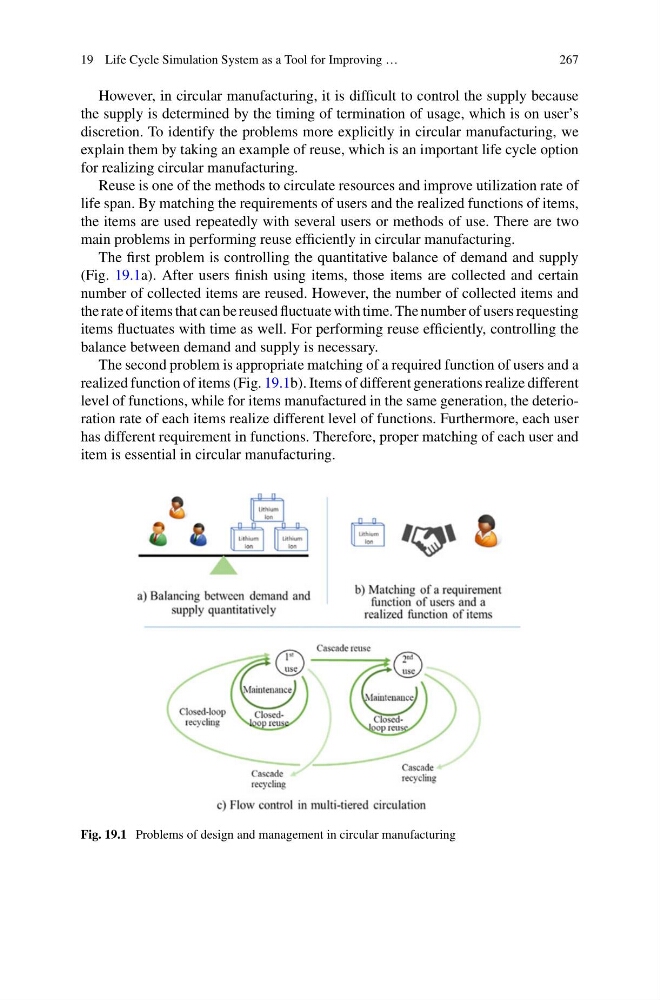
The first problem is controlling the quantitative balance of demand and supply
(Fig. 19.1a). After users finish using items, those items are collected and certain
number of collected items are reused. However, the number of collected items and
the rate of items that can be reused fluctuate with time. The number of users requesting
items fluctuates with time as well. For performing reuse efficiently, controlling the
balance between demand and supply is necessary.
The second problem is appropriate matching of a required function of users and a
realized function of items (Fig. 19.1b). Items of different generations realize different
level of functions, while for items manufactured in the same generation, the deterioration rate of each items realize different level of functions. Furthermore, each user
has different requirement in functions. Therefore, proper matching of each user and
item is essential in circular manufacturing.
Fig. 19.1 Problems of design and management in circular manufacturing
267
However, in circular manufacturing, it is difficult to control the supply because
the supply is determined by the timing of termination of usage, which is on user’s
discretion. To identify the problems more explicitly in circular manufacturing, we
explain them by taking an example of reuse, which is an important life cycle option
for realizing circular manufacturing.
Reuse is one of the methods to circulate resources and improve utilization rate of
life span. By matching the requirements of users and the realized functions of items,
the items are used repeatedly with several users or methods of use. There are two
main problems in performing reuse efficiently in circular manufacturing.
The first problem is controlling the quantitative balance of demand and supply
(Fig. 19.1a). After users finish using items, those items are collected and certain
number of collected items are reused. However, the number of collected items and
the rate of items that can be reused fluctuate with time. The number of users requesting
items fluctuates with time as well. For performing reuse efficiently, controlling the
balance between demand and supply is necessary.
The second problem is appropriate matching of a required function of users and a
realized function of items (Fig. 19.1b). Items of different generations realize different
level of functions, while for items manufactured in the same generation, the deterioration rate of each items realize different level of functions. Furthermore, each user
has different requirement in functions. Therefore, proper matching of each user and
item is essential in circular manufacturing.
Fig. 19.1 Problems of design and management in circular manufacturing