

252
X. Chen et al.
The literature shows that digital technologies can reduce the environmental impact
along the manufacturing value chain. The case study presented in this paper focuses
on how digital technologies support sustainability performance in practice.
18.3 Methodology
Any case study finding or conclusion is likely to be more convincing and accurate
if it is based on several different sources of information, following a corroboratory mode (Yin 2009). In this case study, qualitative research method was applied.
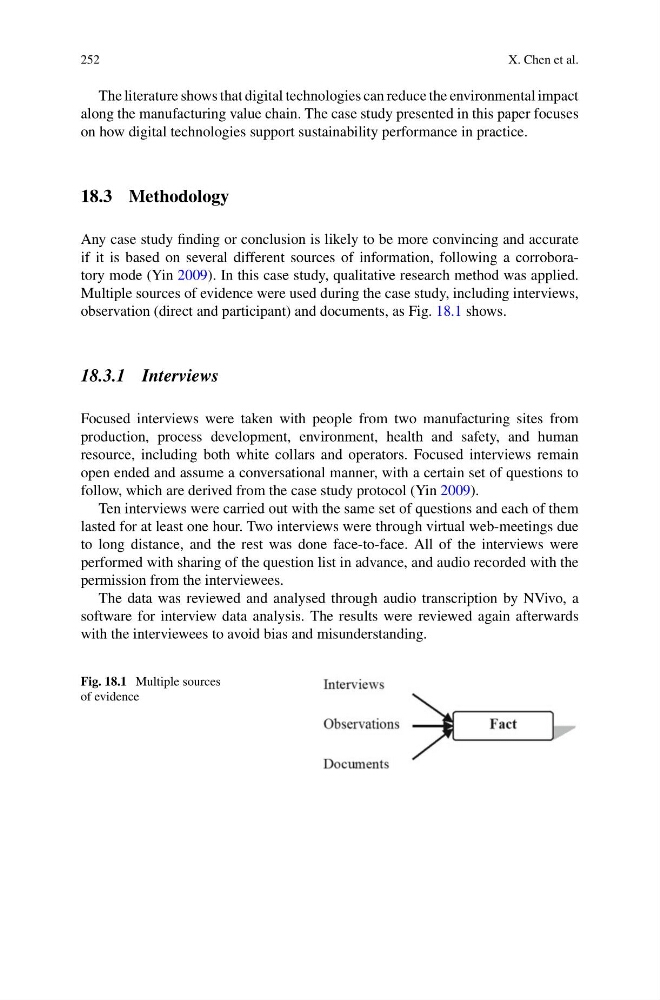
Multiple sources of evidence were used during the case study, including interviews,
observation (direct and participant) and documents, as Fig. 18.1 shows.
18.3.1 Interviews
Focused interviews were taken with people from two manufacturing sites from
production, process development, environment, health and safety, and human
resource, including both white collars and operators. Focused interviews remain
open ended and assume a conversational manner, with a certain set of questions to
follow, which are derived from the case study protocol (Yin 2009).
Ten interviews were carried out with the same set of questions and each of them
lasted for at least one hour. Two interviews were through virtual web-meetings due
to long distance, and the rest was done face-to-face. All of the interviews were
performed with sharing of the question list in advance, and audio recorded with the
permission from the interviewees.
The data was reviewed and analysed through audio transcription by NVivo, a
software for interview data analysis. The results were reviewed again afterwards
with the interviewees to avoid bias and misunderstanding.
Fig. 18.1 Multiple sources
of evidence
X. Chen et al.
The literature shows that digital technologies can reduce the environmental impact
along the manufacturing value chain. The case study presented in this paper focuses
on how digital technologies support sustainability performance in practice.
18.3 Methodology
Any case study finding or conclusion is likely to be more convincing and accurate
if it is based on several different sources of information, following a corroboratory mode (Yin 2009). In this case study, qualitative research method was applied.
Multiple sources of evidence were used during the case study, including interviews,
observation (direct and participant) and documents, as Fig. 18.1 shows.
18.3.1 Interviews
Focused interviews were taken with people from two manufacturing sites from
production, process development, environment, health and safety, and human
resource, including both white collars and operators. Focused interviews remain
open ended and assume a conversational manner, with a certain set of questions to
follow, which are derived from the case study protocol (Yin 2009).
Ten interviews were carried out with the same set of questions and each of them
lasted for at least one hour. Two interviews were through virtual web-meetings due
to long distance, and the rest was done face-to-face. All of the interviews were
performed with sharing of the question list in advance, and audio recorded with the
permission from the interviewees.
The data was reviewed and analysed through audio transcription by NVivo, a
software for interview data analysis. The results were reviewed again afterwards
with the interviewees to avoid bias and misunderstanding.
Fig. 18.1 Multiple sources
of evidence