

240
A. Chari et al.
empirical study for this research was to evaluate whether a business case existed for
the technology and in turn assess how successful firms such as these (who operate
within niches) can influence other industries to break the lock-ins of established
technologies and gain momentum towards adopting newer, cleaner technologies.
Such radical technologies also have the potential to make industries in the textile
industry domain to gradually phase out from being material- and energy-dependent
(Stubbs and Cocklin 2008; Hart and Milstein 2003).
17.3.2 Data Collection
To deliver the results from the case study of the project, the paper adopted a qualitative
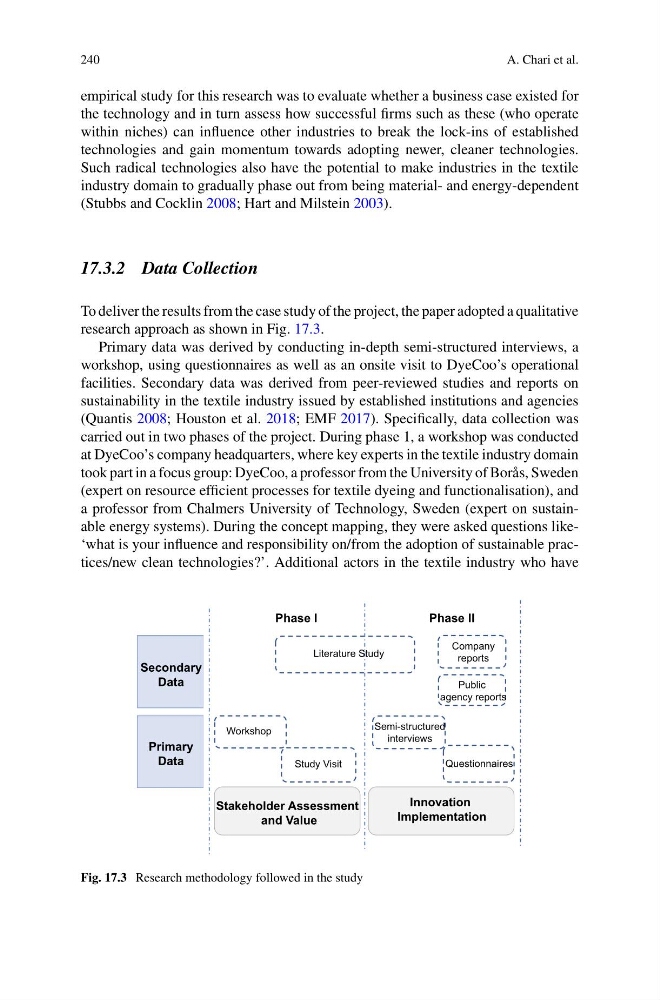
research approach as shown in Fig. 17.3.
Primary data was derived by conducting in-depth semi-structured interviews, a
workshop, using questionnaires as well as an onsite visit to DyeCoo’s operational
facilities. Secondary data was derived from peer-reviewed studies and reports on
sustainability in the textile industry issued by established institutions and agencies
(Quantis 2008; Houston et al. 2018; EMF 2017). Specifically, data collection was
carried out in two phases of the project. During phase 1, a workshop was conducted
at DyeCoo’s company headquarters, where key experts in the textile industry domain
took part in a focus group: DyeCoo, a professor from the University of Borås, Sweden
(expert on resource efficient processes for textile dyeing and functionalisation), and
a professor from Chalmers University of Technology, Sweden (expert on sustainable energy systems). During the concept mapping, they were asked questions like‘what is your influence and responsibility on/from the adoption of sustainable practices/new clean technologies?’. Additional actors in the textile industry who have
Stakeholder Assessment
and Value
Innovation
Implementation
Primary
Data
Secondary
Data
Phase I
Phase II
Workshop
Study Visit
Company
reports
Public
agency reports
Semi-structured
interviews
Questionnaires
Literature Study
Fig. 17.3 Research methodology followed in the study
A. Chari et al.
empirical study for this research was to evaluate whether a business case existed for
the technology and in turn assess how successful firms such as these (who operate
within niches) can influence other industries to break the lock-ins of established
technologies and gain momentum towards adopting newer, cleaner technologies.
Such radical technologies also have the potential to make industries in the textile
industry domain to gradually phase out from being material- and energy-dependent
(Stubbs and Cocklin 2008; Hart and Milstein 2003).
17.3.2 Data Collection
To deliver the results from the case study of the project, the paper adopted a qualitative
research approach as shown in Fig. 17.3.
Primary data was derived by conducting in-depth semi-structured interviews, a
workshop, using questionnaires as well as an onsite visit to DyeCoo’s operational
facilities. Secondary data was derived from peer-reviewed studies and reports on
sustainability in the textile industry issued by established institutions and agencies
(Quantis 2008; Houston et al. 2018; EMF 2017). Specifically, data collection was
carried out in two phases of the project. During phase 1, a workshop was conducted
at DyeCoo’s company headquarters, where key experts in the textile industry domain
took part in a focus group: DyeCoo, a professor from the University of Borås, Sweden
(expert on resource efficient processes for textile dyeing and functionalisation), and
a professor from Chalmers University of Technology, Sweden (expert on sustainable energy systems). During the concept mapping, they were asked questions like‘what is your influence and responsibility on/from the adoption of sustainable practices/new clean technologies?’. Additional actors in the textile industry who have
Stakeholder Assessment
and Value
Innovation
Implementation
Primary
Data
Secondary
Data
Phase I
Phase II
Workshop
Study Visit
Company
reports
Public
agency reports
Semi-structured
interviews
Questionnaires
Literature Study
Fig. 17.3 Research methodology followed in the study