

238
A. Chari et al.
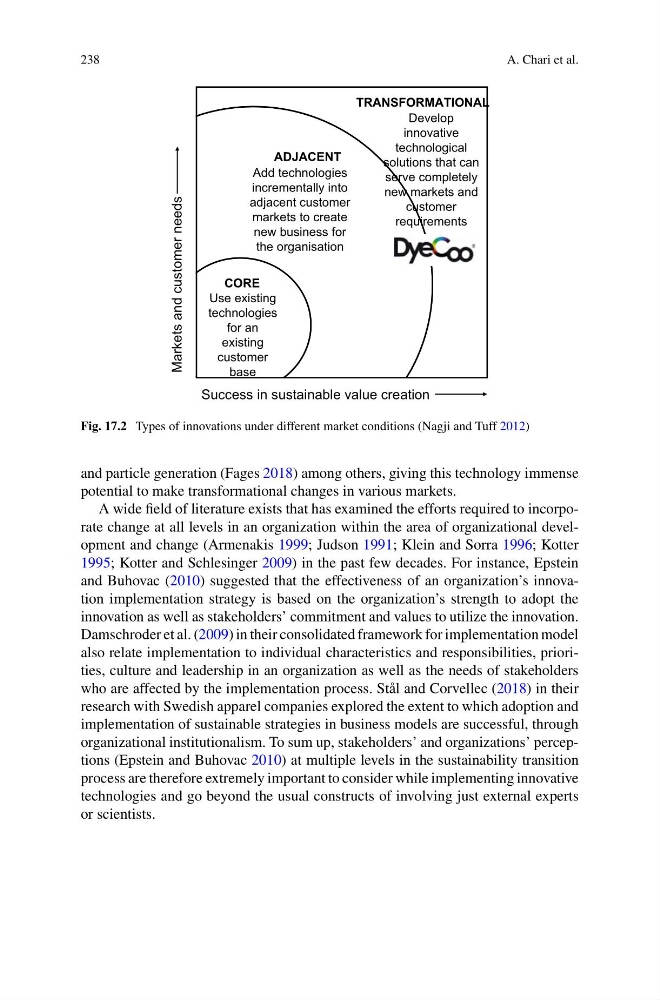
Success in sustainable value creation
Markets and customer needs
Use existing
technologies
for an
existing
customer
base
CORE
Add technologies
incrementally into
adjacent customer
markets to create
new business for
the organisation
ADJACENT
Develop
innovative
technological
solutions that can
serve completely
new markets and
customer
requirements
TRANSFORMATIONAL
Fig. 17.2 Types of innovations under different market conditions (Nagji and Tuff 2012)
and particle generation (Fages 2018) among others, giving this technology immense
potential to make transformational changes in various markets.
A wide field of literature exists that has examined the efforts required to incorporate change at all levels in an organization within the area of organizational development and change (Armenakis 1999; Judson 1991; Klein and Sorra 1996; Kotter
1995; Kotter and Schlesinger 2009) in the past few decades. For instance, Epstein
and Buhovac (2010) suggested that the effectiveness of an organization’s innovation implementation strategy is based on the organization’s strength to adopt the
innovation as well as stakeholders’ commitment and values to utilize the innovation.
Damschroder et al. (2009) in their consolidated framework for implementation model
also relate implementation to individual characteristics and responsibilities, priorities, culture and leadership in an organization as well as the needs of stakeholders
who are affected by the implementation process. Stål and Corvellec (2018) in their
research with Swedish apparel companies explored the extent to which adoption and
implementation of sustainable strategies in business models are successful, through
organizational institutionalism. To sum up, stakeholders’ and organizations’ perceptions (Epstein and Buhovac 2010) at multiple levels in the sustainability transition
process are therefore extremely important to consider while implementing innovative
technologies and go beyond the usual constructs of involving just external experts
or scientists.
A. Chari et al.
Success in sustainable value creation
Markets and customer needs
Use existing
technologies
for an
existing
customer
base
CORE
Add technologies
incrementally into
adjacent customer
markets to create
new business for
the organisation
ADJACENT
Develop
innovative
technological
solutions that can
serve completely
new markets and
customer
requirements
TRANSFORMATIONAL
Fig. 17.2 Types of innovations under different market conditions (Nagji and Tuff 2012)
and particle generation (Fages 2018) among others, giving this technology immense
potential to make transformational changes in various markets.
A wide field of literature exists that has examined the efforts required to incorporate change at all levels in an organization within the area of organizational development and change (Armenakis 1999; Judson 1991; Klein and Sorra 1996; Kotter
1995; Kotter and Schlesinger 2009) in the past few decades. For instance, Epstein
and Buhovac (2010) suggested that the effectiveness of an organization’s innovation implementation strategy is based on the organization’s strength to adopt the
innovation as well as stakeholders’ commitment and values to utilize the innovation.
Damschroder et al. (2009) in their consolidated framework for implementation model
also relate implementation to individual characteristics and responsibilities, priorities, culture and leadership in an organization as well as the needs of stakeholders
who are affected by the implementation process. Stål and Corvellec (2018) in their
research with Swedish apparel companies explored the extent to which adoption and
implementation of sustainable strategies in business models are successful, through
organizational institutionalism. To sum up, stakeholders’ and organizations’ perceptions (Epstein and Buhovac 2010) at multiple levels in the sustainability transition
process are therefore extremely important to consider while implementing innovative
technologies and go beyond the usual constructs of involving just external experts
or scientists.