

16 Production Planning of Remanufactured Products with Inventory …
223
holding cost for the collected products which means the cost when one collected
product is stocked for a unit time in the collected product inventory, and I C (·) is the
number of products in the collected product inventory.
16.3 Influence of System Parameters on Optimal
Production Plan for New Manufacture
When new manufacture is applied as the lot production, the optimal number of
ordering for new manufacture changes depending on demand λ(t), collecting quantity
γ (t), an ordering cost for new manufacture K M , and an inventory holding cost for
the finished products h F . Therefore, the influence of these parameters on the optimal
number of orders is investigated in this section.
16.3.1 LCS Conditions
Concentrating on the optimal production plan of the newly manufactured products,
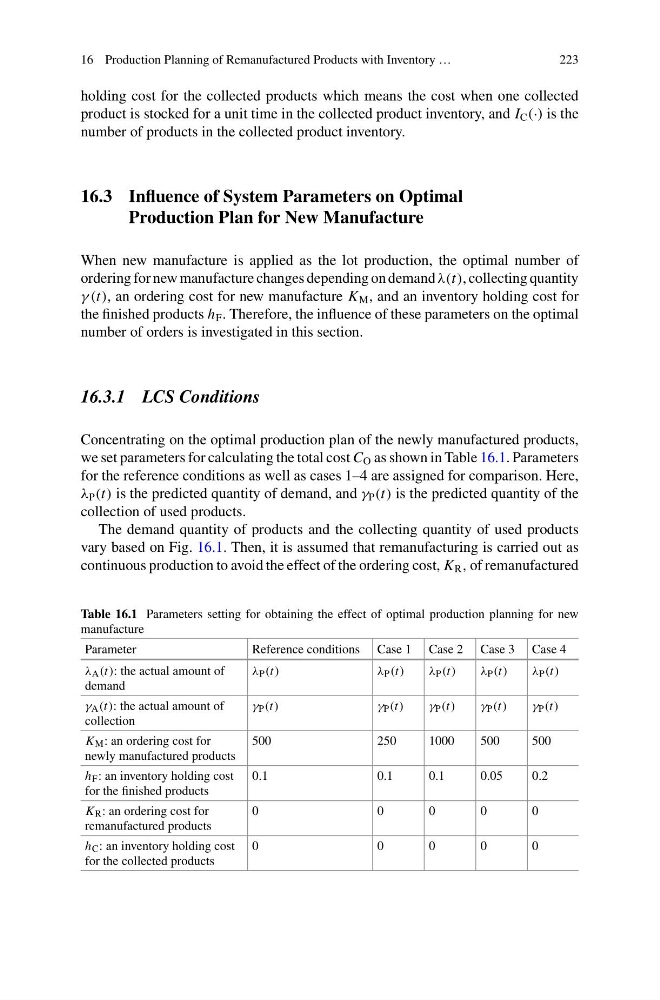
we set parameters for calculating the total cost C O as shown in Table 16.1. Parameters
for the reference conditions as well as cases 1–4 are assigned for comparison. Here,
λ P (t) is the predicted quantity of demand, and γ P (t) is the predicted quantity of the
collection of used products.
The demand quantity of products and the collecting quantity of used products
vary based on Fig. 16.1. Then, it is assumed that remanufacturing is carried out as
continuous production to avoid the effect of the ordering cost, K R , of remanufactured
Table 16.1 Parameters setting for obtaining the effect of optimal production planning for new
manufacture
Parameter
Reference conditions Case 1 Case 2 Case 3 Case 4
λ A (t): the actual amount of
demand
λ P (t)
λ P (t)
λ P (t)
λ P (t)
λ P (t)
γ A (t): the actual amount of
collection
γ P (t)
γ P (t)
γ P (t)
γ P (t)
γ P (t)
K M : an ordering cost for
newly manufactured products
500
250
1000
500
500
h F : an inventory holding cost
for the finished products
0.1
0.1
0.1
0.05
0.2
K R : an ordering cost for
remanufactured products
0
0
0
0
0
h C : an inventory holding cost
for the collected products
0
0
0
0
0
223
holding cost for the collected products which means the cost when one collected
product is stocked for a unit time in the collected product inventory, and I C (·) is the
number of products in the collected product inventory.
16.3 Influence of System Parameters on Optimal
Production Plan for New Manufacture
When new manufacture is applied as the lot production, the optimal number of
ordering for new manufacture changes depending on demand λ(t), collecting quantity
γ (t), an ordering cost for new manufacture K M , and an inventory holding cost for
the finished products h F . Therefore, the influence of these parameters on the optimal
number of orders is investigated in this section.
16.3.1 LCS Conditions
Concentrating on the optimal production plan of the newly manufactured products,
we set parameters for calculating the total cost C O as shown in Table 16.1. Parameters
for the reference conditions as well as cases 1–4 are assigned for comparison. Here,
λ P (t) is the predicted quantity of demand, and γ P (t) is the predicted quantity of the
collection of used products.
The demand quantity of products and the collecting quantity of used products
vary based on Fig. 16.1. Then, it is assumed that remanufacturing is carried out as
continuous production to avoid the effect of the ordering cost, K R , of remanufactured
Table 16.1 Parameters setting for obtaining the effect of optimal production planning for new
manufacture
Parameter
Reference conditions Case 1 Case 2 Case 3 Case 4
λ A (t): the actual amount of
demand
λ P (t)
λ P (t)
λ P (t)
λ P (t)
λ P (t)
γ A (t): the actual amount of
collection
γ P (t)
γ P (t)
γ P (t)
γ P (t)
γ P (t)
K M : an ordering cost for
newly manufactured products
500
250
1000
500
500
h F : an inventory holding cost
for the finished products
0.1
0.1
0.1
0.05
0.2
K R : an ordering cost for
remanufactured products
0
0
0
0
0
h C : an inventory holding cost
for the collected products
0
0
0
0
0