

1 Industrial Designers Towards Design Concepts …
11
Table 1.6 Basic sustainable dimensions of product design concepts based on the water and fire
themes
Sustainability dimensions
Water (%)
Fire (%)
1.Social
8.9
37.0
2.Cultural
10.1
37.0
3.Environmental
81.1
25.9
Total
100
100
Analyzing basic phases of ecodesign strategies in relation to the total percent
item (T%) of water theme in Table 1.5, industrial designers gave attention on
the new concepts, in order to explore new solutions in relation with the theme
water (75.2%), the selection-of-material phase by minimizing materials (9.1%) was
designers’ second approach, in which they simplified their designs to reduce the
number of parts and facilitate their assembly and disassembly.
Regarding the use phase, the item ease of maintenance and cleaner energy
consumption were the most important aspects designers considered (details in
Table 1.1).
In the end-of-life phase, designers considered only the element not emit waste
and toxic substances, demonstrating basic knowledge and concern about the lifecycle principle. However, industrial designers did not pay attention to production
phase (2.2%), that might have been integrated into their design concepts, such as
renewable materials, recycled materials, ease of repair, low energy consumption,
ease of disposal, cleaner disposal, reuse of product, or recycling materials.
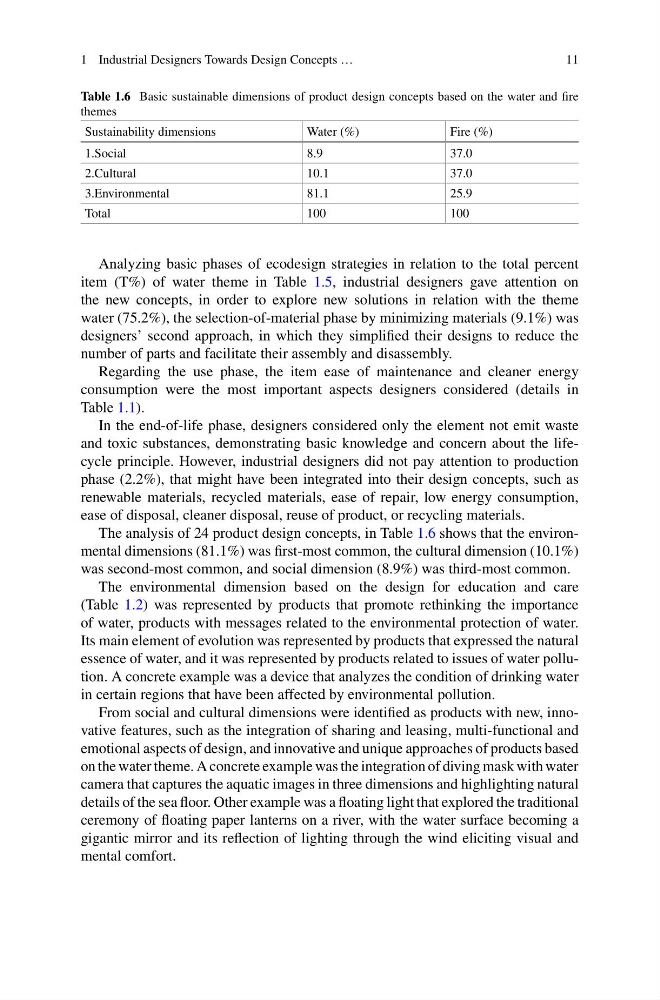
The analysis of 24 product design concepts, in Table 1.6 shows that the environmental dimensions (81.1%) was first-most common, the cultural dimension (10.1%)
was second-most common, and social dimension (8.9%) was third-most common.
The environmental dimension based on the design for education and care
(Table 1.2) was represented by products that promote rethinking the importance
of water, products with messages related to the environmental protection of water.
Its main element of evolution was represented by products that expressed the natural
essence of water, and it was represented by products related to issues of water pollution. A concrete example was a device that analyzes the condition of drinking water
in certain regions that have been affected by environmental pollution.
From social and cultural dimensions were identified as products with new, innovative features, such as the integration of sharing and leasing, multi-functional and
emotional aspects of design, and innovative and unique approaches of products based
on the water theme. A concrete example was the integration of diving mask with water
camera that captures the aquatic images in three dimensions and highlighting natural
details of the sea floor. Other example was a floating light that explored the traditional
ceremony of floating paper lanterns on a river, with the water surface becoming a
gigantic mirror and its reflection of lighting through the wind eliciting visual and
mental comfort.
11
Table 1.6 Basic sustainable dimensions of product design concepts based on the water and fire
themes
Sustainability dimensions
Water (%)
Fire (%)
1.Social
8.9
37.0
2.Cultural
10.1
37.0
3.Environmental
81.1
25.9
Total
100
100
Analyzing basic phases of ecodesign strategies in relation to the total percent
item (T%) of water theme in Table 1.5, industrial designers gave attention on
the new concepts, in order to explore new solutions in relation with the theme
water (75.2%), the selection-of-material phase by minimizing materials (9.1%) was
designers’ second approach, in which they simplified their designs to reduce the
number of parts and facilitate their assembly and disassembly.
Regarding the use phase, the item ease of maintenance and cleaner energy
consumption were the most important aspects designers considered (details in
Table 1.1).
In the end-of-life phase, designers considered only the element not emit waste
and toxic substances, demonstrating basic knowledge and concern about the lifecycle principle. However, industrial designers did not pay attention to production
phase (2.2%), that might have been integrated into their design concepts, such as
renewable materials, recycled materials, ease of repair, low energy consumption,
ease of disposal, cleaner disposal, reuse of product, or recycling materials.
The analysis of 24 product design concepts, in Table 1.6 shows that the environmental dimensions (81.1%) was first-most common, the cultural dimension (10.1%)
was second-most common, and social dimension (8.9%) was third-most common.
The environmental dimension based on the design for education and care
(Table 1.2) was represented by products that promote rethinking the importance
of water, products with messages related to the environmental protection of water.
Its main element of evolution was represented by products that expressed the natural
essence of water, and it was represented by products related to issues of water pollution. A concrete example was a device that analyzes the condition of drinking water
in certain regions that have been affected by environmental pollution.
From social and cultural dimensions were identified as products with new, innovative features, such as the integration of sharing and leasing, multi-functional and
emotional aspects of design, and innovative and unique approaches of products based
on the water theme. A concrete example was the integration of diving mask with water
camera that captures the aquatic images in three dimensions and highlighting natural
details of the sea floor. Other example was a floating light that explored the traditional
ceremony of floating paper lanterns on a river, with the water surface becoming a
gigantic mirror and its reflection of lighting through the wind eliciting visual and
mental comfort.