

14 Ecodesign and the Circular Economy: Conflicting …
193
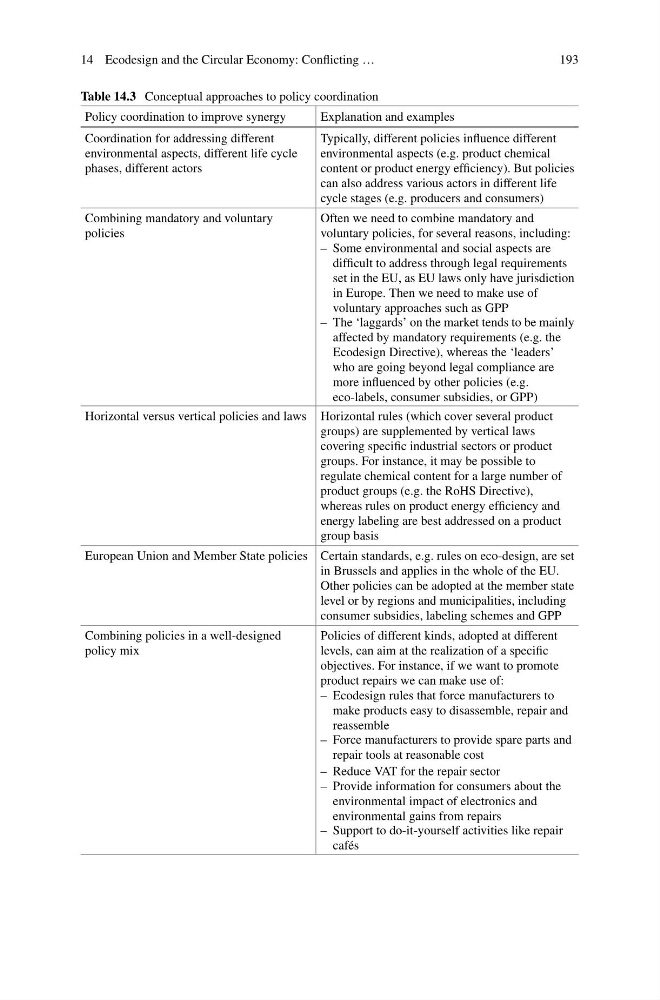
Table 14.3 Conceptual approaches to policy coordination
Policy coordination to improve synergy
Explanation and examples
Coordination for addressing different
environmental aspects, different life cycle
phases, different actors
Typically, different policies influence different
environmental aspects (e.g. product chemical
content or product energy efficiency). But policies
can also address various actors in different life
cycle stages (e.g. producers and consumers)
Combining mandatory and voluntary
policies
Often we need to combine mandatory and
voluntary policies, for several reasons, including:
– Some environmental and social aspects are
difficult to address through legal requirements
set in the EU, as EU laws only have jurisdiction
in Europe. Then we need to make use of
voluntary approaches such as GPP
– The ‘laggards’ on the market tends to be mainly
affected by mandatory requirements (e.g. the
Ecodesign Directive), whereas the ‘leaders’
who are going beyond legal compliance are
more influenced by other policies (e.g.
eco-labels, consumer subsidies, or GPP)
Horizontal versus vertical policies and laws Horizontal rules (which cover several product
groups) are supplemented by vertical laws
covering specific industrial sectors or product
groups. For instance, it may be possible to
regulate chemical content for a large number of
product groups (e.g. the RoHS Directive),
whereas rules on product energy efficiency and
energy labeling are best addressed on a product
group basis
European Union and Member State policies Certain standards, e.g. rules on eco-design, are set
in Brussels and applies in the whole of the EU.
Other policies can be adopted at the member state
level or by regions and municipalities, including
consumer subsidies, labeling schemes and GPP
Combining policies in a well-designed
policy mix
Policies of different kinds, adopted at different
levels, can aim at the realization of a specific
objectives. For instance, if we want to promote
product repairs we can make use of:
– Ecodesign rules that force manufacturers to
make products easy to disassemble, repair and
reassemble
– Force manufacturers to provide spare parts and
repair tools at reasonable cost
– Reduce VAT for the repair sector
– Provide information for consumers about the
environmental impact of electronics and
environmental gains from repairs
– Support to do-it-yourself activities like repair
cafés
193
Table 14.3 Conceptual approaches to policy coordination
Policy coordination to improve synergy
Explanation and examples
Coordination for addressing different
environmental aspects, different life cycle
phases, different actors
Typically, different policies influence different
environmental aspects (e.g. product chemical
content or product energy efficiency). But policies
can also address various actors in different life
cycle stages (e.g. producers and consumers)
Combining mandatory and voluntary
policies
Often we need to combine mandatory and
voluntary policies, for several reasons, including:
– Some environmental and social aspects are
difficult to address through legal requirements
set in the EU, as EU laws only have jurisdiction
in Europe. Then we need to make use of
voluntary approaches such as GPP
– The ‘laggards’ on the market tends to be mainly
affected by mandatory requirements (e.g. the
Ecodesign Directive), whereas the ‘leaders’
who are going beyond legal compliance are
more influenced by other policies (e.g.
eco-labels, consumer subsidies, or GPP)
Horizontal versus vertical policies and laws Horizontal rules (which cover several product
groups) are supplemented by vertical laws
covering specific industrial sectors or product
groups. For instance, it may be possible to
regulate chemical content for a large number of
product groups (e.g. the RoHS Directive),
whereas rules on product energy efficiency and
energy labeling are best addressed on a product
group basis
European Union and Member State policies Certain standards, e.g. rules on eco-design, are set
in Brussels and applies in the whole of the EU.
Other policies can be adopted at the member state
level or by regions and municipalities, including
consumer subsidies, labeling schemes and GPP
Combining policies in a well-designed
policy mix
Policies of different kinds, adopted at different
levels, can aim at the realization of a specific
objectives. For instance, if we want to promote
product repairs we can make use of:
– Ecodesign rules that force manufacturers to
make products easy to disassemble, repair and
reassemble
– Force manufacturers to provide spare parts and
repair tools at reasonable cost
– Reduce VAT for the repair sector
– Provide information for consumers about the
environmental impact of electronics and
environmental gains from repairs
– Support to do-it-yourself activities like repair
cafés