

188
C. Dalhammar et al.
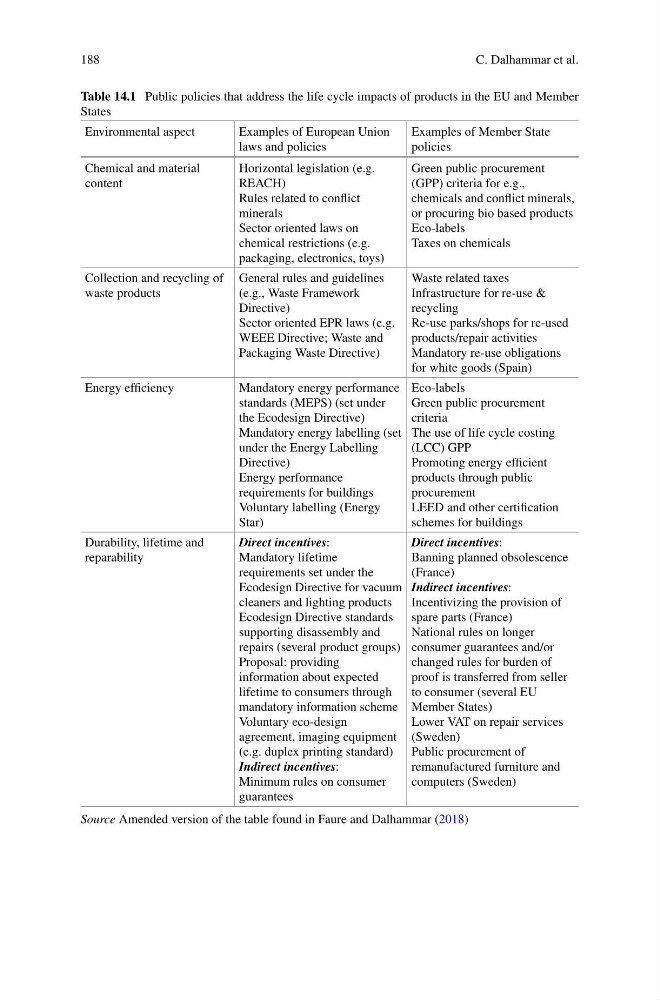
Table 14.1 Public policies that address the life cycle impacts of products in the EU and Member
States
Environmental aspect
Examples of European Union
laws and policies
Examples of Member State
policies
Chemical and material
content
Horizontal legislation (e.g.
REACH)
Rules related to conflict
minerals
Sector oriented laws on
chemical restrictions (e.g.
packaging, electronics, toys)
Green public procurement
(GPP) criteria for e.g.,
chemicals and conflict minerals,
or procuring bio based products
Eco-labels
Taxes on chemicals
Collection and recycling of
waste products
General rules and guidelines
(e.g., Waste Framework
Directive)
Sector oriented EPR laws (e.g.
WEEE Directive; Waste and
Packaging Waste Directive)
Waste related taxes
Infrastructure for re-use &
recycling
Re-use parks/shops for re-used
products/repair activities
Mandatory re-use obligations
for white goods (Spain)
Energy efficiency
Mandatory energy performance
standards (MEPS) (set under
the Ecodesign Directive)
Mandatory energy labelling (set
under the Energy Labelling
Directive)
Energy performance
requirements for buildings
Voluntary labelling (Energy
Star)
Eco-labels
Green public procurement
criteria
The use of life cycle costing
(LCC) GPP
Promoting energy efficient
products through public
procurement
LEED and other certification
schemes for buildings
Durability, lifetime and
reparability
Direct incentives:
Mandatory lifetime
requirements set under the
Ecodesign Directive for vacuum
cleaners and lighting products
Ecodesign Directive standards
supporting disassembly and
repairs (several product groups)
Proposal: providing
information about expected
lifetime to consumers through
mandatory information scheme
Voluntary eco-design
agreement, imaging equipment
(e.g. duplex printing standard)
Indirect incentives:
Minimum rules on consumer
guarantees
Direct incentives:
Banning planned obsolescence
(France)
Indirect incentives:
Incentivizing the provision of
spare parts (France)
National rules on longer
consumer guarantees and/or
changed rules for burden of
proof is transferred from seller
to consumer (several EU
Member States)
Lower VAT on repair services
(Sweden)
Public procurement of
remanufactured furniture and
computers (Sweden)
Source Amended version of the table found in Faure and Dalhammar (2018)
C. Dalhammar et al.
Table 14.1 Public policies that address the life cycle impacts of products in the EU and Member
States
Environmental aspect
Examples of European Union
laws and policies
Examples of Member State
policies
Chemical and material
content
Horizontal legislation (e.g.
REACH)
Rules related to conflict
minerals
Sector oriented laws on
chemical restrictions (e.g.
packaging, electronics, toys)
Green public procurement
(GPP) criteria for e.g.,
chemicals and conflict minerals,
or procuring bio based products
Eco-labels
Taxes on chemicals
Collection and recycling of
waste products
General rules and guidelines
(e.g., Waste Framework
Directive)
Sector oriented EPR laws (e.g.
WEEE Directive; Waste and
Packaging Waste Directive)
Waste related taxes
Infrastructure for re-use &
recycling
Re-use parks/shops for re-used
products/repair activities
Mandatory re-use obligations
for white goods (Spain)
Energy efficiency
Mandatory energy performance
standards (MEPS) (set under
the Ecodesign Directive)
Mandatory energy labelling (set
under the Energy Labelling
Directive)
Energy performance
requirements for buildings
Voluntary labelling (Energy
Star)
Eco-labels
Green public procurement
criteria
The use of life cycle costing
(LCC) GPP
Promoting energy efficient
products through public
procurement
LEED and other certification
schemes for buildings
Durability, lifetime and
reparability
Direct incentives:
Mandatory lifetime
requirements set under the
Ecodesign Directive for vacuum
cleaners and lighting products
Ecodesign Directive standards
supporting disassembly and
repairs (several product groups)
Proposal: providing
information about expected
lifetime to consumers through
mandatory information scheme
Voluntary eco-design
agreement, imaging equipment
(e.g. duplex printing standard)
Indirect incentives:
Minimum rules on consumer
guarantees
Direct incentives:
Banning planned obsolescence
(France)
Indirect incentives:
Incentivizing the provision of
spare parts (France)
National rules on longer
consumer guarantees and/or
changed rules for burden of
proof is transferred from seller
to consumer (several EU
Member States)
Lower VAT on repair services
(Sweden)
Public procurement of
remanufactured furniture and
computers (Sweden)
Source Amended version of the table found in Faure and Dalhammar (2018)