

8
U. Edilson
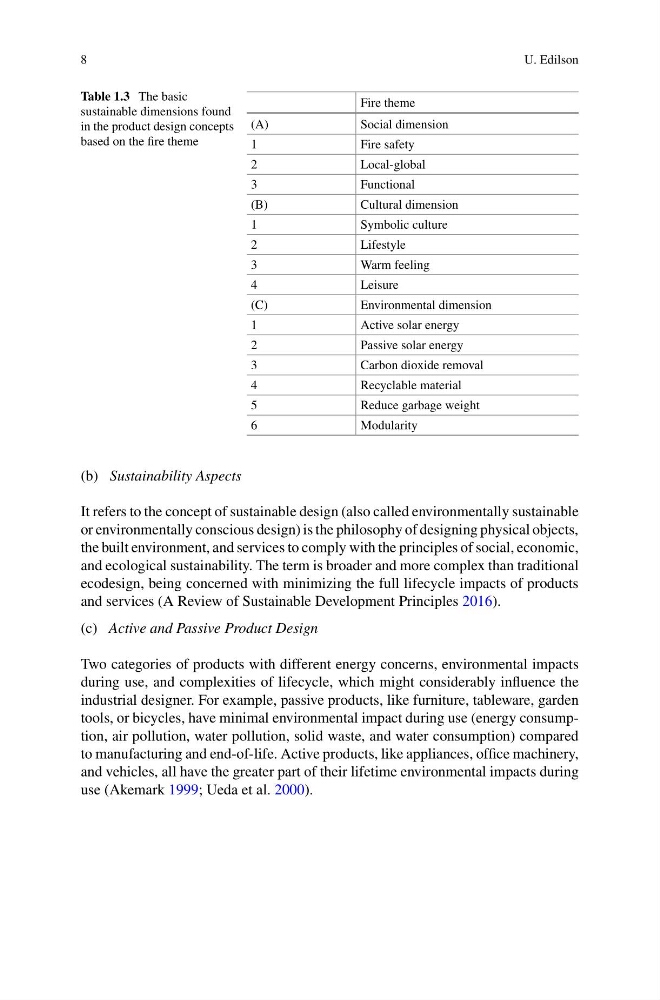
Table 1.3 The basic
sustainable dimensions found
in the product design concepts
based on the fire theme
Fire theme
(A)
Social dimension
1
Fire safety
2
Local-global
3
Functional
(B)
Cultural dimension
1
Symbolic culture
2
Lifestyle
3
Warm feeling
4
Leisure
(C)
Environmental dimension
1
Active solar energy
2
Passive solar energy
3
Carbon dioxide removal
4
Recyclable material
5
Reduce garbage weight
6
Modularity
(b) Sustainability Aspects
It refers to the concept of sustainable design (also called environmentally sustainable
or environmentally conscious design) is the philosophy of designing physical objects,
the built environment, and services to comply with the principles of social, economic,
and ecological sustainability. The term is broader and more complex than traditional
ecodesign, being concerned with minimizing the full lifecycle impacts of products
and services (A Review of Sustainable Development Principles 2016).
(c) Active and Passive Product Design
Two categories of products with different energy concerns, environmental impacts
during use, and complexities of lifecycle, which might considerably influence the
industrial designer. For example, passive products, like furniture, tableware, garden
tools, or bicycles, have minimal environmental impact during use (energy consumption, air pollution, water pollution, solid waste, and water consumption) compared
to manufacturing and end-of-life. Active products, like appliances, office machinery,
and vehicles, all have the greater part of their lifetime environmental impacts during
use (Akemark 1999; Ueda et al. 2000).
U. Edilson
Table 1.3 The basic
sustainable dimensions found
in the product design concepts
based on the fire theme
Fire theme
(A)
Social dimension
1
Fire safety
2
Local-global
3
Functional
(B)
Cultural dimension
1
Symbolic culture
2
Lifestyle
3
Warm feeling
4
Leisure
(C)
Environmental dimension
1
Active solar energy
2
Passive solar energy
3
Carbon dioxide removal
4
Recyclable material
5
Reduce garbage weight
6
Modularity
(b) Sustainability Aspects
It refers to the concept of sustainable design (also called environmentally sustainable
or environmentally conscious design) is the philosophy of designing physical objects,
the built environment, and services to comply with the principles of social, economic,
and ecological sustainability. The term is broader and more complex than traditional
ecodesign, being concerned with minimizing the full lifecycle impacts of products
and services (A Review of Sustainable Development Principles 2016).
(c) Active and Passive Product Design
Two categories of products with different energy concerns, environmental impacts
during use, and complexities of lifecycle, which might considerably influence the
industrial designer. For example, passive products, like furniture, tableware, garden
tools, or bicycles, have minimal environmental impact during use (energy consumption, air pollution, water pollution, solid waste, and water consumption) compared
to manufacturing and end-of-life. Active products, like appliances, office machinery,
and vehicles, all have the greater part of their lifetime environmental impacts during
use (Akemark 1999; Ueda et al. 2000).