

12 Efforts to Reduce CO 2 Emissions in the Japanese Automobile …
173
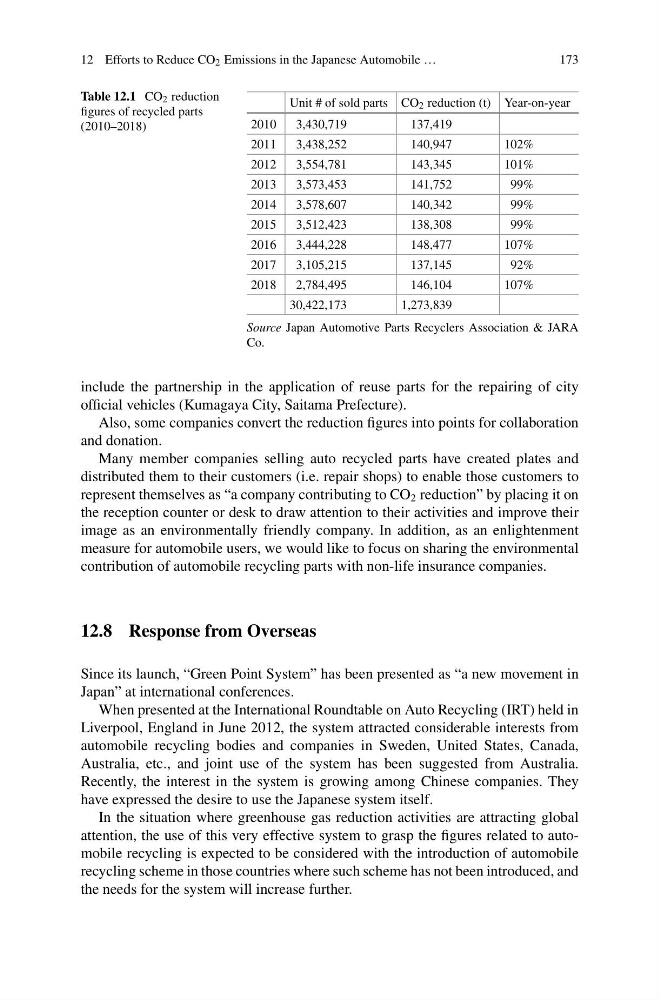
Table 12.1 CO 2 reduction
figures of recycled parts
(2010–2018)
Unit # of sold parts CO 2 reduction (t) Year-on-year
2010
3,430,719
137,419
2011
3,438,252
140,947
102%
2012
3,554,781
143,345
101%
2013
3,573,453
141,752
99%
2014
3,578,607
140,342
99%
2015
3,512,423
138,308
99%
2016
3,444,228
148,477
107%
2017
3,105,215
137,145
92%
2018
2,784,495
146,104
107%
30,422,173
1,273,839
Source Japan Automotive Parts Recyclers Association & JARA
Co.
include the partnership in the application of reuse parts for the repairing of city
official vehicles (Kumagaya City, Saitama Prefecture).
Also, some companies convert the reduction figures into points for collaboration
and donation.
Many member companies selling auto recycled parts have created plates and
distributed them to their customers (i.e. repair shops) to enable those customers to
represent themselves as “a company contributing to CO 2 reduction” by placing it on
the reception counter or desk to draw attention to their activities and improve their
image as an environmentally friendly company. In addition, as an enlightenment
measure for automobile users, we would like to focus on sharing the environmental
contribution of automobile recycling parts with non-life insurance companies.
12.8 Response from Overseas
Since its launch, “Green Point System” has been presented as “a new movement in
Japan” at international conferences.
When presented at the International Roundtable on Auto Recycling (IRT) held in
Liverpool, England in June 2012, the system attracted considerable interests from
automobile recycling bodies and companies in Sweden, United States, Canada,
Australia, etc., and joint use of the system has been suggested from Australia.
Recently, the interest in the system is growing among Chinese companies. They
have expressed the desire to use the Japanese system itself.
In the situation where greenhouse gas reduction activities are attracting global
attention, the use of this very effective system to grasp the figures related to automobile recycling is expected to be considered with the introduction of automobile
recycling scheme in those countries where such scheme has not been introduced, and
the needs for the system will increase further.
173
Table 12.1 CO 2 reduction
figures of recycled parts
(2010–2018)
Unit # of sold parts CO 2 reduction (t) Year-on-year
2010
3,430,719
137,419
2011
3,438,252
140,947
102%
2012
3,554,781
143,345
101%
2013
3,573,453
141,752
99%
2014
3,578,607
140,342
99%
2015
3,512,423
138,308
99%
2016
3,444,228
148,477
107%
2017
3,105,215
137,145
92%
2018
2,784,495
146,104
107%
30,422,173
1,273,839
Source Japan Automotive Parts Recyclers Association & JARA
Co.
include the partnership in the application of reuse parts for the repairing of city
official vehicles (Kumagaya City, Saitama Prefecture).
Also, some companies convert the reduction figures into points for collaboration
and donation.
Many member companies selling auto recycled parts have created plates and
distributed them to their customers (i.e. repair shops) to enable those customers to
represent themselves as “a company contributing to CO 2 reduction” by placing it on
the reception counter or desk to draw attention to their activities and improve their
image as an environmentally friendly company. In addition, as an enlightenment
measure for automobile users, we would like to focus on sharing the environmental
contribution of automobile recycling parts with non-life insurance companies.
12.8 Response from Overseas
Since its launch, “Green Point System” has been presented as “a new movement in
Japan” at international conferences.
When presented at the International Roundtable on Auto Recycling (IRT) held in
Liverpool, England in June 2012, the system attracted considerable interests from
automobile recycling bodies and companies in Sweden, United States, Canada,
Australia, etc., and joint use of the system has been suggested from Australia.
Recently, the interest in the system is growing among Chinese companies. They
have expressed the desire to use the Japanese system itself.
In the situation where greenhouse gas reduction activities are attracting global
attention, the use of this very effective system to grasp the figures related to automobile recycling is expected to be considered with the introduction of automobile
recycling scheme in those countries where such scheme has not been introduced, and
the needs for the system will increase further.