

11 Barriers for Remanufacturing Business in Southeast Asia …
153
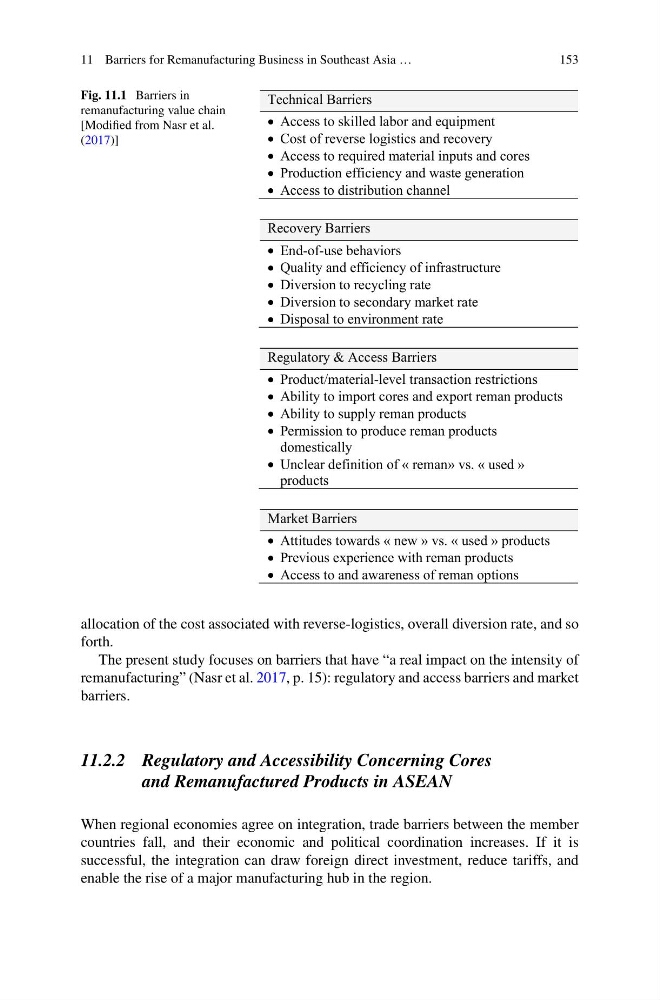
Fig. 11.1 Barriers in
remanufacturing value chain
[Modified from Nasr et al.
(2017)]
Technical Barriers
Access to skilled labor and equipment
Cost of reverse logistics and recovery
Access to required material inputs and cores
Production efficiency and waste generation
Access to distribution channel
Recovery Barriers
End-of-use behaviors
Quality and efficiency of infrastructure
Diversion to recycling rate
Diversion to secondary market rate
Disposal to environment rate
Regulatory & Access Barriers
Product/material-level transaction restrictions
Ability to import cores and export reman products
Ability to supply reman products
Permission to produce reman products
domestically
Unclear definition of « reman» vs. « used »
products
Market Barriers
Attitudes towards « new » vs. « used » products
Previous experience with reman products
Access to and awareness of reman options
allocation of the cost associated with reverse-logistics, overall diversion rate, and so
forth.
The present study focuses on barriers that have “a real impact on the intensity of
remanufacturing” (Nasr et al. 2017, p. 15): regulatory and access barriers and market
barriers.
11.2.2 Regulatory and Accessibility Concerning Cores
and Remanufactured Products in ASEAN
When regional economies agree on integration, trade barriers between the member
countries fall, and their economic and political coordination increases. If it is
successful, the integration can draw foreign direct investment, reduce tariffs, and
enable the rise of a major manufacturing hub in the region.
153
Fig. 11.1 Barriers in
remanufacturing value chain
[Modified from Nasr et al.
(2017)]
Technical Barriers
Access to skilled labor and equipment
Cost of reverse logistics and recovery
Access to required material inputs and cores
Production efficiency and waste generation
Access to distribution channel
Recovery Barriers
End-of-use behaviors
Quality and efficiency of infrastructure
Diversion to recycling rate
Diversion to secondary market rate
Disposal to environment rate
Regulatory & Access Barriers
Product/material-level transaction restrictions
Ability to import cores and export reman products
Ability to supply reman products
Permission to produce reman products
domestically
Unclear definition of « reman» vs. « used »
products
Market Barriers
Attitudes towards « new » vs. « used » products
Previous experience with reman products
Access to and awareness of reman options
allocation of the cost associated with reverse-logistics, overall diversion rate, and so
forth.
The present study focuses on barriers that have “a real impact on the intensity of
remanufacturing” (Nasr et al. 2017, p. 15): regulatory and access barriers and market
barriers.
11.2.2 Regulatory and Accessibility Concerning Cores
and Remanufactured Products in ASEAN
When regional economies agree on integration, trade barriers between the member
countries fall, and their economic and political coordination increases. If it is
successful, the integration can draw foreign direct investment, reduce tariffs, and
enable the rise of a major manufacturing hub in the region.