

63
In Terengganu, there are three major Orang Asli settlements, namely Kampung
Sungai Pergam (Kemaman district), Kampung Sungai Berua (Hulu Terengganu district, near Tasik Kenyir, the largest man-made lake in Southeast Asia) and Kampung
Sungai Sayap (Hulu Besut district, upnorth of Terengganu) (Fig. 1). Kampung
Sungai Berua was established in 1977 to provide a permanent settlement for the
Semoq Beri and Bateq communities living near the Kenyir forest complex during the
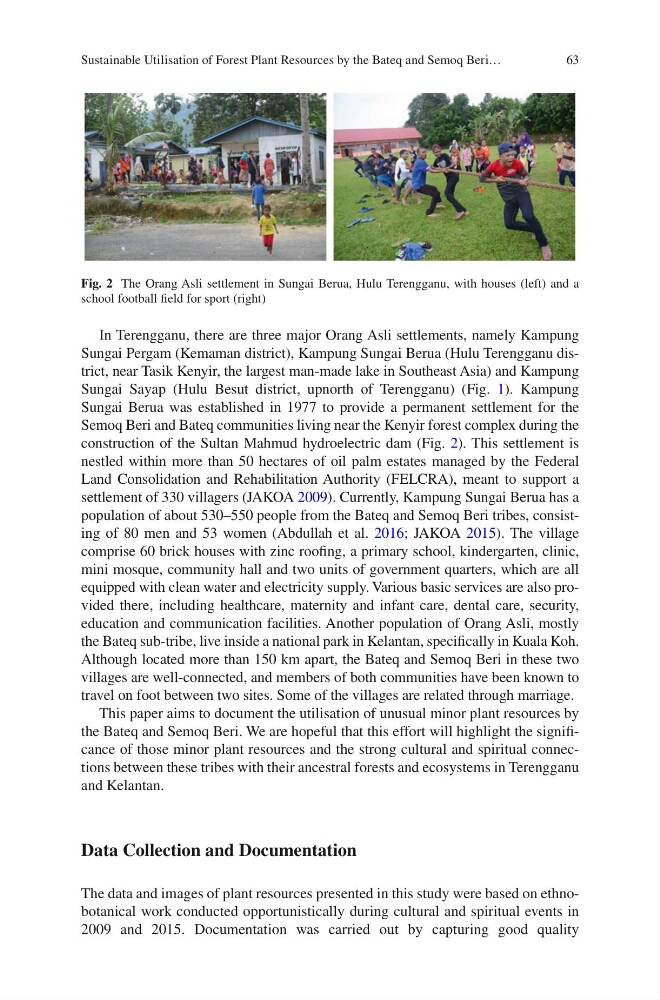
construction of the Sultan Mahmud hydroelectric dam (Fig. 2). This settlement is
nestled within more than 50 hectares of oil palm estates managed by the Federal
Land Consolidation and Rehabilitation Authority (FELCRA), meant to support a
settlement of 330 villagers (JAKOA 2009). Currently, Kampung Sungai Berua has a
population of about 530–550 people from the Bateq and Semoq Beri tribes, consisting of 80 men and 53 women (Abdullah et al. 2016; JAKOA 2015). The village
comprise 60 brick houses with zinc roofing, a primary school, kindergarten, clinic,
mini mosque, community hall and two units of government quarters, which are all
equipped with clean water and electricity supply. Various basic services are also provided there, including healthcare, maternity and infant care, dental care, security,
education and communication facilities. Another population of Orang Asli, mostly
the Bateq sub-tribe, live inside a national park in Kelantan, specifically in Kuala Koh.
Although located more than 150 km apart, the Bateq and Semoq Beri in these two
villages are well-connected, and members of both communities have been known to
travel on foot between two sites. Some of the villages are related through marriage.
This paper aims to document the utilisation of unusual minor plant resources by
the Bateq and Semoq Beri. We are hopeful that this effort will highlight the significance of those minor plant resources and the strong cultural and spiritual connections between these tribes with their ancestral forests and ecosystems in Terengganu
and Kelantan.
Data Collection and Documentation
The data and images of plant resources presented in this study were based on ethnobotanical work conducted opportunistically during cultural and spiritual events in
2009 and 2015. Documentation was carried out by capturing good quality
Fig. 2 The Orang Asli settlement in Sungai Berua, Hulu Terengganu, with houses (left) and a
school football field for sport (right)
Sustainable Utilisation of Forest Plant Resources by the Bateq and Semoq Beri…
In Terengganu, there are three major Orang Asli settlements, namely Kampung
Sungai Pergam (Kemaman district), Kampung Sungai Berua (Hulu Terengganu district, near Tasik Kenyir, the largest man-made lake in Southeast Asia) and Kampung
Sungai Sayap (Hulu Besut district, upnorth of Terengganu) (Fig. 1). Kampung
Sungai Berua was established in 1977 to provide a permanent settlement for the
Semoq Beri and Bateq communities living near the Kenyir forest complex during the
construction of the Sultan Mahmud hydroelectric dam (Fig. 2). This settlement is
nestled within more than 50 hectares of oil palm estates managed by the Federal
Land Consolidation and Rehabilitation Authority (FELCRA), meant to support a
settlement of 330 villagers (JAKOA 2009). Currently, Kampung Sungai Berua has a
population of about 530–550 people from the Bateq and Semoq Beri tribes, consisting of 80 men and 53 women (Abdullah et al. 2016; JAKOA 2015). The village
comprise 60 brick houses with zinc roofing, a primary school, kindergarten, clinic,
mini mosque, community hall and two units of government quarters, which are all
equipped with clean water and electricity supply. Various basic services are also provided there, including healthcare, maternity and infant care, dental care, security,
education and communication facilities. Another population of Orang Asli, mostly
the Bateq sub-tribe, live inside a national park in Kelantan, specifically in Kuala Koh.
Although located more than 150 km apart, the Bateq and Semoq Beri in these two
villages are well-connected, and members of both communities have been known to
travel on foot between two sites. Some of the villages are related through marriage.
This paper aims to document the utilisation of unusual minor plant resources by
the Bateq and Semoq Beri. We are hopeful that this effort will highlight the significance of those minor plant resources and the strong cultural and spiritual connections between these tribes with their ancestral forests and ecosystems in Terengganu
and Kelantan.
Data Collection and Documentation
The data and images of plant resources presented in this study were based on ethnobotanical work conducted opportunistically during cultural and spiritual events in
2009 and 2015. Documentation was carried out by capturing good quality
Fig. 2 The Orang Asli settlement in Sungai Berua, Hulu Terengganu, with houses (left) and a
school football field for sport (right)
Sustainable Utilisation of Forest Plant Resources by the Bateq and Semoq Beri…