

18
In Tasik Chini, DARA recommended that the catchment area draining into the
lake be left undisturbed and, in any event, that native forest areas should be no less
than five times the height of mature forests. Unfortunately, in 1976, perhaps an
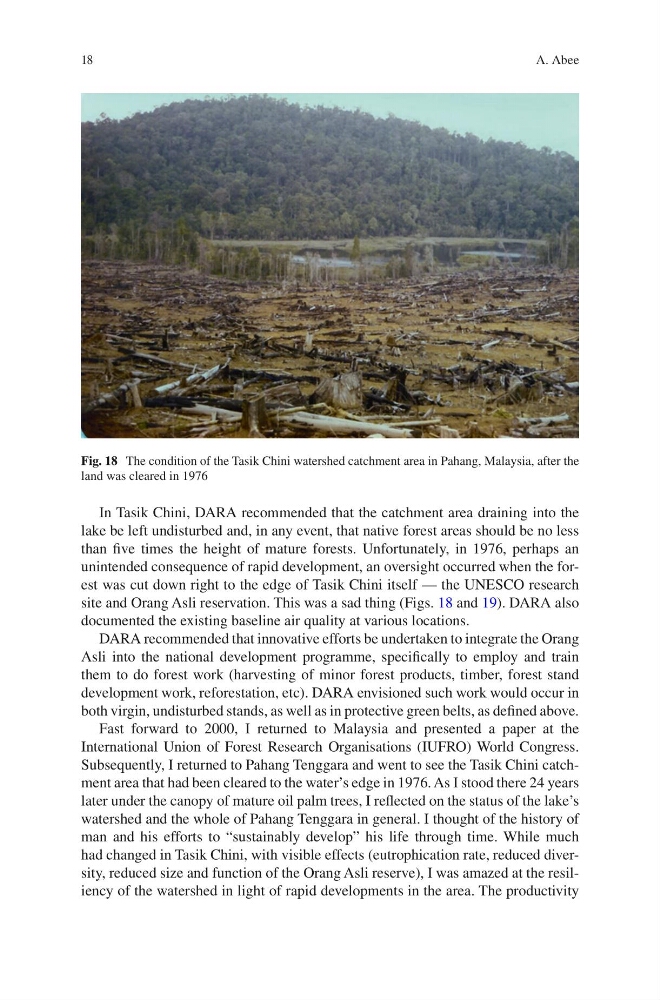
unintended consequence of rapid development, an oversight occurred when the forest was cut down right to the edge of Tasik Chini itself — the UNESCO research
site and Orang Asli reservation. This was a sad thing (Figs. 18 and 19). DARA also
documented the existing baseline air quality at various locations.
DARA recommended that innovative efforts be undertaken to integrate the Orang
Asli into the national development programme, specifically to employ and train
them to do forest work (harvesting of minor forest products, timber, forest stand
development work, reforestation, etc). DARA envisioned such work would occur in
both virgin, undisturbed stands, as well as in protective green belts, as defined above.
Fast forward to 2000, I returned to Malaysia and presented a paper at the
International Union of Forest Research Organisations (IUFRO) World Congress.
Subsequently, I returned to Pahang Tenggara and went to see the Tasik Chini catchment area that had been cleared to the water’s edge in 1976. As I stood there 24 years
later under the canopy of mature oil palm trees, I reflected on the status of the lake’s
watershed and the whole of Pahang Tenggara in general. I thought of the history of
man and his efforts to “sustainably develop” his life through time. While much
had changed in Tasik Chini, with visible effects (eutrophication rate, reduced diversity, reduced size and function of the Orang Asli reserve), I was amazed at the resiliency of the watershed in light of rapid developments in the area. The productivity
Fig. 18 The condition of the Tasik Chini watershed catchment area in Pahang, Malaysia, after the
land was cleared in 1976
A. Abee
In Tasik Chini, DARA recommended that the catchment area draining into the
lake be left undisturbed and, in any event, that native forest areas should be no less
than five times the height of mature forests. Unfortunately, in 1976, perhaps an
unintended consequence of rapid development, an oversight occurred when the forest was cut down right to the edge of Tasik Chini itself — the UNESCO research
site and Orang Asli reservation. This was a sad thing (Figs. 18 and 19). DARA also
documented the existing baseline air quality at various locations.
DARA recommended that innovative efforts be undertaken to integrate the Orang
Asli into the national development programme, specifically to employ and train
them to do forest work (harvesting of minor forest products, timber, forest stand
development work, reforestation, etc). DARA envisioned such work would occur in
both virgin, undisturbed stands, as well as in protective green belts, as defined above.
Fast forward to 2000, I returned to Malaysia and presented a paper at the
International Union of Forest Research Organisations (IUFRO) World Congress.
Subsequently, I returned to Pahang Tenggara and went to see the Tasik Chini catchment area that had been cleared to the water’s edge in 1976. As I stood there 24 years
later under the canopy of mature oil palm trees, I reflected on the status of the lake’s
watershed and the whole of Pahang Tenggara in general. I thought of the history of
man and his efforts to “sustainably develop” his life through time. While much
had changed in Tasik Chini, with visible effects (eutrophication rate, reduced diversity, reduced size and function of the Orang Asli reserve), I was amazed at the resiliency of the watershed in light of rapid developments in the area. The productivity
Fig. 18 The condition of the Tasik Chini watershed catchment area in Pahang, Malaysia, after the
land was cleared in 1976
A. Abee