

202
83.9% of the Orang Asli agreed that development growth had changed their social,
economic and cultural lifestyle. However, this scenario had sparked great concern
among them in continuing their traditional practices and cultures in future. It is
found that the young Orang Asli were already influenced by the modern world and
refused to practice their heritage cultures and traditions. This study recommended
ecotourism as a means of preserving Orang Asli culture while maintaining their
traditional practices.
Keywords Orang Asli · Sustainability · Socio-economic · Development ·
Ecotourism · Tasik Kenyir
Introduction
The Orang Asli are a minority in Peninsular Malaysia who are generally poor. They
are defined as the original or "first people" who are different from the mainstream
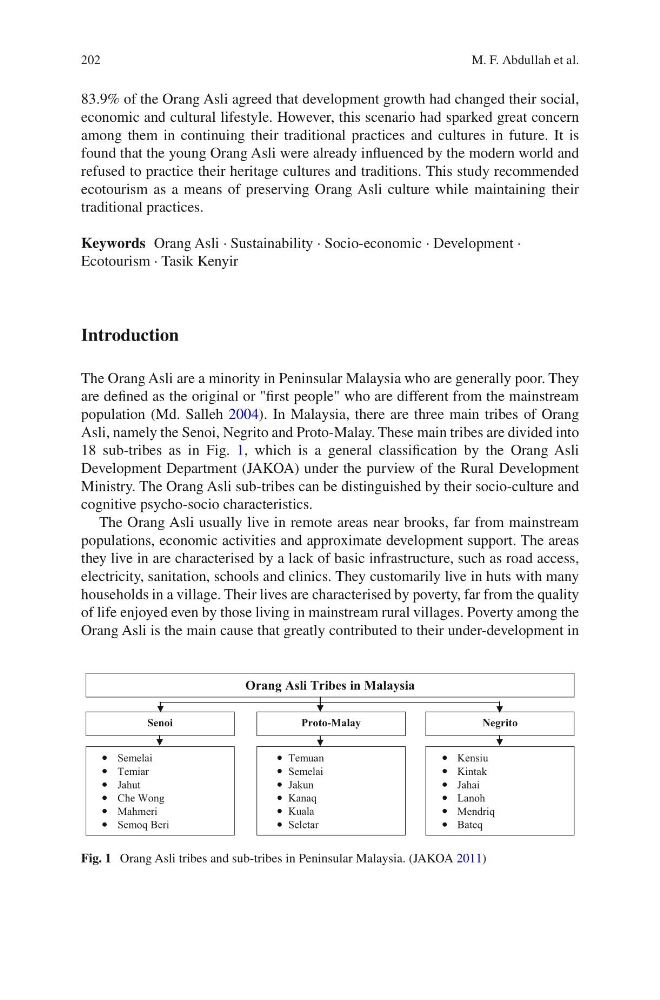
population (Md. Salleh 2004). In Malaysia, there are three main tribes of Orang
Asli, namely the Senoi, Negrito and Proto-Malay. These main tribes are divided into
18 sub-tribes as in Fig. 1, which is a general classification by the Orang Asli
Development Department (JAKOA) under the purview of the Rural Development
Ministry. The Orang Asli sub-tribes can be distinguished by their socio-culture and
cognitive psycho-socio characteristics.
The Orang Asli usually live in remote areas near brooks, far from mainstream
populations, economic activities and approximate development support. The areas
they live in are characterised by a lack of basic infrastructure, such as road access,
electricity, sanitation, schools and clinics. They customarily live in huts with many
households in a village. Their lives are characterised by poverty, far from the quality
of life enjoyed even by those living in mainstream rural villages. Poverty among the
Orang Asli is the main cause that greatly contributed to their under-development in
Semelai
Temiar
Jahut
Che Wong
Mahmeri
Semoq Beri
Orang Asli Tribes in Malaysia
Senoi
Proto-Malay
Negrito
Temuan
Semelai
Jakun
Kanaq
Kuala
Seletar
Kensiu
Kintak
Jahai
Lanoh
Mendriq
Bateq
Fig. 1 Orang Asli tribes and sub-tribes in Peninsular Malaysia. (JAKOA 2011)
M. F. Abdullah et al.
83.9% of the Orang Asli agreed that development growth had changed their social,
economic and cultural lifestyle. However, this scenario had sparked great concern
among them in continuing their traditional practices and cultures in future. It is
found that the young Orang Asli were already influenced by the modern world and
refused to practice their heritage cultures and traditions. This study recommended
ecotourism as a means of preserving Orang Asli culture while maintaining their
traditional practices.
Keywords Orang Asli · Sustainability · Socio-economic · Development ·
Ecotourism · Tasik Kenyir
Introduction
The Orang Asli are a minority in Peninsular Malaysia who are generally poor. They
are defined as the original or "first people" who are different from the mainstream
population (Md. Salleh 2004). In Malaysia, there are three main tribes of Orang
Asli, namely the Senoi, Negrito and Proto-Malay. These main tribes are divided into
18 sub-tribes as in Fig. 1, which is a general classification by the Orang Asli
Development Department (JAKOA) under the purview of the Rural Development
Ministry. The Orang Asli sub-tribes can be distinguished by their socio-culture and
cognitive psycho-socio characteristics.
The Orang Asli usually live in remote areas near brooks, far from mainstream
populations, economic activities and approximate development support. The areas
they live in are characterised by a lack of basic infrastructure, such as road access,
electricity, sanitation, schools and clinics. They customarily live in huts with many
households in a village. Their lives are characterised by poverty, far from the quality
of life enjoyed even by those living in mainstream rural villages. Poverty among the
Orang Asli is the main cause that greatly contributed to their under-development in
Semelai
Temiar
Jahut
Che Wong
Mahmeri
Semoq Beri
Orang Asli Tribes in Malaysia
Senoi
Proto-Malay
Negrito
Temuan
Semelai
Jakun
Kanaq
Kuala
Seletar
Kensiu
Kintak
Jahai
Lanoh
Mendriq
Bateq
Fig. 1 Orang Asli tribes and sub-tribes in Peninsular Malaysia. (JAKOA 2011)
M. F. Abdullah et al.