

159
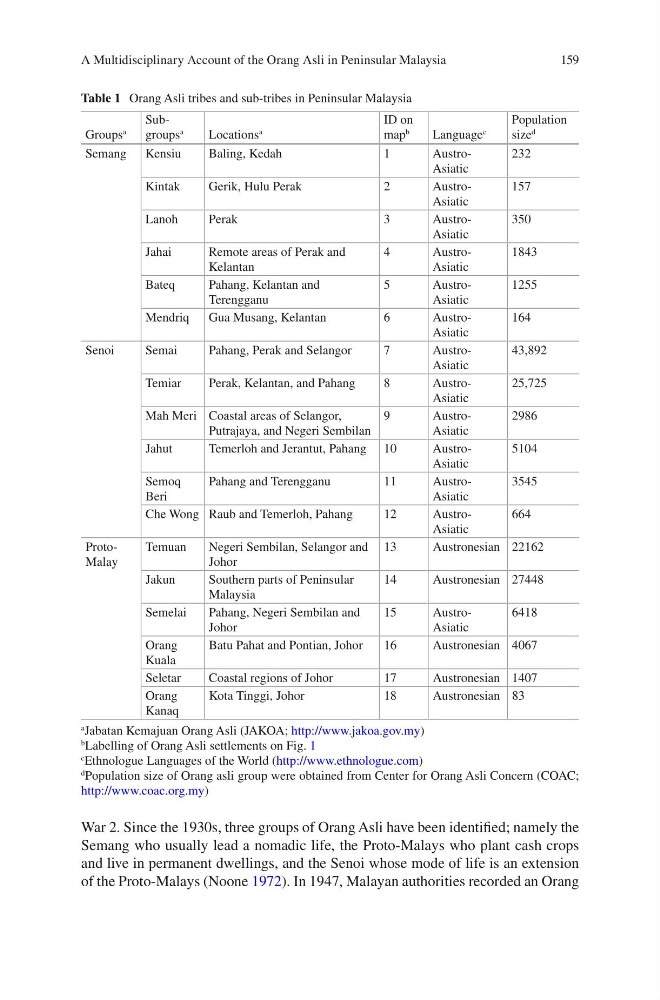
War 2. Since the 1930s, three groups of Orang Asli have been identified; namely the
Semang who usually lead a nomadic life, the Proto-Malays who plant cash crops
and live in permanent dwellings, and the Senoi whose mode of life is an extension
of the Proto-Malays (Noone 1972). In 1947, Malayan authorities recorded an Orang
Table 1 Orang Asli tribes and sub-tribes in Peninsular Malaysia
Groups
a
Subgroups
a
Locations
a
ID on
map
b
Language
c
Population
size
d
Semang Kensiu
Baling, Kedah
1
AustroAsiatic
232
Kintak
Gerik, Hulu Perak
2
AustroAsiatic
157
Lanoh
Perak
3
AustroAsiatic
350
Jahai
Remote areas of Perak and
Kelantan
4
AustroAsiatic
1843
Bateq
Pahang, Kelantan and
Terengganu
5
AustroAsiatic
1255
Mendriq
Gua Musang, Kelantan
6
AustroAsiatic
164
Senoi
Semai
Pahang, Perak and Selangor
7
AustroAsiatic
43,892
Temiar
Perak, Kelantan, and Pahang
8
AustroAsiatic
25,725
Mah Meri Coastal areas of Selangor,
Putrajaya, and Negeri Sembilan
9
AustroAsiatic
2986
Jahut
Temerloh and Jerantut, Pahang 10
AustroAsiatic
5104
Semoq
Beri
Pahang and Terengganu
11
AustroAsiatic
3545
Che Wong Raub and Temerloh, Pahang
12
AustroAsiatic
664
ProtoMalay
Temuan
Negeri Sembilan, Selangor and
Johor
13
Austronesian 22162
Jakun
Southern parts of Peninsular
Malaysia
14
Austronesian 27448
Semelai
Pahang, Negeri Sembilan and
Johor
15
AustroAsiatic
6418
Orang
Kuala
Batu Pahat and Pontian, Johor
16
Austronesian 4067
Seletar
Coastal regions of Johor
17
Austronesian 1407
Orang
Kanaq
Kota Tinggi, Johor
18
Austronesian 83
a
Jabatan Kemajuan Orang Asli (JAKOA; http://www.jakoa.gov.my)
b
Labelling of Orang Asli settlements on Fig. 1
c
Ethnologue Languages of the World (http://www.ethnologue.com)
d
Population size of Orang asli group were obtained from Center for Orang Asli Concern (COAC;
http://www.coac.org.my)
A Multidisciplinary Account of the Orang Asli in Peninsular Malaysia
War 2. Since the 1930s, three groups of Orang Asli have been identified; namely the
Semang who usually lead a nomadic life, the Proto-Malays who plant cash crops
and live in permanent dwellings, and the Senoi whose mode of life is an extension
of the Proto-Malays (Noone 1972). In 1947, Malayan authorities recorded an Orang
Table 1 Orang Asli tribes and sub-tribes in Peninsular Malaysia
Groups
a
Subgroups
a
Locations
a
ID on
map
b
Language
c
Population
size
d
Semang Kensiu
Baling, Kedah
1
AustroAsiatic
232
Kintak
Gerik, Hulu Perak
2
AustroAsiatic
157
Lanoh
Perak
3
AustroAsiatic
350
Jahai
Remote areas of Perak and
Kelantan
4
AustroAsiatic
1843
Bateq
Pahang, Kelantan and
Terengganu
5
AustroAsiatic
1255
Mendriq
Gua Musang, Kelantan
6
AustroAsiatic
164
Senoi
Semai
Pahang, Perak and Selangor
7
AustroAsiatic
43,892
Temiar
Perak, Kelantan, and Pahang
8
AustroAsiatic
25,725
Mah Meri Coastal areas of Selangor,
Putrajaya, and Negeri Sembilan
9
AustroAsiatic
2986
Jahut
Temerloh and Jerantut, Pahang 10
AustroAsiatic
5104
Semoq
Beri
Pahang and Terengganu
11
AustroAsiatic
3545
Che Wong Raub and Temerloh, Pahang
12
AustroAsiatic
664
ProtoMalay
Temuan
Negeri Sembilan, Selangor and
Johor
13
Austronesian 22162
Jakun
Southern parts of Peninsular
Malaysia
14
Austronesian 27448
Semelai
Pahang, Negeri Sembilan and
Johor
15
AustroAsiatic
6418
Orang
Kuala
Batu Pahat and Pontian, Johor
16
Austronesian 4067
Seletar
Coastal regions of Johor
17
Austronesian 1407
Orang
Kanaq
Kota Tinggi, Johor
18
Austronesian 83
a
Jabatan Kemajuan Orang Asli (JAKOA; http://www.jakoa.gov.my)
b
Labelling of Orang Asli settlements on Fig. 1
c
Ethnologue Languages of the World (http://www.ethnologue.com)
d
Population size of Orang asli group were obtained from Center for Orang Asli Concern (COAC;
http://www.coac.org.my)
A Multidisciplinary Account of the Orang Asli in Peninsular Malaysia