

119
also stated that the leaf monkey was among the mammals targeted by the Semoq
Beri people during their hunting activities. These animals provide a good quantity
of meat and since they are social animals, several members of one group can be
captured at once. One of the respondents was able to demonstrate how to call for
different types of primates, indicating how immense their hunting skills are. The
hunters determine the direction the targeted primates are travelling, and they position themselves under a troop as they attempt to shoot using blowpipes. The length
of the blowpipes is kept at about 6 ft. (1.8 m) so it would be convenient to carry them
around. The poisonous darts are stored in a canister made from bamboo and rattan.
Figure 9 presents a flowchart that shows the process of making the poisonous darts.
A variety of traps and snares are used to target different groups of mammals. The
hunter–gatherers prefer to capture animals like the barking deer (Muntiacus muntjac) and lesser Javanese mouse-deer, or kanchil, (Tragulus javanicus) using snares.
Traps are more commonly used to capture small mammals, such as the brush-tailed
porcupine (Atherurus macrourus) (Fig. 10), which will be consumed if no other
sources of food are available. Spears are used to kill large mammals, including the
bearded pig (Sus barbatus). Bearded pigs are targeted as they are quite numerous
and their considerable size makes for a good source of food. The distinctive sound
of pigs crunching on roots, and the grunts and squeals of the young make them
easier to spot. On rare occasions, a sun bear, a tapir, or even an elephant may be
killed. Malayan tapirs (Tapirus indicus) are captured with the help of dogs, and
spears are used to kill them by aiming them toward the vital organs. Asian elephants
are also captured using spears. The hunting of elephants involves about 20 hunters
led by an experienced leader, with each hunter carrying at least four spears.
The slingshot is used to catch birds that are to be food. The frequency of consumption of white-breasted waterhens (Amaurornis phoenicurus) is higher than that
of emerald doves (Chalcophaps indica). According to the respondents, doves are
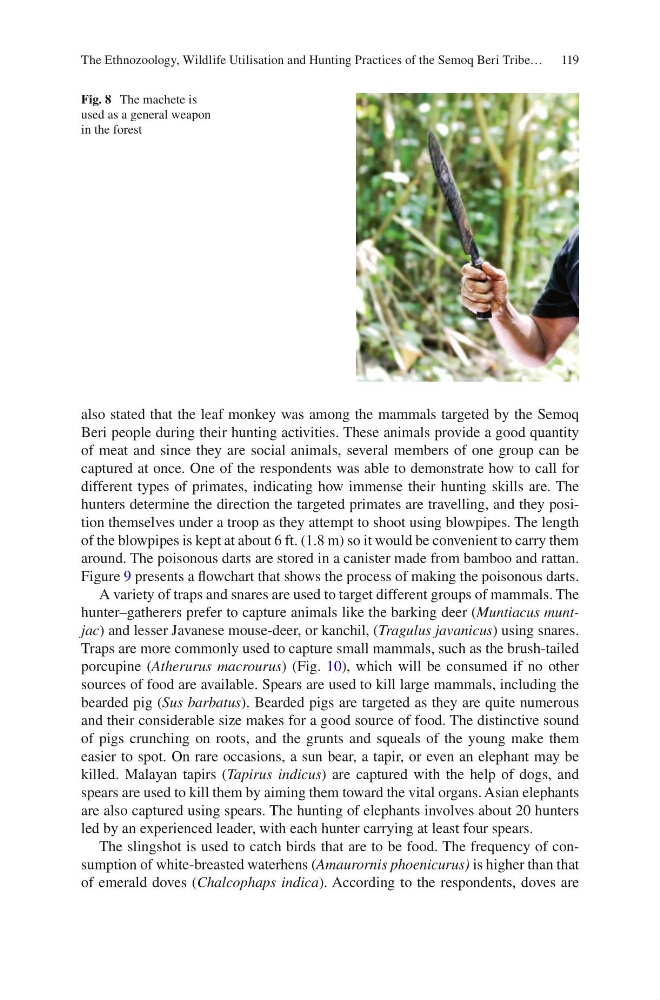
Fig. 8 The machete is
used as a general weapon
in the forest
The Ethnozoology, Wildlife Utilisation and Hunting Practices of the Semoq Beri Tribe…
also stated that the leaf monkey was among the mammals targeted by the Semoq
Beri people during their hunting activities. These animals provide a good quantity
of meat and since they are social animals, several members of one group can be
captured at once. One of the respondents was able to demonstrate how to call for
different types of primates, indicating how immense their hunting skills are. The
hunters determine the direction the targeted primates are travelling, and they position themselves under a troop as they attempt to shoot using blowpipes. The length
of the blowpipes is kept at about 6 ft. (1.8 m) so it would be convenient to carry them
around. The poisonous darts are stored in a canister made from bamboo and rattan.
Figure 9 presents a flowchart that shows the process of making the poisonous darts.
A variety of traps and snares are used to target different groups of mammals. The
hunter–gatherers prefer to capture animals like the barking deer (Muntiacus muntjac) and lesser Javanese mouse-deer, or kanchil, (Tragulus javanicus) using snares.
Traps are more commonly used to capture small mammals, such as the brush-tailed
porcupine (Atherurus macrourus) (Fig. 10), which will be consumed if no other
sources of food are available. Spears are used to kill large mammals, including the
bearded pig (Sus barbatus). Bearded pigs are targeted as they are quite numerous
and their considerable size makes for a good source of food. The distinctive sound
of pigs crunching on roots, and the grunts and squeals of the young make them
easier to spot. On rare occasions, a sun bear, a tapir, or even an elephant may be
killed. Malayan tapirs (Tapirus indicus) are captured with the help of dogs, and
spears are used to kill them by aiming them toward the vital organs. Asian elephants
are also captured using spears. The hunting of elephants involves about 20 hunters
led by an experienced leader, with each hunter carrying at least four spears.
The slingshot is used to catch birds that are to be food. The frequency of consumption of white-breasted waterhens (Amaurornis phoenicurus) is higher than that
of emerald doves (Chalcophaps indica). According to the respondents, doves are
Fig. 8 The machete is
used as a general weapon
in the forest
The Ethnozoology, Wildlife Utilisation and Hunting Practices of the Semoq Beri Tribe…