

56
to those which are highly branched (Zhao et al. 2010). Therefore, it is important to
understand how the structure of these polysaccharides influences their biological
activities.
The three-dimensional arrangement of a polysaccharide is greatly influenced by
the type of monomer, linkage type and position, and the number and position of
branches occurring within the polymer chain. This factor, in addition to the molecular size, determines the behavior of a polysaccharide (Xie et al. 2016b). Some physical properties, such as solubility, viscosity, and gelation, may also influence the
bioactivity since they can affect bioavailability (Sletmoen and Stokke 2008). Some
studies have suggested that polysaccharides which have significantly different average molecular weights but have fractions with similar monosaccharide compositions can possess the same biological activity (Luo et al. 2010). Therefore, the
elucidation of molecular structures of bioactive polysaccharides is very important
for predicting their bioactivities.
The development of bioanalytical technology has tremendously helped to understand the structure of polysaccharides and apply their functions. Through the continuous investigation on the structure of plant polysaccharides, many new groups of
physiologically active compounds has been discovered. Similarly, nutraceutical
applications of bioactive carbohydrates are also related to their structural resistance
Table 4.4 Examples of bioactive carbohydrates from microbes and their potential health benefits
Bioactive
carbohydrate
Sources
Potential health benefits
Dextran
L. mesenteroides
Anticoagulation, Plasma/volume expander in
biomedical applications (Khalikova et al. 2005)
Xanthan gum
Xanthomonas
campestris
Antioxidant, antibacterial and biofilm inhibitory
activities (Munir et al. 2017)
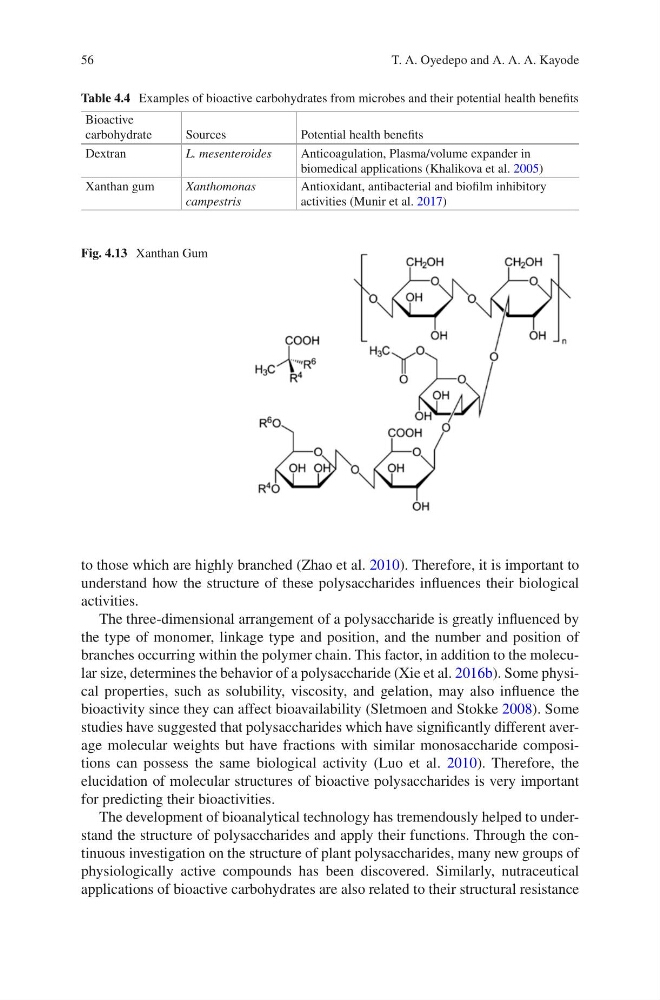
Fig. 4.13 Xanthan Gum
T. A. Oyedepo and A. A. A. Kayode
to those which are highly branched (Zhao et al. 2010). Therefore, it is important to
understand how the structure of these polysaccharides influences their biological
activities.
The three-dimensional arrangement of a polysaccharide is greatly influenced by
the type of monomer, linkage type and position, and the number and position of
branches occurring within the polymer chain. This factor, in addition to the molecular size, determines the behavior of a polysaccharide (Xie et al. 2016b). Some physical properties, such as solubility, viscosity, and gelation, may also influence the
bioactivity since they can affect bioavailability (Sletmoen and Stokke 2008). Some
studies have suggested that polysaccharides which have significantly different average molecular weights but have fractions with similar monosaccharide compositions can possess the same biological activity (Luo et al. 2010). Therefore, the
elucidation of molecular structures of bioactive polysaccharides is very important
for predicting their bioactivities.
The development of bioanalytical technology has tremendously helped to understand the structure of polysaccharides and apply their functions. Through the continuous investigation on the structure of plant polysaccharides, many new groups of
physiologically active compounds has been discovered. Similarly, nutraceutical
applications of bioactive carbohydrates are also related to their structural resistance
Table 4.4 Examples of bioactive carbohydrates from microbes and their potential health benefits
Bioactive
carbohydrate
Sources
Potential health benefits
Dextran
L. mesenteroides
Anticoagulation, Plasma/volume expander in
biomedical applications (Khalikova et al. 2005)
Xanthan gum
Xanthomonas
campestris
Antioxidant, antibacterial and biofilm inhibitory
activities (Munir et al. 2017)
Fig. 4.13 Xanthan Gum
T. A. Oyedepo and A. A. A. Kayode