

53
4.4.3 Chitin and Chitosan
Chitin and chitosan are linear polysaccharides. The source of chitosan is chitin, a
natural biopolymer (Fig. 4.11a) most abundant in exoskeletons of crustaceans,
insect cuticles, cell walls of fungi, shells of mollusks, etc. (Paul et al. 2015). Chitin
consists of 2-acetamido- 2-deoxy- β -D-glucose monomers (N-acetyl glucosamine
units) linked through β (1 → 4) linkages (Ramya et al. 2012).
Hydrolysis of chitin is generally used for the industrial production of the glucosamine monomer and chito- oligosaccharides (Despras et al. 2014). Multidimensional
utilization of chitin derivatives is as a result of certain functional properties such as
their bacteriostatic and fungi static power, polyelectrolyte and cationic nature, presence of reactive groups and high adsorption capability. All these functions make
them very versatile biomolecules (Hayes et al. 2008; Hayes 2012). Chitosan is a
polymer of deacetyl α-(1, 4) glucosamine units that can typically be obtained by
deacetylation of chitin (Fig. 4.11b) with sodium hydroxide (Yuan et al. 2015) after
demineralization and deproteinization of the crustacean shells or exoskeletons. The
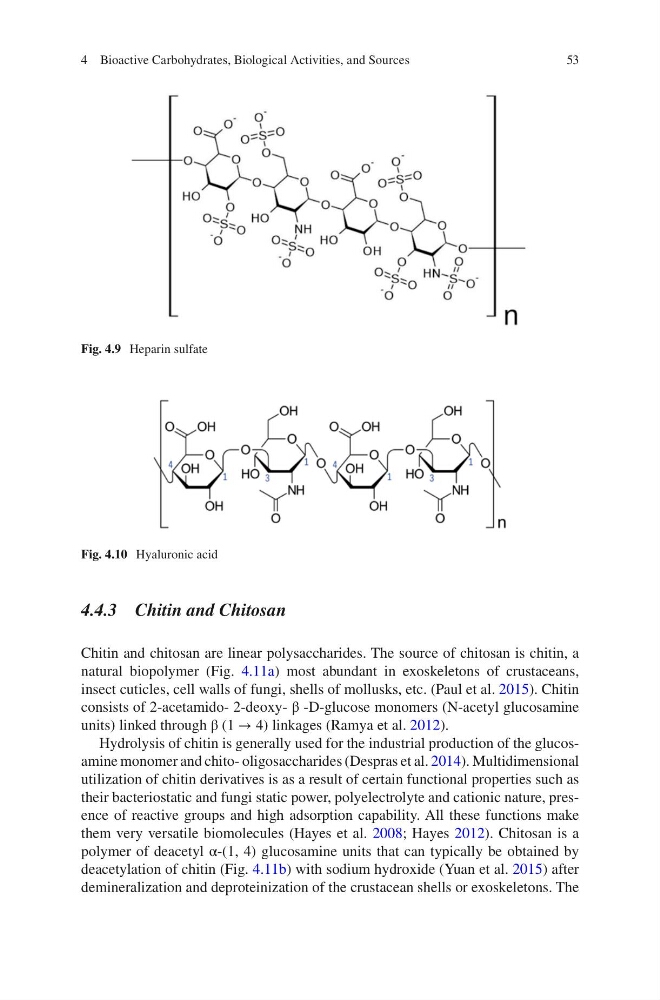
Fig. 4.9 Heparin sulfate
Fig. 4.10 Hyaluronic acid
4 Bioactive Carbohydrates, Biological Activities, and Sources
4.4.3 Chitin and Chitosan
Chitin and chitosan are linear polysaccharides. The source of chitosan is chitin, a
natural biopolymer (Fig. 4.11a) most abundant in exoskeletons of crustaceans,
insect cuticles, cell walls of fungi, shells of mollusks, etc. (Paul et al. 2015). Chitin
consists of 2-acetamido- 2-deoxy- β -D-glucose monomers (N-acetyl glucosamine
units) linked through β (1 → 4) linkages (Ramya et al. 2012).
Hydrolysis of chitin is generally used for the industrial production of the glucosamine monomer and chito- oligosaccharides (Despras et al. 2014). Multidimensional
utilization of chitin derivatives is as a result of certain functional properties such as
their bacteriostatic and fungi static power, polyelectrolyte and cationic nature, presence of reactive groups and high adsorption capability. All these functions make
them very versatile biomolecules (Hayes et al. 2008; Hayes 2012). Chitosan is a
polymer of deacetyl α-(1, 4) glucosamine units that can typically be obtained by
deacetylation of chitin (Fig. 4.11b) with sodium hydroxide (Yuan et al. 2015) after
demineralization and deproteinization of the crustacean shells or exoskeletons. The
Fig. 4.9 Heparin sulfate
Fig. 4.10 Hyaluronic acid
4 Bioactive Carbohydrates, Biological Activities, and Sources