

44
biological functions are determined by environmental factors, such as water, salinity, temperature, nutritive salt, depth of immersion, waves and sea current.
Laminarins have been established to possess antibacterial, anti-tumor and prebiotics
activities.
Furthermore, sulphated exopolysaccharides are produced by several species of
microalgae. They have found applications in food, nutraceuticals, and medicine due
to their various biological activities (Beluhan and Ranogajec 2011). The exocellular
polysaccharides of all marine microalgae are heteropolymers which consist majorly
of xylose, galactose, and glucose at varying degrees, except those of Gyrodinium
impudicum, which are homopolymer of galactose. Other sugars such as fucose,
rhamnose, and fructose also exist in marine microalgae (Raposo et al. 2013).
4.2.2 Mushrooms
Edible mushrooms are great sources of dietary fiber which are consumed by many
populations because of their sensory characteristics, unique aroma and great taste
(Beluhan and Ranogajec 2011; Wang et al. 2013). They represent an excellent
source of bioactive carbohydrates (Villares et al. 2012). Polysaccharides that are
isolated from mushrooms have been established as biological response modifiers
(BRM) (El Khoury et al. 2011). They are present in the fungal cell wall with different forms of glycosidic linkages, such as (1 → 3) and (1 → 6) – β-D-glucans. The
glucan moieties showed both α and β linkages with the β being more abundant and
having more biological activities (Villares et al. 2012).
O
O
O
O
O
O
O
O
CH 3
O
O
O
O
O
OSO
-
3
OSO
-
3
OH
- O 3 SOH 2 C
H 3 C
OH
H 3 C
OH
OH
CH 3
CH 2 OH
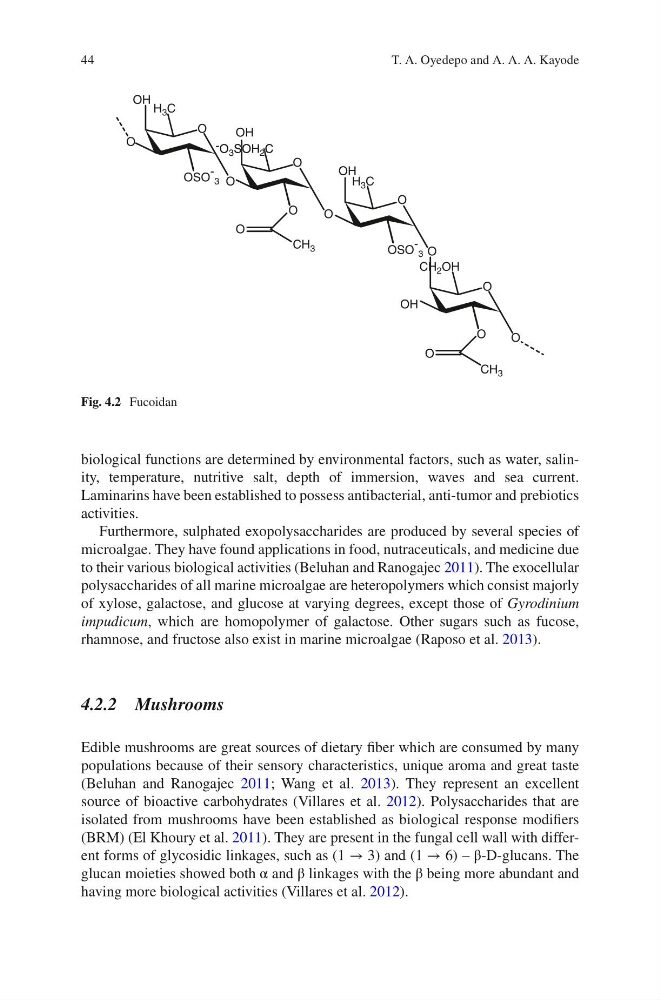
Fig. 4.2 Fucoidan
T. A. Oyedepo and A. A. A. Kayode
biological functions are determined by environmental factors, such as water, salinity, temperature, nutritive salt, depth of immersion, waves and sea current.
Laminarins have been established to possess antibacterial, anti-tumor and prebiotics
activities.
Furthermore, sulphated exopolysaccharides are produced by several species of
microalgae. They have found applications in food, nutraceuticals, and medicine due
to their various biological activities (Beluhan and Ranogajec 2011). The exocellular
polysaccharides of all marine microalgae are heteropolymers which consist majorly
of xylose, galactose, and glucose at varying degrees, except those of Gyrodinium
impudicum, which are homopolymer of galactose. Other sugars such as fucose,
rhamnose, and fructose also exist in marine microalgae (Raposo et al. 2013).
4.2.2 Mushrooms
Edible mushrooms are great sources of dietary fiber which are consumed by many
populations because of their sensory characteristics, unique aroma and great taste
(Beluhan and Ranogajec 2011; Wang et al. 2013). They represent an excellent
source of bioactive carbohydrates (Villares et al. 2012). Polysaccharides that are
isolated from mushrooms have been established as biological response modifiers
(BRM) (El Khoury et al. 2011). They are present in the fungal cell wall with different forms of glycosidic linkages, such as (1 → 3) and (1 → 6) – β-D-glucans. The
glucan moieties showed both α and β linkages with the β being more abundant and
having more biological activities (Villares et al. 2012).
O
O
O
O
O
O
O
O
CH 3
O
O
O
O
O
OSO
-
3
OSO
-
3
OH
- O 3 SOH 2 C
H 3 C
OH
H 3 C
OH
OH
CH 3
CH 2 OH
Fig. 4.2 Fucoidan
T. A. Oyedepo and A. A. A. Kayode