

512
23.3.1.4 Advantages of RUTF
– Demonstrated efficacy and effectiveness in treatment of acute malnutrition when
used according to protocol.
– It can be eaten direct from the packet without need for any dilution, processing
or cooking.
– The products have long shelf lives due to the low water content making it less
susceptible to contamination due storage.
– RUTF is readily acceptable by patients and can be used at home thus reducing
the default rate of treatment and time spent in hospital
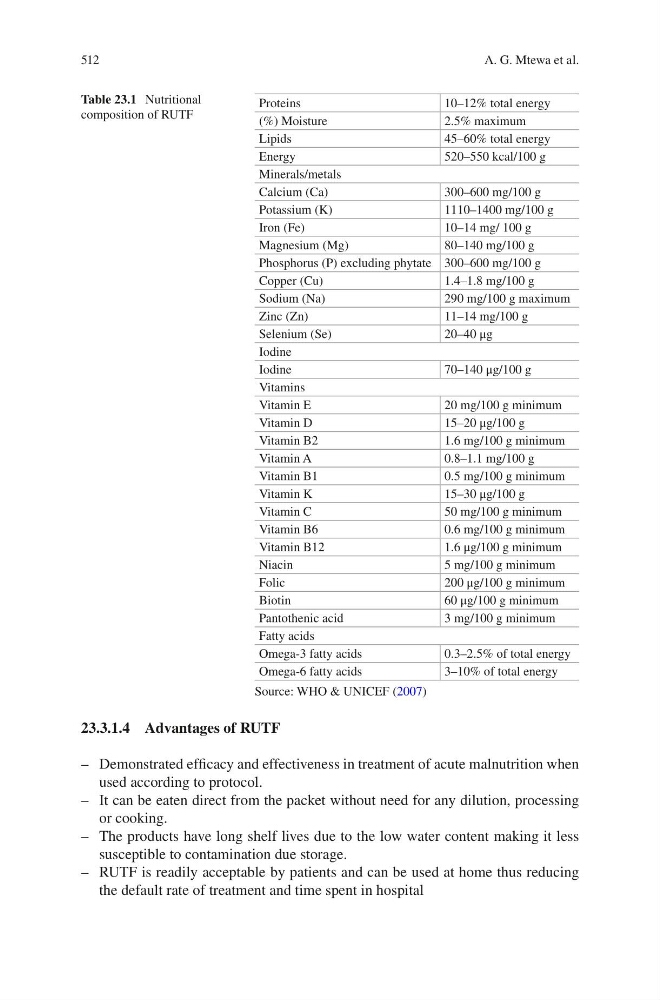
Table 23.1 Nutritional
composition of RUTF
Proteins
10–12% total energy
(%) Moisture
2.5% maximum
Lipids
45–60% total energy
Energy
520–550 kcal/100 g
Minerals/metals
Calcium (Ca)
300–600 mg/100 g
Potassium (K)
1110–1400 mg/100 g
Iron (Fe)
10–14 mg/ 100 g
Magnesium (Mg)
80–140 mg/100 g
Phosphorus (P) excluding phytate 300–600 mg/100 g
Copper (Cu)
1.4–1.8 mg/100 g
Sodium (Na)
290 mg/100 g maximum
Zinc (Zn)
11–14 mg/100 g
Selenium (Se)
20–40 μg
Iodine
Iodine
70–140 μg/100 g
Vitamins
Vitamin E
20 mg/100 g minimum
Vitamin D
15–20 μg/100 g
Vitamin B2
1.6 mg/100 g minimum
Vitamin A
0.8–1.1 mg/100 g
Vitamin B1
0.5 mg/100 g minimum
Vitamin K
15–30 μg/100 g
Vitamin C
50 mg/100 g minimum
Vitamin B6
0.6 mg/100 g minimum
Vitamin B12
1.6 μg/100 g minimum
Niacin
5 mg/100 g minimum
Folic
200 μg/100 g minimum
Biotin
60 μg/100 g minimum
Pantothenic acid
3 mg/100 g minimum
Fatty acids
Omega-3 fatty acids
0.3–2.5% of total energy
Omega-6 fatty acids
3–10% of total energy
Source: WHO & UNICEF (2007)
A. G. Mtewa et al.
23.3.1.4 Advantages of RUTF
– Demonstrated efficacy and effectiveness in treatment of acute malnutrition when
used according to protocol.
– It can be eaten direct from the packet without need for any dilution, processing
or cooking.
– The products have long shelf lives due to the low water content making it less
susceptible to contamination due storage.
– RUTF is readily acceptable by patients and can be used at home thus reducing
the default rate of treatment and time spent in hospital
Table 23.1 Nutritional
composition of RUTF
Proteins
10–12% total energy
(%) Moisture
2.5% maximum
Lipids
45–60% total energy
Energy
520–550 kcal/100 g
Minerals/metals
Calcium (Ca)
300–600 mg/100 g
Potassium (K)
1110–1400 mg/100 g
Iron (Fe)
10–14 mg/ 100 g
Magnesium (Mg)
80–140 mg/100 g
Phosphorus (P) excluding phytate 300–600 mg/100 g
Copper (Cu)
1.4–1.8 mg/100 g
Sodium (Na)
290 mg/100 g maximum
Zinc (Zn)
11–14 mg/100 g
Selenium (Se)
20–40 μg
Iodine
Iodine
70–140 μg/100 g
Vitamins
Vitamin E
20 mg/100 g minimum
Vitamin D
15–20 μg/100 g
Vitamin B2
1.6 mg/100 g minimum
Vitamin A
0.8–1.1 mg/100 g
Vitamin B1
0.5 mg/100 g minimum
Vitamin K
15–30 μg/100 g
Vitamin C
50 mg/100 g minimum
Vitamin B6
0.6 mg/100 g minimum
Vitamin B12
1.6 μg/100 g minimum
Niacin
5 mg/100 g minimum
Folic
200 μg/100 g minimum
Biotin
60 μg/100 g minimum
Pantothenic acid
3 mg/100 g minimum
Fatty acids
Omega-3 fatty acids
0.3–2.5% of total energy
Omega-6 fatty acids
3–10% of total energy
Source: WHO & UNICEF (2007)
A. G. Mtewa et al.