

477
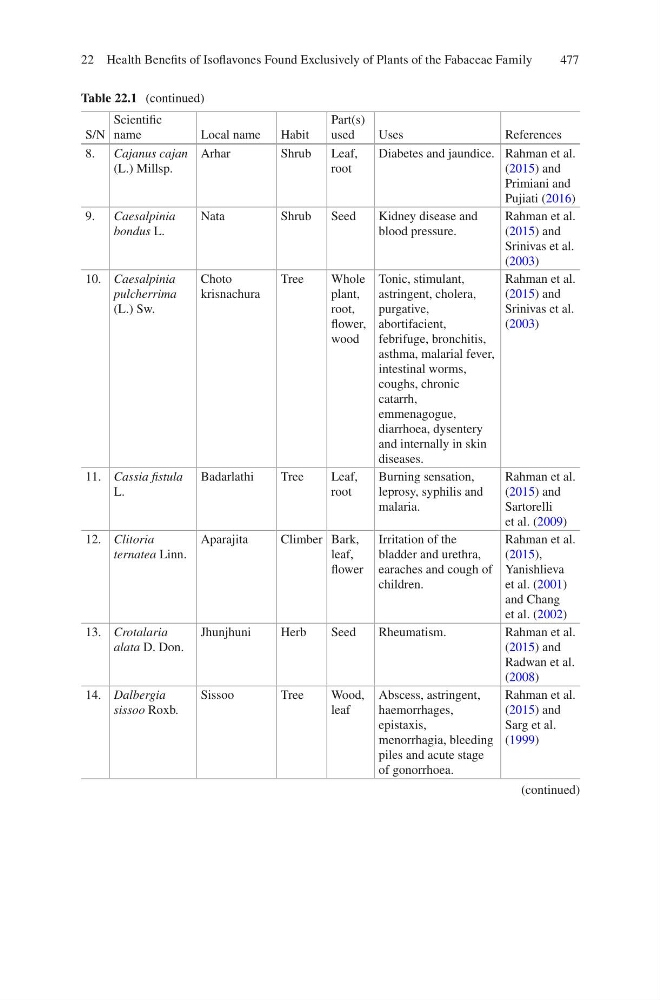
Table 22.1 (continued)
S/N
Scientific
name
Local name
Habit
Part(s)
used
Uses
References
8. Cajanus cajan
(L.) Millsp.
Arhar
Shrub
Leaf,
root
Diabetes and jaundice. Rahman et al.
(2015) and
Primiani and
Pujiati (2016)
9. Caesalpinia
bondus L.
Nata
Shrub
Seed
Kidney disease and
blood pressure.
Rahman et al.
(2015) and
Srinivas et al.
(2003)
10. Caesalpinia
pulcherrima
(L.) Sw.
Choto
krisnachura
Tree
Whole
plant,
root,
flower,
wood
Tonic, stimulant,
astringent, cholera,
purgative,
abortifacient,
febrifuge, bronchitis,
asthma, malarial fever,
intestinal worms,
coughs, chronic
catarrh,
emmenagogue,
diarrhoea, dysentery
and internally in skin
diseases.
Rahman et al.
(2015) and
Srinivas et al.
(2003)
11. Cassia fistula
L.
Badarlathi
Tree
Leaf,
root
Burning sensation,
leprosy, syphilis and
malaria.
Rahman et al.
(2015) and
Sartorelli
et al. (2009)
12. Clitoria
ternatea Linn.
Aparajita
Climber Bark,
leaf,
flower
Irritation of the
bladder and urethra,
earaches and cough of
children.
Rahman et al.
(2015),
Yanishlieva
et al. (2001)
and Chang
et al. (2002)
13. Crotalaria
alata D. Don.
Jhunjhuni
Herb
Seed
Rheumatism.
Rahman et al.
(2015) and
Radwan et al.
(2008)
14. Dalbergia
sissoo Roxb.
Sissoo
Tree
Wood,
leaf
Abscess, astringent,
haemorrhages,
epistaxis,
menorrhagia, bleeding
piles and acute stage
of gonorrhoea.
Rahman et al.
(2015) and
Sarg et al.
(1999)
(continued)
22 Health Benefits of Isoflavones Found Exclusively of Plants of the Fabaceae Family
Table 22.1 (continued)
S/N
Scientific
name
Local name
Habit
Part(s)
used
Uses
References
8. Cajanus cajan
(L.) Millsp.
Arhar
Shrub
Leaf,
root
Diabetes and jaundice. Rahman et al.
(2015) and
Primiani and
Pujiati (2016)
9. Caesalpinia
bondus L.
Nata
Shrub
Seed
Kidney disease and
blood pressure.
Rahman et al.
(2015) and
Srinivas et al.
(2003)
10. Caesalpinia
pulcherrima
(L.) Sw.
Choto
krisnachura
Tree
Whole
plant,
root,
flower,
wood
Tonic, stimulant,
astringent, cholera,
purgative,
abortifacient,
febrifuge, bronchitis,
asthma, malarial fever,
intestinal worms,
coughs, chronic
catarrh,
emmenagogue,
diarrhoea, dysentery
and internally in skin
diseases.
Rahman et al.
(2015) and
Srinivas et al.
(2003)
11. Cassia fistula
L.
Badarlathi
Tree
Leaf,
root
Burning sensation,
leprosy, syphilis and
malaria.
Rahman et al.
(2015) and
Sartorelli
et al. (2009)
12. Clitoria
ternatea Linn.
Aparajita
Climber Bark,
leaf,
flower
Irritation of the
bladder and urethra,
earaches and cough of
children.
Rahman et al.
(2015),
Yanishlieva
et al. (2001)
and Chang
et al. (2002)
13. Crotalaria
alata D. Don.
Jhunjhuni
Herb
Seed
Rheumatism.
Rahman et al.
(2015) and
Radwan et al.
(2008)
14. Dalbergia
sissoo Roxb.
Sissoo
Tree
Wood,
leaf
Abscess, astringent,
haemorrhages,
epistaxis,
menorrhagia, bleeding
piles and acute stage
of gonorrhoea.
Rahman et al.
(2015) and
Sarg et al.
(1999)
(continued)
22 Health Benefits of Isoflavones Found Exclusively of Plants of the Fabaceae Family