

340
For centuries, Aloe plants have been widely used as therapeutic and topical
agents due its medicinal and pharmacological properties, where it participate in the
treatment of different types of diseases through molecular and biochemical pathway
modulation (Surjushe et al. 2008; Rahmani et al. 2015). Research studies demonstrate that there is a presence of wide variety of phytochemicals and nutrients in the
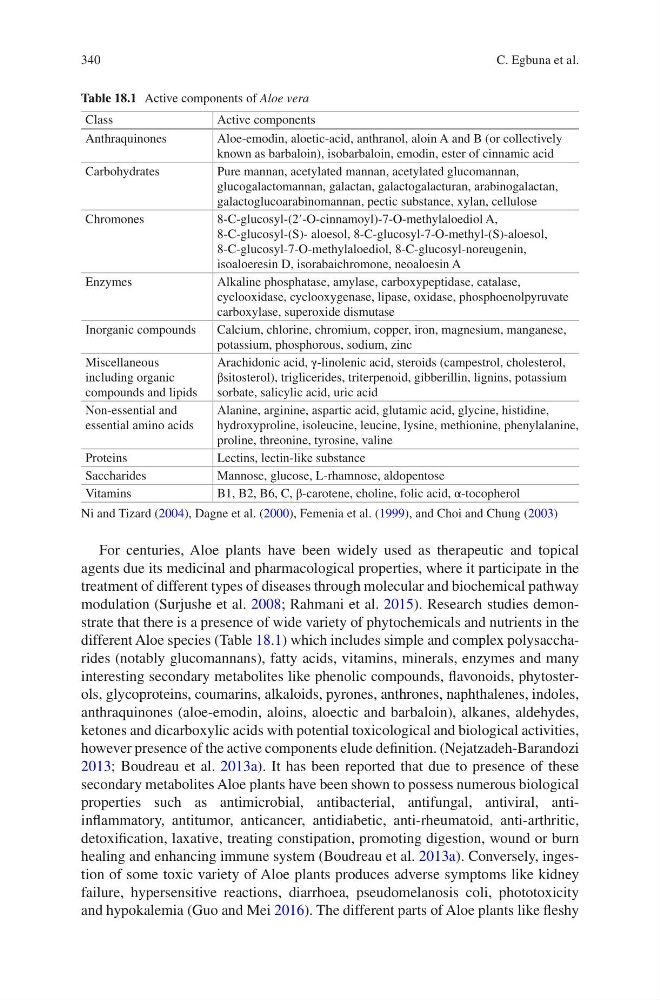
different Aloe species (Table 18.1) which includes simple and complex polysaccharides (notably glucomannans), fatty acids, vitamins, minerals, enzymes and many
interesting secondary metabolites like phenolic compounds, flavonoids, phytosterols, glycoproteins, coumarins, alkaloids, pyrones, anthrones, naphthalenes, indoles,
anthraquinones (aloe-emodin, aloins, aloectic and barbaloin), alkanes, aldehydes,
ketones and dicarboxylic acids with potential toxicological and biological activities,
however presence of the active components elude definition. (Nejatzadeh-Barandozi
2013; Boudreau et al. 2013a). It has been reported that due to presence of these
secondary metabolites Aloe plants have been shown to possess numerous biological
properties such as antimicrobial, antibacterial, antifungal, antiviral, antiinflammatory, antitumor, anticancer, antidiabetic, anti-rheumatoid, anti-arthritic,
detoxification, laxative, treating constipation, promoting digestion, wound or burn
healing and enhancing immune system (Boudreau et al. 2013a). Conversely, ingestion of some toxic variety of Aloe plants produces adverse symptoms like kidney
failure, hypersensitive reactions, diarrhoea, pseudomelanosis coli, phototoxicity
and hypokalemia (Guo and Mei 2016). The different parts of Aloe plants like fleshy
Table 18.1 Active components of Aloe vera
Class
Active components
Anthraquinones
Aloe-emodin, aloetic-acid, anthranol, aloin A and B (or collectively
known as barbaloin), isobarbaloin, emodin, ester of cinnamic acid
Carbohydrates
Pure mannan, acetylated mannan, acetylated glucomannan,
glucogalactomannan, galactan, galactogalacturan, arabinogalactan,
galactoglucoarabinomannan, pectic substance, xylan, cellulose
Chromones
8-C-glucosyl-(2′-O-cinnamoyl)-7-O-methylaloediol A,
8-C-glucosyl-(S)- aloesol, 8-C-glucosyl-7-O-methyl-(S)-aloesol,
8-C-glucosyl-7-O-methylaloediol, 8-C-glucosyl-noreugenin,
isoaloeresin D, isorabaichromone, neoaloesin A
Enzymes
Alkaline phosphatase, amylase, carboxypeptidase, catalase,
cyclooxidase, cyclooxygenase, lipase, oxidase, phosphoenolpyruvate
carboxylase, superoxide dismutase
Inorganic compounds
Calcium, chlorine, chromium, copper, iron, magnesium, manganese,
potassium, phosphorous, sodium, zinc
Miscellaneous
including organic
compounds and lipids
Arachidonic acid, γ-linolenic acid, steroids (campestrol, cholesterol,
βsitosterol), triglicerides, triterpenoid, gibberillin, lignins, potassium
sorbate, salicylic acid, uric acid
Non-essential and
essential amino acids
Alanine, arginine, aspartic acid, glutamic acid, glycine, histidine,
hydroxyproline, isoleucine, leucine, lysine, methionine, phenylalanine,
proline, threonine, tyrosine, valine
Proteins
Lectins, lectin-like substance
Saccharides
Mannose, glucose, L-rhamnose, aldopentose
Vitamins
B1, B2, B6, C, β-carotene, choline, folic acid, α-tocopherol
Ni and Tizard (2004), Dagne et al. (2000), Femenia et al. (1999), and Choi and Chung (2003)
C. Egbuna et al.
For centuries, Aloe plants have been widely used as therapeutic and topical
agents due its medicinal and pharmacological properties, where it participate in the
treatment of different types of diseases through molecular and biochemical pathway
modulation (Surjushe et al. 2008; Rahmani et al. 2015). Research studies demonstrate that there is a presence of wide variety of phytochemicals and nutrients in the
different Aloe species (Table 18.1) which includes simple and complex polysaccharides (notably glucomannans), fatty acids, vitamins, minerals, enzymes and many
interesting secondary metabolites like phenolic compounds, flavonoids, phytosterols, glycoproteins, coumarins, alkaloids, pyrones, anthrones, naphthalenes, indoles,
anthraquinones (aloe-emodin, aloins, aloectic and barbaloin), alkanes, aldehydes,
ketones and dicarboxylic acids with potential toxicological and biological activities,
however presence of the active components elude definition. (Nejatzadeh-Barandozi
2013; Boudreau et al. 2013a). It has been reported that due to presence of these
secondary metabolites Aloe plants have been shown to possess numerous biological
properties such as antimicrobial, antibacterial, antifungal, antiviral, antiinflammatory, antitumor, anticancer, antidiabetic, anti-rheumatoid, anti-arthritic,
detoxification, laxative, treating constipation, promoting digestion, wound or burn
healing and enhancing immune system (Boudreau et al. 2013a). Conversely, ingestion of some toxic variety of Aloe plants produces adverse symptoms like kidney
failure, hypersensitive reactions, diarrhoea, pseudomelanosis coli, phototoxicity
and hypokalemia (Guo and Mei 2016). The different parts of Aloe plants like fleshy
Table 18.1 Active components of Aloe vera
Class
Active components
Anthraquinones
Aloe-emodin, aloetic-acid, anthranol, aloin A and B (or collectively
known as barbaloin), isobarbaloin, emodin, ester of cinnamic acid
Carbohydrates
Pure mannan, acetylated mannan, acetylated glucomannan,
glucogalactomannan, galactan, galactogalacturan, arabinogalactan,
galactoglucoarabinomannan, pectic substance, xylan, cellulose
Chromones
8-C-glucosyl-(2′-O-cinnamoyl)-7-O-methylaloediol A,
8-C-glucosyl-(S)- aloesol, 8-C-glucosyl-7-O-methyl-(S)-aloesol,
8-C-glucosyl-7-O-methylaloediol, 8-C-glucosyl-noreugenin,
isoaloeresin D, isorabaichromone, neoaloesin A
Enzymes
Alkaline phosphatase, amylase, carboxypeptidase, catalase,
cyclooxidase, cyclooxygenase, lipase, oxidase, phosphoenolpyruvate
carboxylase, superoxide dismutase
Inorganic compounds
Calcium, chlorine, chromium, copper, iron, magnesium, manganese,
potassium, phosphorous, sodium, zinc
Miscellaneous
including organic
compounds and lipids
Arachidonic acid, γ-linolenic acid, steroids (campestrol, cholesterol,
βsitosterol), triglicerides, triterpenoid, gibberillin, lignins, potassium
sorbate, salicylic acid, uric acid
Non-essential and
essential amino acids
Alanine, arginine, aspartic acid, glutamic acid, glycine, histidine,
hydroxyproline, isoleucine, leucine, lysine, methionine, phenylalanine,
proline, threonine, tyrosine, valine
Proteins
Lectins, lectin-like substance
Saccharides
Mannose, glucose, L-rhamnose, aldopentose
Vitamins
B1, B2, B6, C, β-carotene, choline, folic acid, α-tocopherol
Ni and Tizard (2004), Dagne et al. (2000), Femenia et al. (1999), and Choi and Chung (2003)
C. Egbuna et al.