

18
deficiency is engineered with recombinant human lactoferrin (rhLf) to be able to
solve the lactoferrin deficiency (Hyvonen et al. 2006).
2.3 Herbals as Nutraceuticals
Herbs play a significant role in the maintenance of the quality of human life through
the abundant source of bio-constituents. The herbal bioactive constituents are an
essential category of nutraceuticals which have plenty of health promoting medicinal properties in addition to minerals, vitamins and other active compounds. The
herbs harbor a widespread variety of active phytochemicals like flavonoids, terpenoids, saponin, and polyphenols. These herbal bioactives are most times commonly
used by people who seek conventional health care as a food supplement. In this
regard, it is seen as using herbs as nutraceutical (Chauhan et al. 2013). Example of
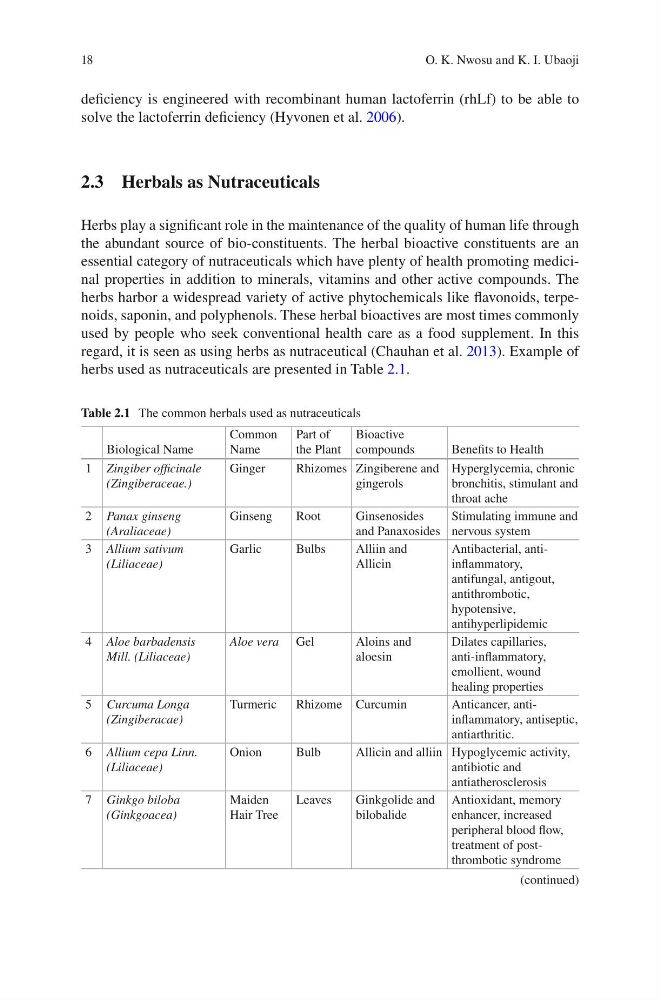
herbs used as nutraceuticals are presented in Table 2.1.
Table 2.1 The common herbals used as nutraceuticals
Biological Name
Common
Name
Part of
the Plant
Bioactive
compounds
Benefits to Health
1 Zingiber officinale
(Zingiberaceae.)
Ginger
Rhizomes Zingiberene and
gingerols
Hyperglycemia, chronic
bronchitis, stimulant and
throat ache
2 Panax ginseng
(Araliaceae)
Ginseng
Root
Ginsenosides
and Panaxosides
Stimulating immune and
nervous system
3 Allium sativum
(Liliaceae)
Garlic
Bulbs
Alliin and
Allicin
Antibacterial, antiinflammatory,
antifungal, antigout,
antithrombotic,
hypotensive,
antihyperlipidemic
4 Aloe barbadensis
Mill. (Liliaceae)
Aloe vera Gel
Aloins and
aloesin
Dilates capillaries,
anti-inflammatory,
emollient, wound
healing properties
5 Curcuma Longa
(Zingiberacae)
Turmeric
Rhizome Curcumin
Anticancer, antiinflammatory, antiseptic,
antiarthritic.
6 Allium cepa Linn.
(Liliaceae)
Onion
Bulb
Allicin and alliin Hypoglycemic activity,
antibiotic and
antiatherosclerosis
7 Ginkgo biloba
(Ginkgoacea)
Maiden
Hair Tree
Leaves
Ginkgolide and
bilobalide
Antioxidant, memory
enhancer, increased
peripheral blood flow,
treatment of postthrombotic syndrome
(continued)
O. K. Nwosu and K. I. Ubaoji
deficiency is engineered with recombinant human lactoferrin (rhLf) to be able to
solve the lactoferrin deficiency (Hyvonen et al. 2006).
2.3 Herbals as Nutraceuticals
Herbs play a significant role in the maintenance of the quality of human life through
the abundant source of bio-constituents. The herbal bioactive constituents are an
essential category of nutraceuticals which have plenty of health promoting medicinal properties in addition to minerals, vitamins and other active compounds. The
herbs harbor a widespread variety of active phytochemicals like flavonoids, terpenoids, saponin, and polyphenols. These herbal bioactives are most times commonly
used by people who seek conventional health care as a food supplement. In this
regard, it is seen as using herbs as nutraceutical (Chauhan et al. 2013). Example of
herbs used as nutraceuticals are presented in Table 2.1.
Table 2.1 The common herbals used as nutraceuticals
Biological Name
Common
Name
Part of
the Plant
Bioactive
compounds
Benefits to Health
1 Zingiber officinale
(Zingiberaceae.)
Ginger
Rhizomes Zingiberene and
gingerols
Hyperglycemia, chronic
bronchitis, stimulant and
throat ache
2 Panax ginseng
(Araliaceae)
Ginseng
Root
Ginsenosides
and Panaxosides
Stimulating immune and
nervous system
3 Allium sativum
(Liliaceae)
Garlic
Bulbs
Alliin and
Allicin
Antibacterial, antiinflammatory,
antifungal, antigout,
antithrombotic,
hypotensive,
antihyperlipidemic
4 Aloe barbadensis
Mill. (Liliaceae)
Aloe vera Gel
Aloins and
aloesin
Dilates capillaries,
anti-inflammatory,
emollient, wound
healing properties
5 Curcuma Longa
(Zingiberacae)
Turmeric
Rhizome Curcumin
Anticancer, antiinflammatory, antiseptic,
antiarthritic.
6 Allium cepa Linn.
(Liliaceae)
Onion
Bulb
Allicin and alliin Hypoglycemic activity,
antibiotic and
antiatherosclerosis
7 Ginkgo biloba
(Ginkgoacea)
Maiden
Hair Tree
Leaves
Ginkgolide and
bilobalide
Antioxidant, memory
enhancer, increased
peripheral blood flow,
treatment of postthrombotic syndrome
(continued)
O. K. Nwosu and K. I. Ubaoji