

184
Lactobacillus bulgaricus) and fructooligosccharides caused the inhibition of NF-κB
(nuclear factor κB) and decreased the production of TNF-α (tumour necrosis factor
α) which is a factor that contributes to insulin resistance and inflammatory cell
uptake in non-alcoholic fatty liver disease (Wai-Sun Wong et al. 2015; Markowiak
and Slizewska 2017).
10.5 Differences Between Probiotics and Prebiotics
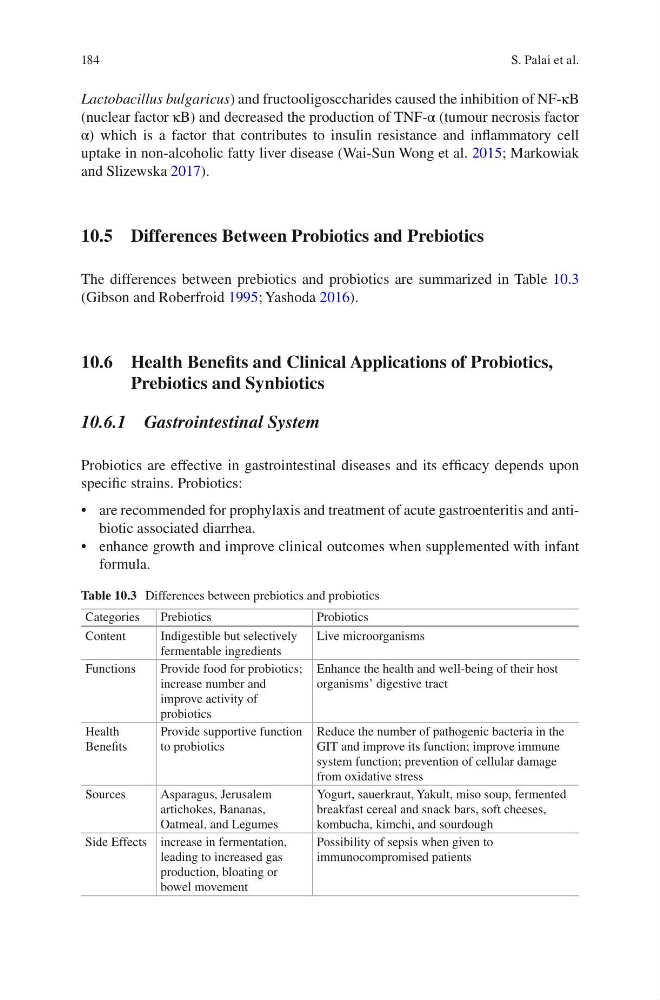
The differences between prebiotics and probiotics are summarized in Table 10.3
(Gibson and Roberfroid 1995; Yashoda 2016).
10.6 Health Benefits and Clinical Applications of Probiotics,
Prebiotics and Synbiotics
10.6.1 Gastrointestinal System
Probiotics are effective in gastrointestinal diseases and its efficacy depends upon
specific strains. Probiotics:
• are recommended for prophylaxis and treatment of acute gastroenteritis and antibiotic associated diarrhea.
• enhance growth and improve clinical outcomes when supplemented with infant
formula.
Table 10.3 Differences between prebiotics and probiotics
Categories
Prebiotics
Probiotics
Content
Indigestible but selectively
fermentable ingredients
Live microorganisms
Functions
Provide food for probiotics;
increase number and
improve activity of
probiotics
Enhance the health and well-being of their host
organisms’ digestive tract
Health
Benefits
Provide supportive function
to probiotics
Reduce the number of pathogenic bacteria in the
GIT and improve its function; improve immune
system function; prevention of cellular damage
from oxidative stress
Sources
Asparagus, Jerusalem
artichokes, Bananas,
Oatmeal, and Legumes
Yogurt, sauerkraut, Yakult, miso soup, fermented
breakfast cereal and snack bars, soft cheeses,
kombucha, kimchi, and sourdough
Side Effects increase in fermentation,
leading to increased gas
production, bloating or
bowel movement
Possibility of sepsis when given to
immunocompromised patients
S. Palai et al.
Lactobacillus bulgaricus) and fructooligosccharides caused the inhibition of NF-κB
(nuclear factor κB) and decreased the production of TNF-α (tumour necrosis factor
α) which is a factor that contributes to insulin resistance and inflammatory cell
uptake in non-alcoholic fatty liver disease (Wai-Sun Wong et al. 2015; Markowiak
and Slizewska 2017).
10.5 Differences Between Probiotics and Prebiotics
The differences between prebiotics and probiotics are summarized in Table 10.3
(Gibson and Roberfroid 1995; Yashoda 2016).
10.6 Health Benefits and Clinical Applications of Probiotics,
Prebiotics and Synbiotics
10.6.1 Gastrointestinal System
Probiotics are effective in gastrointestinal diseases and its efficacy depends upon
specific strains. Probiotics:
• are recommended for prophylaxis and treatment of acute gastroenteritis and antibiotic associated diarrhea.
• enhance growth and improve clinical outcomes when supplemented with infant
formula.
Table 10.3 Differences between prebiotics and probiotics
Categories
Prebiotics
Probiotics
Content
Indigestible but selectively
fermentable ingredients
Live microorganisms
Functions
Provide food for probiotics;
increase number and
improve activity of
probiotics
Enhance the health and well-being of their host
organisms’ digestive tract
Health
Benefits
Provide supportive function
to probiotics
Reduce the number of pathogenic bacteria in the
GIT and improve its function; improve immune
system function; prevention of cellular damage
from oxidative stress
Sources
Asparagus, Jerusalem
artichokes, Bananas,
Oatmeal, and Legumes
Yogurt, sauerkraut, Yakult, miso soup, fermented
breakfast cereal and snack bars, soft cheeses,
kombucha, kimchi, and sourdough
Side Effects increase in fermentation,
leading to increased gas
production, bloating or
bowel movement
Possibility of sepsis when given to
immunocompromised patients
S. Palai et al.