

150
minerals) are essential for the body’s proper functioning. The need for micronutrients depends on the metabolic activities as well as on the life cycle of an individual.
Even in intrauterine life, the need for micronutrients is essential for the normal
development of the fetus. In particular, vitamin D, iodine, iron, and folic acid deficiencies could lead to congenital disorders or even death. The daily requirements of
these micronutrients are not fixed, although many scientific papers have mentioned
the daily-required allowance of various vitamins and minerals. Factors such as
physical exercise, pregnancy, childhood, adolescence, old age or specific diets (e.g.
Vegan) influence the need for micronutrients. Therefore, the evaluation of the
micronutrients’ requirements and the consequences of micronutrients’ deficiencies
are critical to explain their role in health and disease (Derbyshire 2018; Hans and
Jana 2018).
Fortification of food is one of the most effective and safe strategies used to
enhance nourishment. For example, mother milk feeding can be considered a type
of fortification, which is essential for the healthy growth of babies up to 2 years of
age (Allen and Dror 2018). Micronutrients play an important role in reduction in the
risk of disease and the maintenance of good health. Micronutrients and vitamins are
vital for the proper functioning and proliferation of all dividing cells in the body.
Therefore, micronutrients are essential for growth and metabolism. Balanced diet
aids in maintaining good health by increasing the body’s resistance to infection and,
in the case of disease, can be a useful component of the therapy (Piccardi and
Manissier 2009). Nutrients provide basic molecules which humans are unable to
synthesize. Vitamins and minerals are required in small quantities (<100 mg/day)
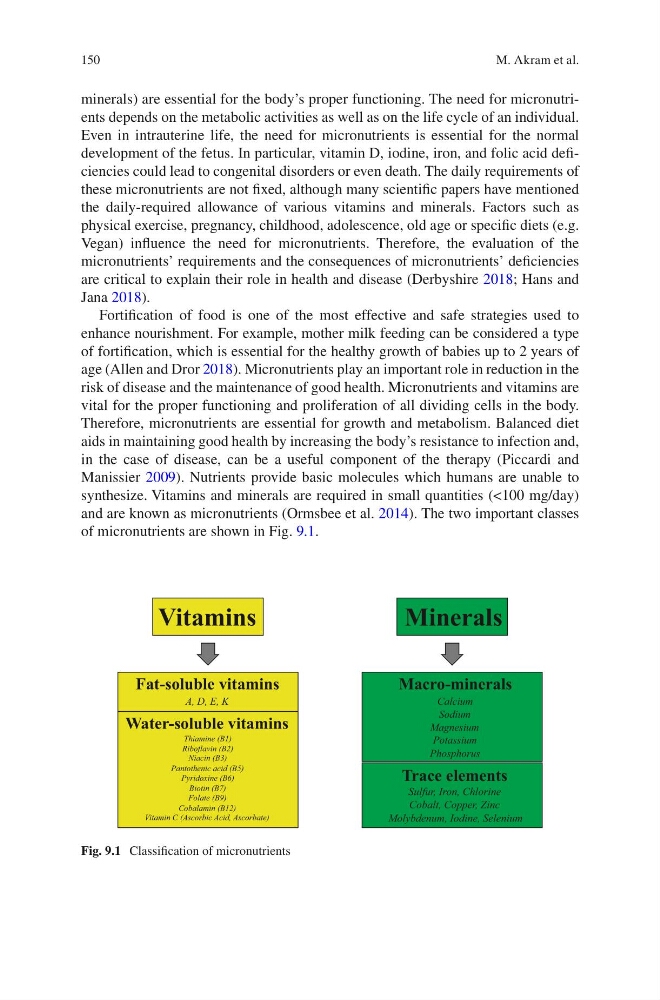
and are known as micronutrients (Ormsbee et al. 2014). The two important classes
of micronutrients are shown in Fig. 9.1.
Vitamins
Fat-soluble vitamins
M acro-minerals
Trace elements
Water-soluble vitamins
Thiamine (B1)
Calcium
Sodium
Magnesium
Potassium
Phosphorus
Sulfur, Iron, Chlorine
Cobalt, Copper, Zinc
Molybdenum, Iodine, Selenium
A, D, E, K
Riboflavin (B2)
Niacin (B3)
Pantothenic acid (B5)
Pyridoxine (B6)
Biotin (B7)
Folate (B9)
Cobalamin (B12)
Vitamin C (Ascorbic Acid, Ascorbate)
Minerals
Fig. 9.1 Classification of micronutrients
M. Akram et al.
minerals) are essential for the body’s proper functioning. The need for micronutrients depends on the metabolic activities as well as on the life cycle of an individual.
Even in intrauterine life, the need for micronutrients is essential for the normal
development of the fetus. In particular, vitamin D, iodine, iron, and folic acid deficiencies could lead to congenital disorders or even death. The daily requirements of
these micronutrients are not fixed, although many scientific papers have mentioned
the daily-required allowance of various vitamins and minerals. Factors such as
physical exercise, pregnancy, childhood, adolescence, old age or specific diets (e.g.
Vegan) influence the need for micronutrients. Therefore, the evaluation of the
micronutrients’ requirements and the consequences of micronutrients’ deficiencies
are critical to explain their role in health and disease (Derbyshire 2018; Hans and
Jana 2018).
Fortification of food is one of the most effective and safe strategies used to
enhance nourishment. For example, mother milk feeding can be considered a type
of fortification, which is essential for the healthy growth of babies up to 2 years of
age (Allen and Dror 2018). Micronutrients play an important role in reduction in the
risk of disease and the maintenance of good health. Micronutrients and vitamins are
vital for the proper functioning and proliferation of all dividing cells in the body.
Therefore, micronutrients are essential for growth and metabolism. Balanced diet
aids in maintaining good health by increasing the body’s resistance to infection and,
in the case of disease, can be a useful component of the therapy (Piccardi and
Manissier 2009). Nutrients provide basic molecules which humans are unable to
synthesize. Vitamins and minerals are required in small quantities (<100 mg/day)
and are known as micronutrients (Ormsbee et al. 2014). The two important classes
of micronutrients are shown in Fig. 9.1.
Vitamins
Fat-soluble vitamins
M acro-minerals
Trace elements
Water-soluble vitamins
Thiamine (B1)
Calcium
Sodium
Magnesium
Potassium
Phosphorus
Sulfur, Iron, Chlorine
Cobalt, Copper, Zinc
Molybdenum, Iodine, Selenium
A, D, E, K
Riboflavin (B2)
Niacin (B3)
Pantothenic acid (B5)
Pyridoxine (B6)
Biotin (B7)
Folate (B9)
Cobalamin (B12)
Vitamin C (Ascorbic Acid, Ascorbate)
Minerals
Fig. 9.1 Classification of micronutrients
M. Akram et al.