

4
1.2 Classification of Functional Foods
According to the International Life Sciences Institute, food has three important
roles in the body. First is the provision of nutrients so the body can carry out its day
to day activities, and for growth and development. Second, food gives satisfaction
and improves well-being, especially food that tastes, looks, and smells good. The
third, and the most recently added function of food relates to the regulation of physiologic processes in the body by components other than the main nutrients from the
food (Sion et al. 2018). The appreciation of this role of food for health fueled global
research on functional food science.
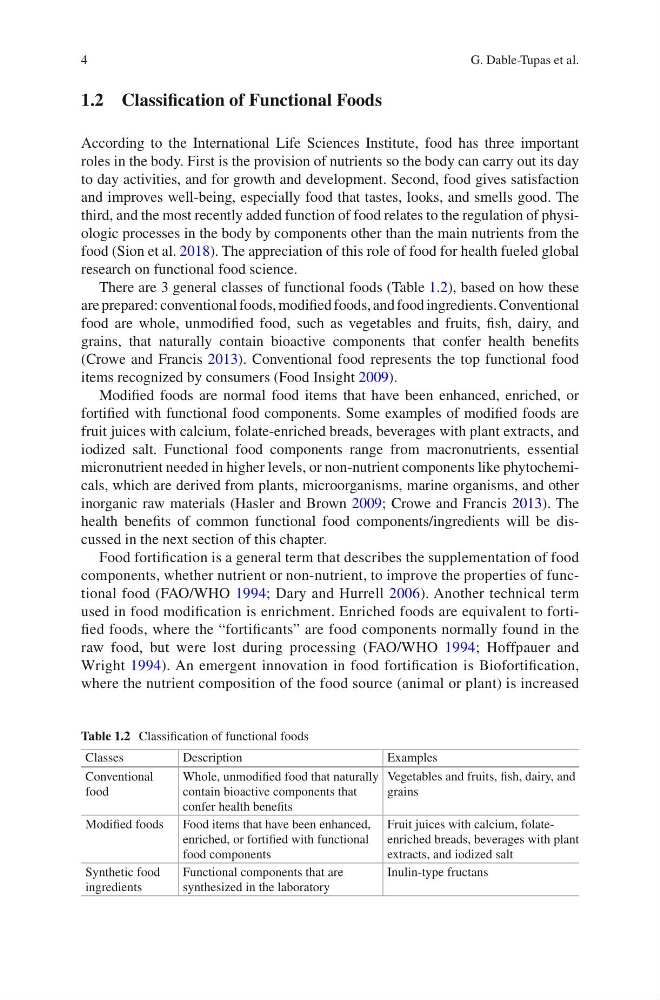
There are 3 general classes of functional foods (Table 1.2), based on how these
are prepared: conventional foods, modified foods, and food ingredients. Conventional
food are whole, unmodified food, such as vegetables and fruits, fish, dairy, and
grains, that naturally contain bioactive components that confer health benefits
(Crowe and Francis 2013). Conventional food represents the top functional food
items recognized by consumers (Food Insight 2009).
Modified foods are normal food items that have been enhanced, enriched, or
fortified with functional food components. Some examples of modified foods are
fruit juices with calcium, folate-enriched breads, beverages with plant extracts, and
iodized salt. Functional food components range from macronutrients, essential
micronutrient needed in higher levels, or non-nutrient components like phytochemicals, which are derived from plants, microorganisms, marine organisms, and other
inorganic raw materials (Hasler and Brown 2009; Crowe and Francis 2013). The
health benefits of common functional food components/ingredients will be discussed in the next section of this chapter.
Food fortification is a general term that describes the supplementation of food
components, whether nutrient or non-nutrient, to improve the properties of functional food (FAO/WHO 1994; Dary and Hurrell 2006). Another technical term
used in food modification is enrichment. Enriched foods are equivalent to fortified foods, where the “fortificants” are food components normally found in the
raw food, but were lost during processing (FAO/WHO 1994; Hoffpauer and
Wright 1994). An emergent innovation in food fortification is Biofortification,
where the nutrient composition of the food source (animal or plant) is increased
Table 1.2 Classification of functional foods
Classes
Description
Examples
Conventional
food
Whole, unmodified food that naturally
contain bioactive components that
confer health benefits
Vegetables and fruits, fish, dairy, and
grains
Modified foods Food items that have been enhanced,
enriched, or fortified with functional
food components
Fruit juices with calcium, folateenriched breads, beverages with plant
extracts, and iodized salt
Synthetic food
ingredients
Functional components that are
synthesized in the laboratory
Inulin-type fructans
G. Dable-Tupas et al.
1.2 Classification of Functional Foods
According to the International Life Sciences Institute, food has three important
roles in the body. First is the provision of nutrients so the body can carry out its day
to day activities, and for growth and development. Second, food gives satisfaction
and improves well-being, especially food that tastes, looks, and smells good. The
third, and the most recently added function of food relates to the regulation of physiologic processes in the body by components other than the main nutrients from the
food (Sion et al. 2018). The appreciation of this role of food for health fueled global
research on functional food science.
There are 3 general classes of functional foods (Table 1.2), based on how these
are prepared: conventional foods, modified foods, and food ingredients. Conventional
food are whole, unmodified food, such as vegetables and fruits, fish, dairy, and
grains, that naturally contain bioactive components that confer health benefits
(Crowe and Francis 2013). Conventional food represents the top functional food
items recognized by consumers (Food Insight 2009).
Modified foods are normal food items that have been enhanced, enriched, or
fortified with functional food components. Some examples of modified foods are
fruit juices with calcium, folate-enriched breads, beverages with plant extracts, and
iodized salt. Functional food components range from macronutrients, essential
micronutrient needed in higher levels, or non-nutrient components like phytochemicals, which are derived from plants, microorganisms, marine organisms, and other
inorganic raw materials (Hasler and Brown 2009; Crowe and Francis 2013). The
health benefits of common functional food components/ingredients will be discussed in the next section of this chapter.
Food fortification is a general term that describes the supplementation of food
components, whether nutrient or non-nutrient, to improve the properties of functional food (FAO/WHO 1994; Dary and Hurrell 2006). Another technical term
used in food modification is enrichment. Enriched foods are equivalent to fortified foods, where the “fortificants” are food components normally found in the
raw food, but were lost during processing (FAO/WHO 1994; Hoffpauer and
Wright 1994). An emergent innovation in food fortification is Biofortification,
where the nutrient composition of the food source (animal or plant) is increased
Table 1.2 Classification of functional foods
Classes
Description
Examples
Conventional
food
Whole, unmodified food that naturally
contain bioactive components that
confer health benefits
Vegetables and fruits, fish, dairy, and
grains
Modified foods Food items that have been enhanced,
enriched, or fortified with functional
food components
Fruit juices with calcium, folateenriched breads, beverages with plant
extracts, and iodized salt
Synthetic food
ingredients
Functional components that are
synthesized in the laboratory
Inulin-type fructans
G. Dable-Tupas et al.